 Lynden Siding
 Birch Bay's Exterior Problem Isn't Obvious Until It's Expensive
Birch Bay sits right on the water, and that changes what a house needs from its exterior compared to homes just a few miles inland in Lynden or Everson. Wind off the Strait of Georgia carries salt spray onto siding, trim, and fascia. Winter storms bring rain sideways, not straight down. And the tree cover and marine humidity that make the area beautiful also make it one of the better places in Whatcom County for moss and algae to take hold on a north-facing wall or a shaded roofline. None of this shows up on day one. It shows up in year three or four, when the wrong material starts to tell on itself.
We install siding, roofing, windows, and decks across Whatcom County, and Birch Bay jobs get looked at differently than a job in town. The wind exposure, the salt, and the moisture load all factor into material choice and installation detail. This page covers what we actually see out there and how we build for it.
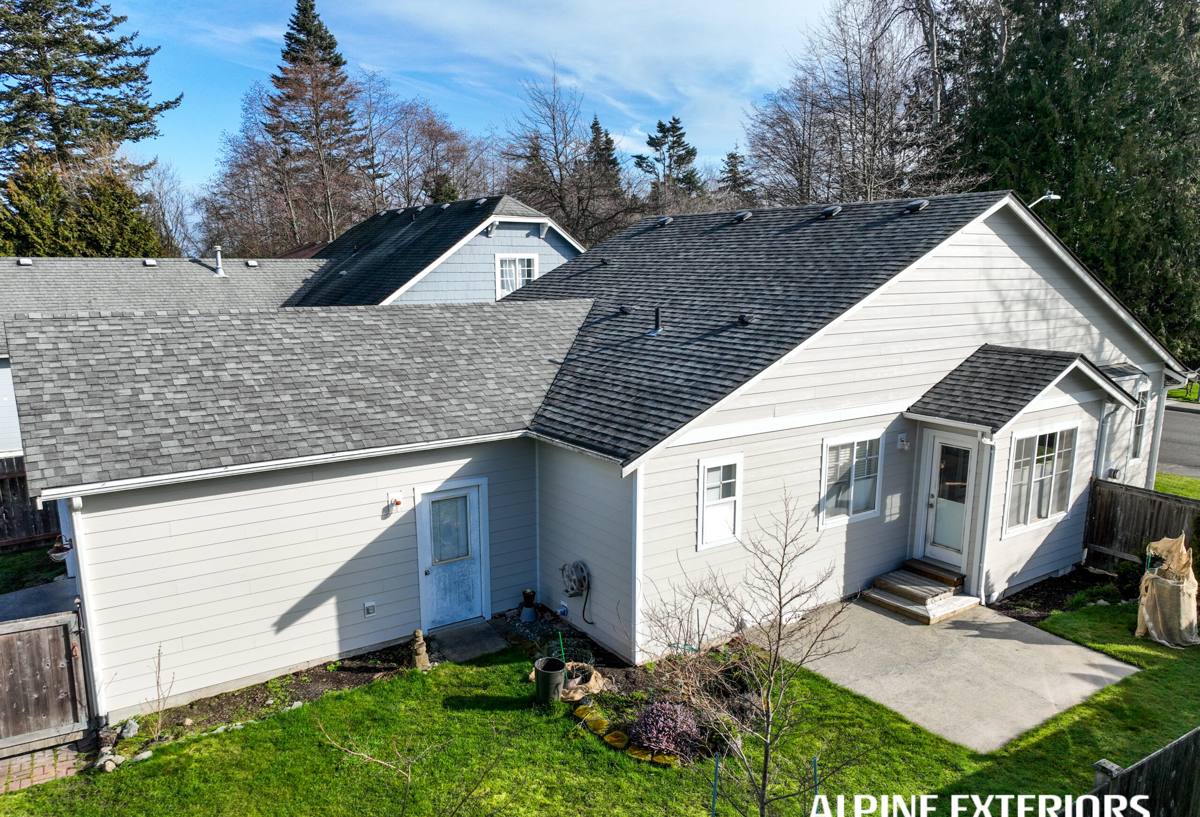
What Salt Air Actually Does to a House
Salt air isn't just a coastal cliché — it's a real corrosion and degradation factor. Salt-laden moisture settles on surfaces and, unlike plain rainwater, it doesn't fully evaporate away cleanly. It leaves mineral residue behind. Over repeated wet-dry cycles, that residue accelerates wear on anything that isn't built to handle it.
Where salt exposure shows up first
- Metal fasteners, flashing, and hardware that aren't corrosion-rated for coastal use
- Painted wood trim, where salt film breaks down the paint film faster than inland exposure
- Vinyl siding, which can become brittle and discolored faster near open water
- Untreated or under-primed wood siding, where salt-driven moisture cycling speeds up rot at joints and end grain
None of this means a house on or near Birch Bay's shoreline is doomed to fail — it means the materials and hardware need to be chosen for that exposure, not for a generic Pacific Northwest spec.
Driving Rain and Wind-Driven Water
Birch Bay gets direct exposure to wind coming off the water, and wind-driven rain behaves very differently from a calm, straight-down shower. It gets pushed under laps, into seams, and behind trim that would stay dry in a more sheltered spot. A wall assembly that's marginal inland can be a real problem right along the bay.
What this means for the wall assembly
Good water management starts before the siding ever goes on: a properly lapped weather-resistive barrier, correctly flashed windows and doors, and a rainscreen gap where the siding needs to breathe and drain rather than trap moisture against the sheathing. On exposed elevations facing the water, we pay extra attention to butt joint sealing, window and door flashing details, and fastener placement — the small details that separate a wall that sheds wind-driven rain from one that slowly lets it in.
Moss, Shade, and the Long Whatcom County Wet Season
Whatcom County's wet season runs long, and Birch Bay's mix of tree cover, marine air, and shaded north- and east-facing walls gives moss and algae exactly the conditions they need: consistent moisture and limited direct sun to dry things out between rains. Moss on a roof is a familiar problem for most Western Washington homeowners, but it also colonizes siding, especially anything with a rough or porous surface that holds moisture at the surface.
Why some materials resist it better than others
A dense, factory-finished fiber cement surface sheds moss growth far more easily than raw or lightly primed wood, and it doesn't feed organic growth the way wood fiber can. Regular gentle cleaning still matters on shaded walls, but the underlying material makes a real difference in how much moss becomes an actual maintenance burden versus a cosmetic non-issue.
Why We Install Only James Hardie Fiber Cement
We made a decision as a company to install James Hardie fiber cement siding exclusively — not vinyl, not LP SmartSide, not Cemplank, not Allura, not primed spruce or cedar. That's not a marketing position; it's a standard we hold because of what we see happen on real Whatcom County homes over time, and it matters more, not less, in an exposure like Birch Bay's.
What Hardie does well in this environment
- Non-combustible core — fiber cement doesn't feed a fire the way wood-based siding can
- Engineered for climate zones — Hardie's HZ5 product line is formulated for regions with freeze-thaw cycling and sustained moisture, which fits the marine exposure around Birch Bay well
- ColorPlus factory finish — baked-on color that resists the fade and peel that field-applied paint suffers under UV and salt exposure
- Dimensional stability — it doesn't swell, cup, or split at butt joints the way wood-based products can under repeated wet-dry cycling
- A strong transferable warranty — backed by a large manufacturer with decades of field performance data, not a warranty that only holds up on paper
Why we passed on the alternatives
Vinyl can perform fine in mild, sheltered settings, but it's more vulnerable to salt-driven brittleness and doesn't hold up as well under direct coastal wind exposure. Engineered wood products like LP SmartSide use a resin-treated wood strand core — a reasonable product in the right setting, but wood-based cores are more sensitive to sustained moisture intrusion than fiber cement, and that sensitivity is magnified near open water. Other fiber cement brands like Cemplank and Allura are legitimate competitors to Hardie on paper, but we standardized on one manufacturer so our crews install one system to one spec, with one warranty structure, every time — consistency we can stand behind on every job, including the harder coastal ones.
Beyond Siding: Roofing, Windows, and Decks Near the Water
Siding is rarely the only exterior component under stress in Birch Bay. Roofing takes the same moss and moisture load, especially on shaded slopes, and needs ventilation and moss-resistant detailing to hold up. Windows near the water benefit from correct flashing and weatherstripping given the wind-driven rain exposure discussed above — a window that's fine inland can leak in a driving coastal storm if it wasn't flashed for that load. Decks face their own version of the same problem: salt air and standing moisture accelerate fastener corrosion and finish breakdown on wood decking, which is why hardware choice and drainage detailing matter as much as the decking material itself. We handle all four — siding, roofing, windows, and decks — as connected parts of the same building envelope, not separate trades that happen to touch the same house.
What Correct Installation Looks Like on a Birch Bay Home
Material choice only gets you halfway. Fiber cement siding installed off-spec — wrong fastener pattern, missing rainscreen gap, unsealed joints, incorrect clearance to grade or roofing — can still develop problems, coastal exposure or not. On Birch Bay jobs specifically, we pay close attention to:
- Corrosion-resistant fastener and flashing selection for salt air exposure
- Proper rainscreen gap for drainage and drying on wind-exposed elevations
- Manufacturer-spec clearance between siding and grade, decks, and roof lines to avoid trapped moisture
- Sealed and back-primed cut edges per Hardie's installation requirements
- Careful joint and trim sealing on the walls that take the most direct wind-driven rain
Cost Factors on a Birch Bay Project
Every home is different, but a few factors consistently move the number on coastal Whatcom County jobs more than they would on a sheltered inland lot.
| Factor | Why It Matters Here |
|---|---|
| Wind/water exposure of the elevation | Bay-facing walls need more careful flashing, sealing, and fastener detailing than sheltered sides |
| Existing wall condition | Moisture-damaged sheathing found during tear-off adds repair scope before new siding goes on |
| Trim and accessory complexity | Corners, window trim, and fascia detailing add labor, especially with corrosion-rated hardware |
| Access and site conditions | Shoreline lots, tree cover, and tighter setbacks can affect staging and scheduling |
| Scope beyond siding | Bundling roofing, window, or deck work with siding can reduce duplicated setup and access costs |
Signs It's Time to Have Your Siding Looked At
Homeowners in Birch Bay don't need to wait for a full-blown failure before calling someone out. A few signs are worth acting on early:
- Persistent moss or algae staining on north- or shaded walls that keeps returning after cleaning
- Soft spots, bubbling, or visible swelling at seams and butt joints
- Paint that's peeling or chalking faster than it should, especially on bay-facing walls
- Visible gaps or separation at trim and window edges
- Rust staining running down from fasteners or flashing
Why a Local Crew Matters for a Job Like This
A crew based inland that doesn't regularly work the coastal side of Whatcom County can miss the details that matter most here — the fastener spec, the extra attention on wind-exposed elevations, the moss-prone shaded walls. We work throughout the Lynden area and the broader county, which means we've seen how the same product performs differently a few miles apart depending on wind exposure and shade, and we build to the conditions in front of us rather than a one-size-fits-all spec.
If you're planning siding work in Birch Bay — or want a second opinion on roofing, windows, or a deck that's taking a beating from the salt air — we're happy to take a look and walk you through what we're seeing, with no pressure to move forward. Use the form below to request a free estimate.