 Lynden Siding
 Why Birch Bay Siding Has to Work Harder
Birch Bay sits right on the water, and that changes what a wall assembly has to deal with day to day. Homes here get a steady dose of salt-laden air off the Strait of Georgia, wind-driven rain that hits siding sideways instead of just running down it, and long stretches of overcast, damp weather that keep exterior surfaces wet far longer than homes even a few miles inland. Add in the shaded, tree-lined lots common around Birch Bay and you get the third factor: moss and algae that get a real foothold on any surface that stays damp and cool.
None of that is exotic — it is just Whatcom County's marine climate at its most concentrated. But it means a siding installation in Birch Bay is not the same job as a siding installation in a dry, sheltered subdivision. The materials, the water management details behind the siding, and the fastening schedule all need to account for salt exposure, wind-driven moisture, and moss pressure, not just look good on day one.
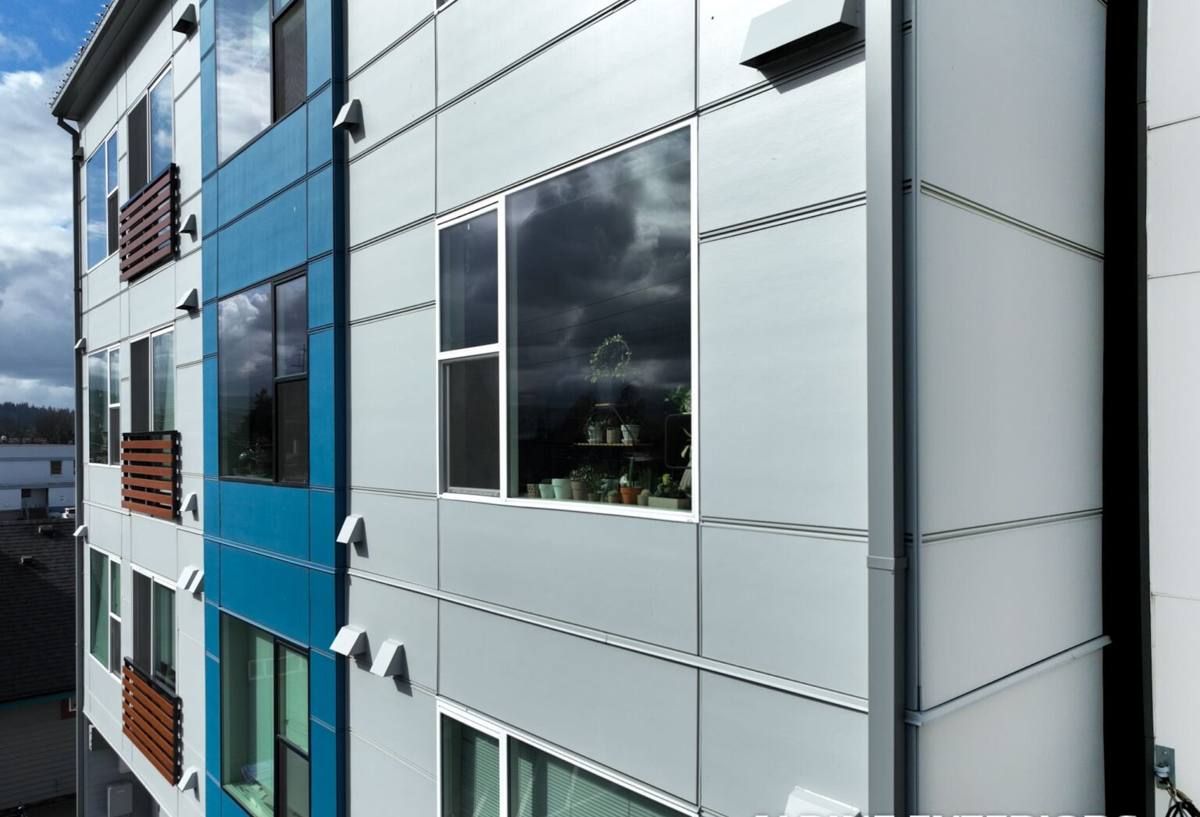
What Salt Air Actually Does to a Building
Salt air is corrosive to metal and hard on anything that relies on a painted surface bonding well and staying intact. Fasteners, flashing, and trim metal exposed to salt-laden air corrode faster than the same materials would inland. Paint films that aren't factory-cured tend to chalk, fade, or lose adhesion sooner in this kind of exposure, which is one reason we care so much about how a product's finish is made, not just what color it is.
Wind-driven rain compounds the problem. In a straight-down rain, siding sheds water and gravity does most of the work. In wind-driven rain — common on exposed Birch Bay lots — water gets pushed sideways and upward into laps, joints, and penetrations. If the siding and the water-resistive barrier behind it aren't detailed correctly, that water finds its way behind the cladding, and once it's there, it's the framing and sheathing that pay the price, not just the siding.
Moss Season Is a Real Design Constraint
Whatcom County's moss season runs long — essentially any stretch of cool, wet weather with limited direct sun, which describes a good part of the year here. North- and east-facing walls, and anything shaded by mature trees or a neighboring structure, will grow moss and algae if the surface stays damp and the material gives it something to hold onto. This is a surface-and-drainage issue as much as a material issue: siding that dries out quickly after a rain event, installed over a wall assembly that actually drains, resists moss far better than siding that stays wet against the sheathing.
Our Position: James Hardie Fiber Cement, Installed to Spec
We install James Hardie fiber cement siding exclusively. We don't install vinyl, LP SmartSide, cedar, primed spruce, Cemplank, or Allura — not because those products have no merit, but because we've made a professional call that Hardie's combination of non-combustible fiber cement, factory-applied ColorPlus finish, and HZ product engineering for Pacific Northwest moisture conditions is the right standard to put our name behind, especially in a coastal exposure like Birch Bay.
The factory-cured ColorPlus finish matters more here than it would in a milder climate: it's baked on under controlled conditions and holds up to UV and moisture exposure noticeably better than field-applied paint, which is exactly the kind of finish that struggles under salt air and constant damp. Fiber cement itself doesn't feed mold or moss the way wood-based products can, and it won't rot if it takes on moisture at a cut edge or fastener hole — as long as that edge is properly sealed and caulked during installation, which is a step we don't skip.
What a Correct Installation Looks Like Here
The material is only half the equation. In a high-exposure area like Birch Bay, installation details are what actually determine whether siding performs for 20-plus years or starts showing problems in five. A correct job includes:
- A continuous, properly lapped water-resistive barrier behind the siding, with all penetrations flashed before the siding goes on
- A drainage plane (rainscreen gap) so any moisture that does get past the cladding can drain and the wall can dry
- Correct fastener type, spacing, and embedment per James Hardie's installation specifications — not generic nailing patterns
- Factory-cut and factory-primed edges used wherever possible, with all field cuts sealed per manufacturer instructions
- Proper clearance between siding and grade, decks, roofing, and other surfaces so water and debris don't sit against the bottom edge
- Corrosion-resistant flashing and trim details at windows, doors, and any wall penetration exposed to wind-driven rain
Skip any one of these and the siding itself can be flawless while the wall behind it fails. This is the single biggest reason we don't treat siding installation as a one-size-fits-all product swap — the water management behind the boards is where most long-term problems actually start.
How We Approach a Birch Bay Job
- On-site assessment — we look at exposure direction, shading, existing moisture damage, and how water currently moves around the house before recommending anything.
- Tear-off and sheathing check — old siding comes off and we inspect the sheathing and framing underneath for rot or prior water intrusion before covering anything back up.
- Water-resistive barrier and flashing — house wrap or equivalent barrier installed continuous and lapped correctly, with flashing at every window, door, and penetration.
- Rainscreen furring — a drainage gap set behind the siding so the wall assembly can shed and dry, which matters more on a shaded or wind-exposed elevation than on a sheltered one.
- Hardie installation to spec — correct fastener schedule, factory edges used at seams and corners, all cuts sealed.
- Trim, caulk, and final detailing — corrosion-resistant fasteners and trim metal at every exposed connection, with attention to the joints most likely to see wind-driven rain.
Comparing Siding Options for a Coastal Whatcom County Lot
| Factor | Vinyl | Wood / Engineered Wood | James Hardie Fiber Cement |
|---|---|---|---|
| Salt air / corrosion resistance | Panel itself doesn't corrode, but can become brittle and fade faster in coastal UV and salt exposure | Finish and fasteners are the weak point; repainting cycles shorten in this exposure | Non-combustible fiber cement; factory ColorPlus finish engineered for UV and moisture exposure |
| Moss / algae resistance | Can grow moss on shaded, damp sections; surface doesn't feed growth but texture can hold moisture | Wood-based products can be more susceptible if moisture reaches the substrate | Doesn't feed moss growth; performance depends on proper drainage detailing behind it |
| Fire resistance | Combustible | Combustible | Non-combustible |
| Finish longevity | Color molded in, but can fade and chalk over time | Field-applied paint typically needs recoating every several years | Factory-cured finish, warrantied against peeling and fading per manufacturer terms |
| Impact / moisture tolerance | Can crack in cold, dent easily | Vulnerable to rot if moisture reaches unsealed wood | Resists impact and moisture when installed and sealed correctly |
What Drives Cost on a Birch Bay Installation
Every siding quote should reflect the specific house, not a flat per-square-foot number pulled out of thin air. On coastal jobs, a few factors tend to move the price more than homeowners expect:
| Cost Factor | Why It Matters in Birch Bay |
|---|---|
| Condition of existing sheathing | Prior wind-driven rain intrusion sometimes means sheathing repair before new siding can go on |
| Rainscreen / drainage plane addition | Adding a proper drainage gap on a wind-exposed or shaded elevation adds labor but reduces long-term risk |
| Trim and flashing complexity | Homes with more windows, dormers, or wall penetrations need more corrosion-resistant flashing work |
| Access and site conditions | Waterfront and bluff lots can have tighter access, affecting staging and labor time |
| James Hardie product line and profile | Lap width, texture, and trim selections affect material cost and install time |
Maintaining Hardie Siding in This Climate
One appeal of fiber cement in a marine climate is how little ongoing maintenance it asks for compared to painted wood, but "low maintenance" doesn't mean zero. In Birch Bay's conditions, we recommend homeowners:
- Rinse siding periodically, especially shaded or north-facing walls, to keep salt residue and organic buildup from accumulating
- Keep gutters and downspouts clear so roof runoff isn't dumping extra water onto siding sections
- Trim back vegetation and tree cover where it's keeping a wall section shaded and damp longer than the rest of the house
- Have caulking and trim joints inspected every few years — sealant is the first thing to give way under constant wind-driven rain
- Address any moss growth early with a gentle wash rather than letting it establish and hold moisture against the surface
Why Local Installation Experience Matters
Siding installation isn't just a manufacturer's spec sheet applied identically everywhere — it's a spec sheet applied correctly to the specific exposure a house sits in. A crew that regularly works Birch Bay and the surrounding Whatcom County waterfront already knows which elevations catch the worst of the wind-driven rain, where moss tends to establish first, and how much drainage detailing a given lot actually needs versus a standard inland installation. That local pattern recognition shows up in fewer callbacks and a wall assembly that's built for the exposure it will actually face, not a generic one.
If you're planning a siding project for a Birch Bay home, we're happy to walk the property, look at your specific exposure and existing conditions, and put together a straightforward plan and estimate — no pressure, no upsell, just a clear look at what your house needs. Use the form below to request a free estimate.