 Lynden Siding
 Siding Built for Maple Falls, Not Just Sold There
Maple Falls sits back against the foothills east of Lynden, and that location changes how a house ages compared to homes closer to town. You get more shade, more standing moisture after a storm, more moss creeping across north-facing walls, and longer stretches where siding simply doesn't get a chance to fully dry out between rain events. We're a Lynden-based crew, and Maple Falls is inside our regular service area — not a once-in-a-while drive for us. That matters when it comes to scheduling, warranty follow-up, and knowing what a given street or elevation is going to throw at a siding job before we even start.
This page covers what we see on Maple Falls homes, how we approach siding, roofing, window, and deck work out there, and why we install James Hardie fiber cement exclusively rather than the wider range of products most contractors carry.
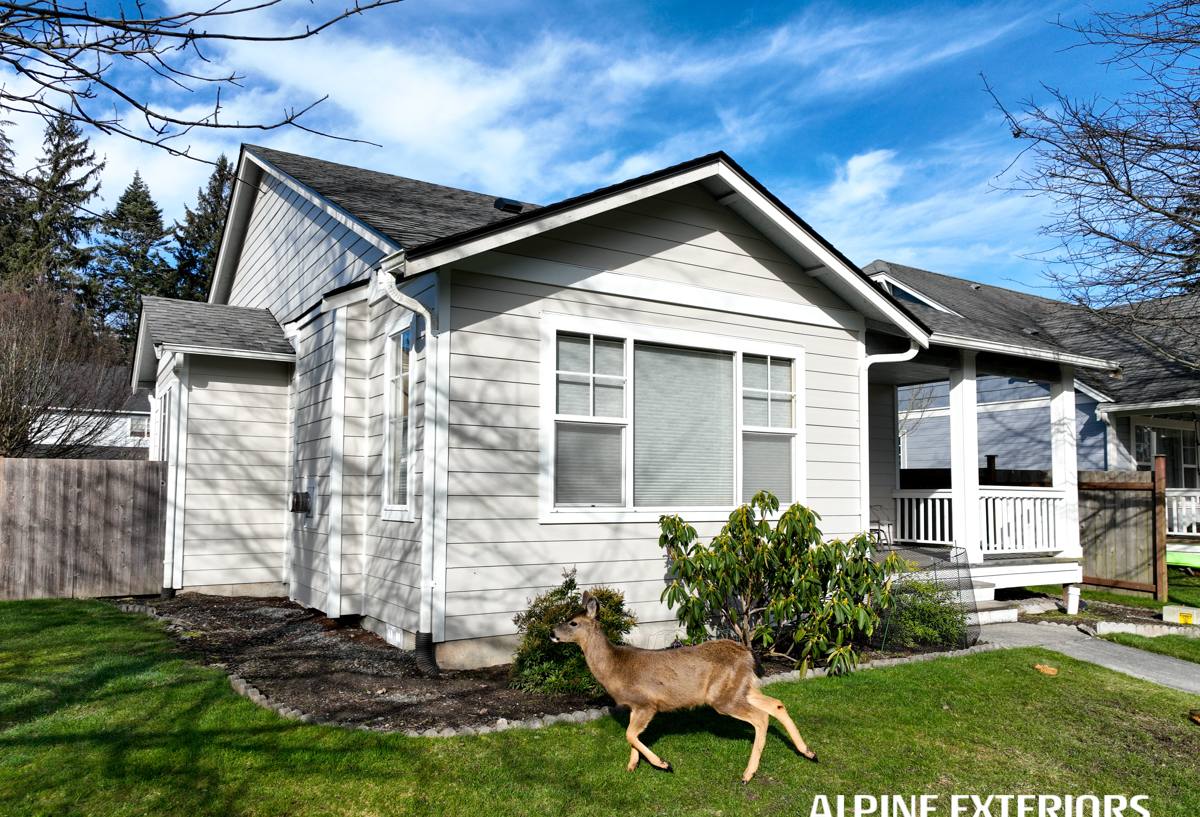
What the Local Climate Does to Exterior Siding
Whatcom County's marine climate is the backdrop for everything we do on the exterior side of a house. Salt-tinged air moving in off the Sound, driving rain that comes in sideways during winter systems, and a moss season that can stretch from fall through spring all put steady, cumulative stress on siding, trim, and fascia. None of it is dramatic in the moment — there's rarely a single storm that "does the damage." It's the slow accumulation over years: paint that chalks and fades faster than it should, seams that take on moisture, and moss and algae that hold dampness against the wall surface long after the rain has stopped.
Why Maple Falls Specifically
Compared to more open, in-town lots, homes tucked against tree lines or hillsides in the Maple Falls area often get less direct sun and wind exposure on at least one or two elevations. That's good for shade in summer, but it means those walls stay damp longer after rain, which is exactly the condition moss, mildew, and wood rot favor. We pay close attention to which sides of a house are chronically shaded and damp when we're planning a siding or trim job here, because that's usually where a lower-grade material shows problems first.
The Common Failure Points We See
- Moss and algae staining on north- and east-facing walls that stay shaded most of the day
- Paint or coating breakdown on wood-based or engineered wood siding where moisture cycles in and out
- Soft or swollen trim boards around windows, corners, and roof-wall intersections
- Caulk joints that have separated, letting water track behind the siding plane
- Fascia and soffit staining tied to gutter overflow during heavy rain events
Why We Install Only James Hardie Fiber Cement
We used to get asked why we don't offer vinyl, LP SmartSide, or other engineered wood options. The honest answer is that we made a call, as a company, to standardize on one product system we can stand behind for this climate rather than carry several and let the homeowner sort out the trade-offs.
What We're Not Installing, and Why
Vinyl siding is affordable and low-maintenance in the sense that it doesn't need painting, but it's a thin plastic product that can warp under sustained heat reflection, crack in cold snaps, and it doesn't offer the same fire resistance or rigidity as fiber cement. LP SmartSide and similar engineered wood products use treated wood strand technology that performs reasonably well when installation and caulking are perfect and stay perfect for decades — but any breach in that protective layer, and in a climate with this much sustained moisture, wood-based cores are vulnerable to swelling and rot at the exact seams and cut edges that are hardest to keep sealed forever. Primed spruce or cedar siding can look excellent, but both require an ongoing paint and maintenance commitment that most homeowners underestimate, and cedar in particular is a combustible, higher-maintenance material compared to fiber cement.
None of these products are "bad" in an absolute sense — they're reasonable choices in the right context, and other contractors install them well. Our standard is narrower: we install what we believe holds up best, with the least ongoing homeowner maintenance, in a wet coastal county with a long moss season and salt air working against painted surfaces year-round.
What James Hardie Gets Right for This Area
James Hardie fiber cement is non-combustible, dimensionally stable (it doesn't expand and contract with moisture the way wood-based products do), and it comes with a factory-applied ColorPlus finish that's baked on rather than field-painted — which means better fade resistance and no repainting cycle for the homeowner. Hardie also builds climate-specific product lines through its HZ5 engineering, formulated for regions with exactly this combination of moisture and temperature swings. Backed by a strong transferable limited warranty, it's a product we're comfortable putting our name behind for the long haul, not just the first few years.
How a Hardie Installation Actually Works
The product is only half the equation — installation quality is what determines whether siding performs for 30+ years or develops problems in five. On a Maple Falls home, that typically means:
- Assessing existing sheathing and house wrap condition before anything new goes up
- Confirming proper weather-resistive barrier and flashing details at every window, door, and penetration
- Correct fastener spacing and placement per Hardie's installation specifications, which affect the warranty
- Proper caulking and sealant at joints, with attention to butt joints that are common failure points if rushed
- Verifying rainscreen or ventilation gaps where called for, so moisture has somewhere to go
A lot of the siding problems we get called out to inspect on older homes trace back to shortcuts in these details, not the product itself. That's part of why the crew matters as much as the material.
Comparing Siding Options for a Whatcom County Home
| Factor | Vinyl | Engineered Wood (LP SmartSide) | James Hardie Fiber Cement |
|---|---|---|---|
| Moisture resilience | Doesn't rot, but can warp/crack | Good if seams stay sealed; vulnerable if breached | Dimensionally stable, doesn't swell or rot |
| Fire resistance | Melts under heat | Combustible (wood-based core) | Non-combustible |
| Finish maintenance | No paint, but fades/chalks over time | Factory-primed, needs repainting eventually | Factory ColorPlus finish, long fade resistance |
| Typical lifespan (properly installed) | 20-30 years | 20-30 years | 30-50+ years |
| Upfront cost | Lowest | Mid-range | Higher upfront, lower lifetime maintenance cost |
Beyond Siding: Roofing, Windows, and Decks
Siding rarely fails in isolation out here — it's usually connected to what's happening at the roofline, around window flashing, or at a deck ledger board where water has a habit of finding its way in. We handle all four exterior trades as one crew rather than subcontracting each piece out separately, which means fewer handoffs and fewer gaps in accountability when something touches two systems at once (a leaking gutter affecting fascia and siding both, for example, or a deck ledger connection that also involves the wall's weather barrier).
Roofing
Roof condition drives a lot of what happens to siding below it. Clogged or undersized gutters overflow onto fascia and the top courses of siding, and moss on a roof eventually sheds onto walls below. We look at roof drainage as part of any siding conversation, not as a separate issue.
Windows
Window flashing and integration with the siding plane is one of the most common sources of hidden water intrusion. When we replace siding, we check window flashing details as part of the job rather than working around them.
Decks
Ledger board connections, especially on older decks, are a frequent point where water tracks into the house structure. If we're already on-site for siding, it's worth having that connection checked.
What to Check Before Hiring Any Exterior Contractor
- Are they licensed and insured to do exterior work in Washington State?
- Do they specify fastener schedules and flashing details in writing, or just "we'll handle it"?
- Will they walk you through why they recommend a specific product over alternatives?
- Are they a local crew who will still be reachable in five or ten years if a warranty issue comes up?
- Do they subcontract the work out, or is the crew on-site the same one that sold the job?
Why a Local Crew Matters Here
A siding job in Maple Falls isn't identical to one in downtown Lynden or a more exposed site closer to the county line — shade patterns, tree cover, and drainage all vary block to block. Being based in Lynden means we're familiar with how homes in this specific pocket of Whatcom County tend to age, and we're not disappearing after the job is done. If a warranty question comes up two years down the road, or a gutter needs adjusting after a wet winter, we're a short drive away, not a call center in another state.
Get a Straightforward Estimate
If you're noticing moss buildup, fading, soft trim, or you're just planning ahead for a home in the Maple Falls area, we're happy to take a look and give you an honest read on what your siding actually needs — no pressure, no upsell. Reach out for a free estimate using the form below.