 Lynden Siding
 One Product, On Purpose
Homeowners in Lynden sometimes ask why we don't offer a menu of siding options the way some contractors do. The honest answer is that we used to install a broader range of materials, and we stopped. After years of both new installs and tear-off repairs across Whatcom County, one pattern kept repeating: the homes with the fewest long-term problems were sided in James Hardie fiber cement, installed to the manufacturer's specification. So we made it our standard, and we've stuck with it.
This isn't a page trying to sell you on hype. It's an explanation of what James Hardie fiber cement actually is, how the product system works, and why it holds up against the specific conditions a Lynden home deals with — salt-tinged air drifting in off the Salish Sea, driving rain that comes sideways during a fall storm, and a moss season that barely takes a break most years.
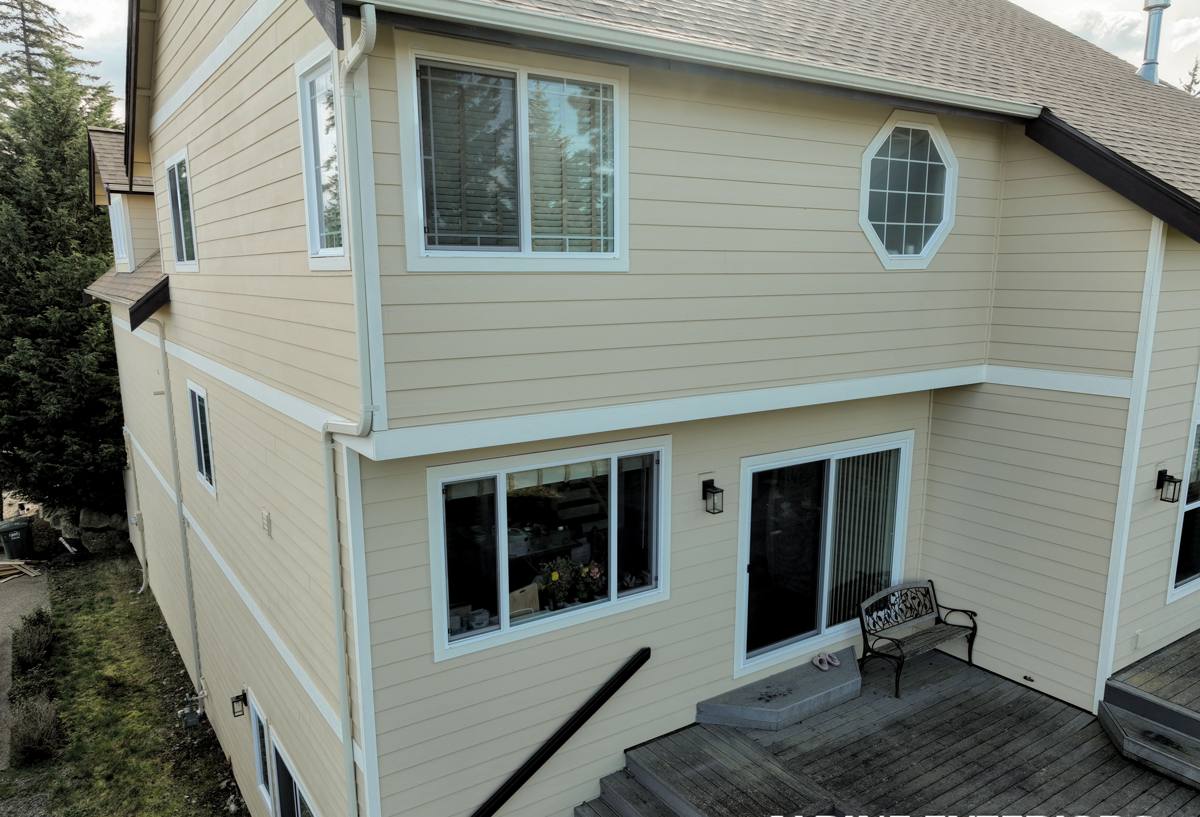
What James Hardie Fiber Cement Actually Is
Fiber cement siding is manufactured from a mix of Portland cement, sand, and cellulose fiber, pressed under high pressure and cured before it ever reaches a jobsite. The result is a dense, dimensionally stable board that doesn't behave like wood or plastic. It doesn't expand and contract with temperature swings the way vinyl does, it doesn't absorb and release moisture the way raw wood does, and it holds its shape and finish far more consistently over decades of Pacific Northwest weather.
James Hardie also engineers its boards for specific climate zones rather than selling one generic product everywhere. The HZ5 formulation, which is what we install throughout Whatcom County, is built for colder, wetter regions with more moisture cycling than the company's warm-climate HZ10 line. That distinction matters more than most homeowners realize — a siding product engineered for the desert Southwest and one engineered for the Pacific Northwest are not interchangeable, even if they carry the same brand name.
The Product Lines We Install
HardiePlank Lap Siding
This is the most common product on Lynden homes — horizontal overlapping boards available in a range of widths and textures, from smooth to a cedar-grain look. It's the closest match to traditional lap siding but without the maintenance burden of real wood.
HardiePanel Vertical Siding
Used for board-and-batten style walls, accent sections, or full vertical applications on more modern home designs. It's increasingly common on newer construction and remodels in this area.
HardieShingle
A shingle-profile product for homeowners who want the look of cedar shakes without the rot, splitting, and repainting cycle that comes with actual cedar shingles.
Trim, Soffit, and Fascia
Hardie also makes matching trim board and soffit products, which lets us finish a home in a single consistent material system rather than mixing fiber cement field siding with wood or composite trim that ages differently.
ColorPlus Technology vs. Field-Applied Paint
Most of the Hardie siding we install carries the ColorPlus finish — a multi-coat color baked onto the board at the factory under controlled temperature and humidity, rather than painted on site after installation. That distinction is bigger than it sounds. A jobsite paint job depends on the weather that day, the surface prep, and the specific crew doing the work. A factory finish is applied the same controlled way on every board, every time, and it comes with its own finish warranty separate from the substrate warranty on the board itself.
Homeowners can still choose primed Hardie board and have it field-painted to an exact custom color if that's the look they want. We'll walk through both options honestly — ColorPlus tends to hold its color longer with less maintenance, while field-painted primed board offers more flexibility if you want a very specific or unusual color that isn't in the ColorPlus palette.
Why This Matters Specifically in Whatcom County
Lynden sits close enough to the Salish Sea and the Nooksack River valley that homes here deal with a combination most siding products aren't built to handle well over the long run: salt-carrying air, frequent wind-driven rain, and long stretches of overcast, damp weather that keep shaded wall sections wet for days at a time. Add in the moss and algae growth that thrives in that environment, and you've got a climate that's genuinely tougher on exterior materials than it looks from the outside.
| Climate Factor | Effect on Siding | How HZ5 Fiber Cement Responds |
|---|---|---|
| Salt air off the Salish Sea | Accelerates corrosion of fasteners, finishes, and metal trim | Non-corrosive board; we pair it with corrosion-resistant fasteners and flashing |
| Wind-driven rain | Pushes moisture behind loose seams and panels | Dense, stable board with a system designed around correct flashing and clearances |
| Long moss/algae season | Discoloration and buildup on shaded, damp walls | Holds factory finish well; periodic gentle washing keeps it looking clean |
| Temperature swings, wet-to-dry cycling | Causes warping, cracking, or fastener pull in less stable materials | Minimal expansion and contraction; dimensionally stable year-round |
None of this means fiber cement is magic or maintenance-free. It means the material itself isn't the weak point in the system the way it can be with products engineered for milder or drier climates.
The Warranty Structure
One of the practical reasons we settled on Hardie is the warranty structure, which is more straightforward than what you'll find with a lot of alternative products. The substrate (the board itself) carries a long-term, transferable non-prorated warranty, and if you choose ColorPlus factory finish, that finish carries its own separate warranty covering fade and chipping. Transferability matters more than people expect — if you sell your Lynden home within the warranty period, that coverage generally passes to the next owner, which is a real selling point when the time comes.
| Warranty Element | What It Covers |
|---|---|
| Substrate warranty | Manufacturing defects in the fiber cement board itself, long-term and transferable |
| ColorPlus finish warranty | Fading and finish integrity, separate from the substrate coverage |
| Installation warranty | Provided by us as the installing contractor, covering our workmanship |
We recommend every homeowner actually read the current warranty terms rather than take a summary at face value — manufacturer warranty language changes over time, and the specifics (labor coverage limits, registration requirements) are worth understanding before you sign a contract.
Why Correct Installation Matters As Much As the Material
Fiber cement is a forgiving material chemically, but it's not forgiving of sloppy installation. Hardie publishes detailed installation specifications, and deviating from them is the single biggest reason we see fiber cement siding fail prematurely — not the material itself. A board installed with the wrong fastener pattern, insufficient clearance from grade or roofing, or unsealed butt joints can develop problems that have nothing to do with the product and everything to do with the crew that put it up.
- Minimum clearance maintained from grade, decks, and roof lines per Hardie's published specs
- Correct fastener type, spacing, and penetration depth — not generic siding nails
- Properly lapped and sealed water-resistive barrier behind the siding, not just the board itself
- Flashing at every window, door, and penetration, installed before siding goes on, not caulked over afterward
- Butt joints sealed or flashed according to spec rather than simply butted together
- Factory-cut edges primed or sealed where field cuts expose raw material
This is part of why we don't spread our crews across multiple siding systems. Installing one product exceptionally well, with a crew that knows Hardie's specification manual cold, produces more consistent results than installing several products competently.
Why We Don't Install Other Products
We get asked fairly often why we won't install vinyl, LP SmartSide, or other engineered wood siding, even when a homeowner requests it. It isn't that those products are worthless — vinyl is inexpensive and quick to install, and engineered wood has real strengths for the right application. Our reasoning is narrower than a blanket judgment: after repairing enough moisture damage behind vinyl seams and enough swelling and edge failure on engineered wood panels in this specific climate, we decided we'd rather stand fully behind one system than offer several and dilute our expertise across all of them. That's a standard we set for our own work, not a claim that every alternative product is a bad choice for every homeowner in every climate.
What This Means for Your Project
Because we only quote and install one siding system, our estimates tend to be more predictable than contractors juggling multiple product lines and price points. Material and labor costs vary by home size, wall complexity, tear-off scope, and product line (lap vs. panel vs. shingle), but Hardie generally runs higher up front than vinyl and comparable to or somewhat above quality engineered wood — a difference that narrows considerably once you factor in the maintenance and replacement cycle over 20-plus years of ownership.
A typical Lynden project runs from an initial walk-around and measurement, to a written estimate breaking out product line, color, and trim details, to a scheduled install that usually takes one to two weeks depending on square footage and how much trim and flashing detail the home requires. Whatcom County weather windows factor into scheduling, and we build reasonable flexibility into the timeline rather than rushing crews between rain systems.
If you're planning a siding project in Lynden and want to understand what a correctly installed James Hardie system would look like on your specific home, we're glad to walk the exterior with you and put together a free, no-pressure estimate.