 Lynden Siding
 LP SmartSide Is a Real Product — This Isn't a Takedown
If you've been pricing siding around Lynden, you've probably run into LP SmartSide. It's a legitimate engineered-wood product, and LP has been making it for decades. It's not a scam, it's not cheap junk, and plenty of homes around Whatcom County have it on the walls right now doing fine. We just don't install it, and homeowners deserve to know why before they sign a contract with someone who does.
This page isn't about scaring you off a product. It's about explaining the trade-offs we weighed as a company, and why we landed on James Hardie fiber cement instead for every job we take on.
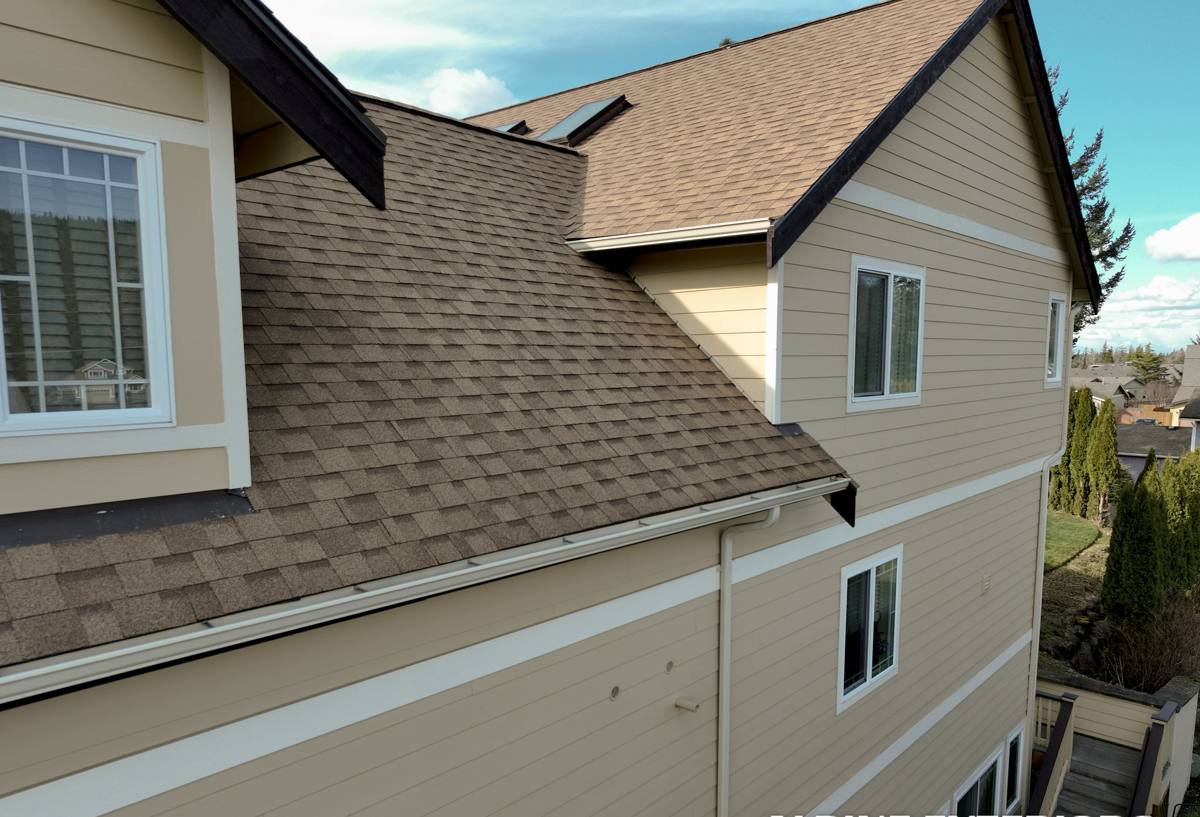
What LP SmartSide Actually Is
LP SmartSide is engineered wood — strand board, similar in concept to OSB, treated with resins, zinc borate for insect and fungal resistance, and a resin-saturated overlay, then coated with a primer. It comes in lap siding, panels, and trim, and it's noticeably lighter and easier to cut and nail than fiber cement. Installers like it because it goes up fast, and the upfront material cost usually runs lower than a comparable Hardie job.
For a lot of climates, that's a fair deal. Our issue is specific to what happens to engineered wood siding here in the Pacific Northwest, and specifically in a moisture-heavy, moss-prone corner of Whatcom County.
The Core Material Difference
LP SmartSide is wood-based. Even with resin treatment and zinc borate, the base material is still strand board — wood fiber held together with adhesive. James Hardie siding is fiber cement: sand, cement, and cellulose fiber, cured into a rigid, non-combustible board. That's the fundamental fork in the road, and it drives almost everything else on this page.
Why Moisture Behavior Is Our Real Concern
Lynden sits in a wet part of a wet state. Whatcom County gets a long, mild, damp stretch from fall through spring, and homes near the Nooksack lowlands or anywhere with limited sun exposure deal with moss creeping up siding, fences, and roofs for months at a time. Add in the driving rain that comes off the Strait during winter storms, and you've got siding that stays damp longer than it dries.
Engineered wood siding is manufactured to resist moisture far better than raw plywood or untreated wood ever could — that's the whole point of the resin treatment. But it's still wood at its core. Wood fiber that stays wet, whether from a caulking gap, a missed flashing detail, a sprinkler hitting the wall, or just chronic damp shade, is going to swell, and swelling engineered wood doesn't shrink back cleanly. Edges can flare, seams can telegraph, and once moisture gets past the surface treatment into the substrate, it's a slower material to dry back out compared to cement board, which doesn't absorb and swell the same way to begin with.
Fiber cement isn't waterproof either — water still needs to be managed with proper flashing and caulking on any siding product. The difference is what happens when a small installation gap or maintenance lapse lets moisture in anyway. Cement board tolerates that margin of error better over a 20-30 year span than an engineered wood product does.
Installation Sensitivity Is a Bigger Deal Than It Sounds
LP SmartSide's warranty and real-world performance both lean hard on installation being done exactly to spec — correct fastener placement, exact clearances above grade, roofline, and decking, factory-cut and field-cut edges sealed with the specified primer or sealant, and gaps caulked before they're exposed to weather. Skip a step, and you've shortened the product's working life in ways that may not show up for a few wet seasons.
That's not unique to LP — every siding product has an install spec. But the margin for error is narrower with engineered wood than with fiber cement, because the failure mode (moisture intrusion into wood fiber) progresses faster and is harder to reverse than the failure mode for cement board. We'd rather standardize on one product where we can guarantee our crews hit the spec every single time than run two install protocols and hope the tighter one gets followed on every job.
Fire Performance: A Straightforward Comparison
This one is simple physics, not a knock on LP's engineering. LP SmartSide is a treated wood product — it carries a Class A fire rating with proper treatment, but it is still combustible at its core. James Hardie fiber cement is non-combustible; cement and sand don't burn. For homes near wooded lots, dry-season brush, or simply for the peace of mind of a non-combustible exterior, that's a meaningful difference we don't want to compromise on when we're the ones putting our name behind the install.
Side-by-Side: LP SmartSide vs. James Hardie Fiber Cement
| Factor | LP SmartSide | James Hardie Fiber Cement |
|---|---|---|
| Base material | Engineered wood strand board | Sand, cement, cellulose fiber |
| Combustibility | Combustible (treated, Class A rated) | Non-combustible |
| Moisture response | Can swell if water reaches substrate | Resists swelling; won't rot |
| Install error tolerance | Narrow — spec must be followed closely | Wider margin, still spec-dependent |
| Finish options | Primed, field-painted | ColorPlus factory finish or primed |
| Typical material cost | Lower | Higher upfront |
| Warranty structure | Limited warranty, install-dependent | Non-prorated limited warranty on ColorPlus finish |
| Weight/handling | Lighter, faster install | Heavier, more labor per board |
Moss, Algae, and the Long Damp Season
Anyone who's lived in Lynden for a few winters knows moss doesn't just grow on roofs — it finds shaded, north-facing wall sections, fence lines, and anywhere airflow is limited. Wood-based siding, even treated, gives organic growth more to hold onto over time than a smooth cement board finish does, and staying damp under a layer of moss or algae is exactly the condition that shortens the life of any wood-fiber product. It's manageable with regular wash-downs and gutter maintenance, but it's another item on the maintenance list that we'd rather not hand a homeowner if we can avoid it.
Why We Standardized on James Hardie Instead
We made a call as a company: install one product, install it right, every time, and stand behind it with a warranty that means something. James Hardie's HZ5 product line is engineered specifically for climates like ours — freeze-thaw cycles, sustained moisture, and coastal-influenced weather patterns that show up from the Strait of Georgia down through Whatcom County. The ColorPlus factory finish holds color without the repaint cycle wood siding needs, the board itself won't rot or feed pests, and it's non-combustible from the day it goes up. The warranty is transferable, which matters if you sell the house before you'd otherwise consider re-siding.
None of that makes LP SmartSide a bad product for every situation. It makes it a product whose trade-offs don't match what we want to guarantee on a home that's going to face a Lynden winter for the next 20-plus years.
What This Means If You're Comparing Bids
- Ask any contractor quoting engineered wood siding exactly what their install spec requires for clearances, fastening, and sealed edges — and ask what happens if that spec isn't followed to the letter.
- Ask what the warranty actually covers if moisture gets into a seam or cut edge, and who's responsible for catching that before it becomes a bigger repair.
- Compare the full picture — material cost, expected repaint or maintenance cycle, and warranty terms — not just the number on the estimate.
- If a contractor installs multiple different siding brands, ask why, and what their real-world experience with long-term performance in Whatcom County weather actually looks like.
- Don't assume a lower quote today means a lower cost over 20 years — maintenance and repaint cycles add up.
The Bottom Line for Lynden Homeowners
LP SmartSide isn't a product we'd call a mistake for every home in every climate. But between the driving rain off the Strait, a moss season that runs long, and the general damp that defines a Whatcom County winter, we decided the trade-offs weren't ones we wanted to build a business around. We install James Hardie fiber cement exclusively because it lets us give every customer the same answer on moisture resistance, fire performance, and warranty coverage, without a second product line pulling in a different direction.
If you're weighing siding options for a home in Lynden or anywhere else in Whatcom County, we're happy to walk through what we see on real jobs in this climate and why Hardie is what goes on the homes we work on. Reach out for a free, no-pressure estimate — we'll look at your home specifically and give you a straight answer.