 Lynden Siding
 Siding That Has to Earn Its Keep in Nooksack
Homes in the Nooksack area, just outside Lynden in Whatcom County, sit in one of the more demanding exterior climates in the Pacific Northwest. You get a steady pull of moist marine air off the Sound, long stretches of driving rain funneled up the Nooksack River valley, and a moss and algae season that can run eight or nine months out of the year in shaded, north-facing spots. None of that is dramatic on its own, but stacked together year after year, it is exactly the kind of slow, patient punishment that separates siding systems that hold up from siding systems that just look good on installation day.
That is the lens we use when we talk to Nooksack homeowners about siding. We are not selling a look. We are specifying a wall assembly that has to survive decades of wetting and drying cycles, wind-driven rain hitting horizontal joints and window returns, and organic growth that thrives on damp, shaded siding. James Hardie fiber cement is the only product we install, and this page is about why that decision matters specifically for homes in this part of the county — not just siding in general.
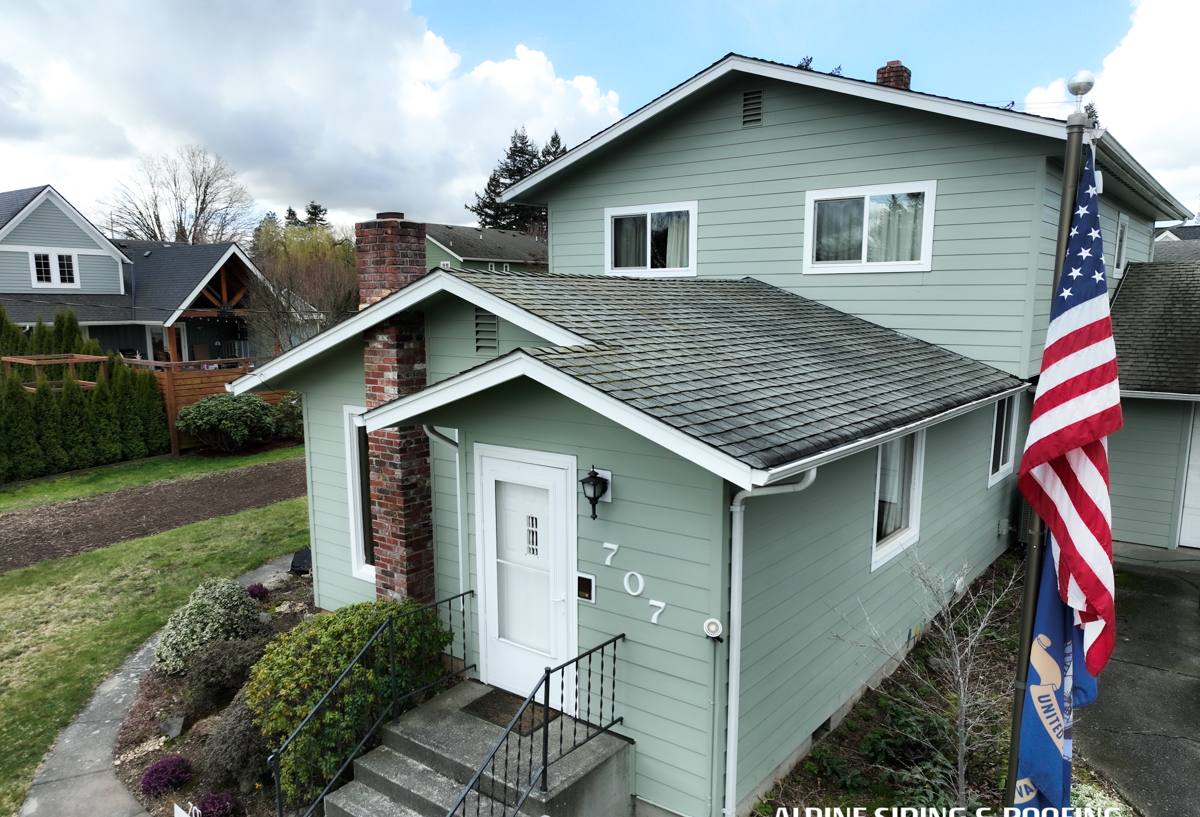
What This Climate Actually Does to a Wall
It helps to be specific about the failure mechanisms, because they are what should drive the material and installation choices.
- Driving rain pushes water sideways into laps, seams, and butt joints, not just straight down. Any siding relying on caulk or paint film alone to keep that water out will eventually let some through.
- Salt-laden air accelerates corrosion of exposed metal fasteners, trim flashing, and hardware, and it degrades some coatings faster than a drier inland climate would.
- Moss and algae establish on shaded, north- and east-facing walls and under eaves where surfaces stay damp longer. Organic growth holds moisture against the siding surface, which is hard on any substrate that swells, softens, or delaminates when wet.
- Freeze-thaw cycles, while less severe here than in the mountains, still happen enough winters to stress any siding that has already absorbed moisture.
The practical takeaway: a siding product's resistance to moisture absorption, and how well the installation manages water once it inevitably reaches the wall, matter more here than in a drier region. This is where fiber cement earns its reputation, and where cheaper alternatives tend to show their age early.
Why We Install Only James Hardie
We standardized on James Hardie fiber cement and do not install vinyl, LP SmartSide, or other fiber cement brands. That is a deliberate professional standard, not a sales pitch, and it is worth explaining honestly.
Non-combustible, dimensionally stable material
Fiber cement is made from cellulose fiber, sand, and cement. It does not burn, it does not attract wood-boring insects, and it does not expand and contract with temperature swings the way vinyl does. In a wet climate, dimensional stability matters because siding that moves a lot works its fasteners loose and opens gaps at joints over time.
Climate-engineered product lines
James Hardie makes region-specific formulations under its HZ5 designation for areas that see significant moisture and freeze-thaw exposure, which includes Western Washington. The engineering targets moisture resistance and durability for exactly the conditions Nooksack sees — it is not a one-size-fits-all product shipped the same way to every climate zone in the country.
Factory-applied ColorPlus finish
ColorPlus finish is baked on at the factory under controlled conditions, rather than field-applied paint over primed board. That matters here specifically because field-applied finishes are more sensitive to the humidity and temperature conditions on the day they are sprayed or rolled — conditions that are hard to control on a job site in this climate for a good chunk of the year. A factory finish gives more consistent coverage and better long-term color and moisture performance, backed by its own finish warranty separate from the substrate.
A warranty structure built for the long haul
James Hardie backs its siding with a substantial transferable limited warranty, and ColorPlus finishes carry their own coverage. That transferability matters to resale, and the length of coverage reflects the manufacturer's confidence in how the product performs over decades, not just through one wet winter.
What a Correct Installation Actually Involves
Fiber cement siding is only as good as the installation behind it. Most of the siding failures we get called out to inspect in this area are not material failures — they are installation shortcuts that let water in behind a product that was otherwise fine. A correct James Hardie install on a Nooksack-area home includes:
Water-resistive barrier and flashing details
A properly lapped weather-resistive barrier underneath the siding, with flashing integrated at every window, door, deck ledger, and roof-to-wall transition. This is the layer that actually keeps a house dry — the siding is the first line of defense, but the barrier behind it is what protects the wall assembly when wind-driven rain gets past that first line, which it will, eventually, on every house.
Proper clearances
James Hardie specifies minimum clearances between the bottom edge of siding and roof surfaces, decks, patios, and grade. Skipping these clearances is one of the most common shortcuts we see, and it is a direct path to trapped moisture and premature rot at the bottom course — exactly where a driving-rain climate does the most damage.
Fastener pattern and type
Corrosion-resistant fasteners, driven at the correct spacing and depth, into solid framing or proper backing at every joint. In a salt-air-influenced climate, fastener corrosion is a real long-term consideration, and it is far cheaper to use the right fastener up front than to chase rust stains and loose boards later.
Joint treatment and caulking
Butt joints, trim intersections, and penetrations sealed with a compatible sealant, not just caulked over and painted. Manufacturer-approved joint flashing at butt joints reduces long-term reliance on caulk, which is the first thing to fail under repeated wetting.
Painted or pre-finished cut edges
Every field cut exposes raw fiber cement. Sealing those cut edges before installation keeps them from wicking moisture, which is a small step that gets skipped constantly on rushed jobs.
Common Problems We Find on Older Siding in This Area
When we inspect existing siding on Nooksack-area homes, a handful of patterns show up repeatedly:
- Moss and algae buildup on north-facing walls and under eave overhangs, especially where trees shade the siding most of the day.
- Cracked or failed caulk at butt joints and trim, letting water track behind the siding before it is visible from outside.
- Rot at the bottom course where siding was installed too close to grade, a deck, or a roof line.
- Rust streaking from fasteners that were not corrosion-resistant or were driven through metal flashing incorrectly.
- Paint failure on field-finished siding, particularly on sun-exposed south and west elevations where UV and moisture cycling both stress the coating.
Most of these are installation and maintenance issues, not evidence that fiber cement itself is a poor fit for this climate — quite the opposite. They are a good illustration of why the installation details above matter as much as the product choice.
Our Process
| Step | What Happens |
|---|---|
| 1. On-site assessment | We walk the home, check existing siding condition, note moisture-prone areas (shaded walls, low clearances, deck and roof transitions), and measure. |
| 2. Product and color selection | We go over James Hardie board profiles (lap, shingle-style, panel) and ColorPlus color options suited to the home's exposure and style. |
| 3. Written estimate | A clear scope covering tear-off (if needed), water-resistive barrier, flashing, siding, trim, and fastener specs — no vague allowances. |
| 4. Prep and barrier work | Removal of failing siding, inspection of sheathing for hidden rot, and installation of the weather-resistive barrier and flashing before a single piece of siding goes up. |
| 5. Installation to manufacturer spec | Correct clearances, fastener pattern, joint treatment, and sealed cut edges, following James Hardie's published installation requirements. |
| 6. Final walkthrough | We review the finished job with the homeowner and cover basic care so the siding performs the way it is designed to. |
What Drives Cost on a Nooksack-Area Siding Job
Every home is different, and we do not publish flat per-square-foot pricing because it would not be honest — but these are the factors that actually move a quote up or down:
| Factor | Why It Matters |
|---|---|
| Existing siding removal | Tear-off of old vinyl, wood, or damaged siding adds labor and disposal cost versus installing over sound sheathing. |
| Sheathing repair | Rot found once old siding comes off — common on older homes with a history of moisture intrusion — needs to be repaired before new siding goes on. |
| Home complexity | Number of corners, window and door openings, gables, and roof transitions all add flashing and trim detail work. |
| Siding profile | Lap siding, shingle-style panels, and vertical panel systems have different material and labor costs. |
| ColorPlus vs. primed | Factory-finished ColorPlus costs more up front than field-painted primed siding but removes a recurring repaint expense. |
| Access and site conditions | Steep grades, limited equipment access, and tall walls affect labor time. |
Maintenance That Keeps It Performing
James Hardie siding is low-maintenance, not no-maintenance. In this climate, a little routine attention goes a long way:
- Rinse siding annually, and more often on shaded north-facing walls, to slow moss and algae buildup before it takes hold.
- Keep gutters clear so overflow does not run directly down the siding face at corners and end walls.
- Trim back vegetation and tree branches that keep siding shaded and damp longer than the rest of the house.
- Reapply caulk at joints and trim if it starts to crack or pull away, before it becomes a water entry point.
- Watch for any staining, streaking, or soft spots near grade, decks, or roof lines and have them checked promptly.
Why Local Experience in This Area Matters
A crew that has already installed siding on homes throughout Lynden and the surrounding Nooksack area knows which elevations tend to grow moss first, which older homes in the area were built with clearance and flashing details that do not meet current standards, and how the local rain and wind patterns actually load a wall — not just what a manufacturer's manual says in the abstract. That familiarity shows up in small decisions on every job: where to add extra flashing attention, which corners need a closer look at the sheathing, and how to sequence work around Whatcom County's wetter months. It is the difference between a crew executing a checklist and a crew that understands why the checklist exists.
If you are planning a siding project for a home in the Nooksack area and want a straightforward look at what James Hardie siding would involve for your specific house, we are happy to walk the property with you and put together a clear, no-pressure estimate. There is no obligation — just an honest assessment of what your home needs.