 Lynden Siding
 Why Birch Bay Roofs Age Differently Than Roofs Inland
Birch Bay sits right on the water, and that changes what a roof has to deal with year after year. Homes a few miles inland in Lynden or Everson still get their share of Pacific Northwest rain, but they aren't fighting salt-laden air off the bay on top of it. Salt air is corrosive to exposed metal fasteners, flashing, and vent components, and it settles into roofing materials in a way that accelerates wear compared to a roof of the same age sitting further from the shoreline.
Add in Whatcom County's driving rain — the kind that comes in sideways during winter storms — and you've got water finding its way into laps, seams, and fastener penetrations that would stay dry in a gentler climate. Then there's moss. Birch Bay's tree cover, shade patterns, and long damp season give moss a real head start each fall, and once it's established on a roof it holds moisture against the shingle or panel surface for months at a time. None of this means a roof in Birch Bay is doomed early — it means the materials, detailing, and ventilation choices matter more here than they would somewhere drier.
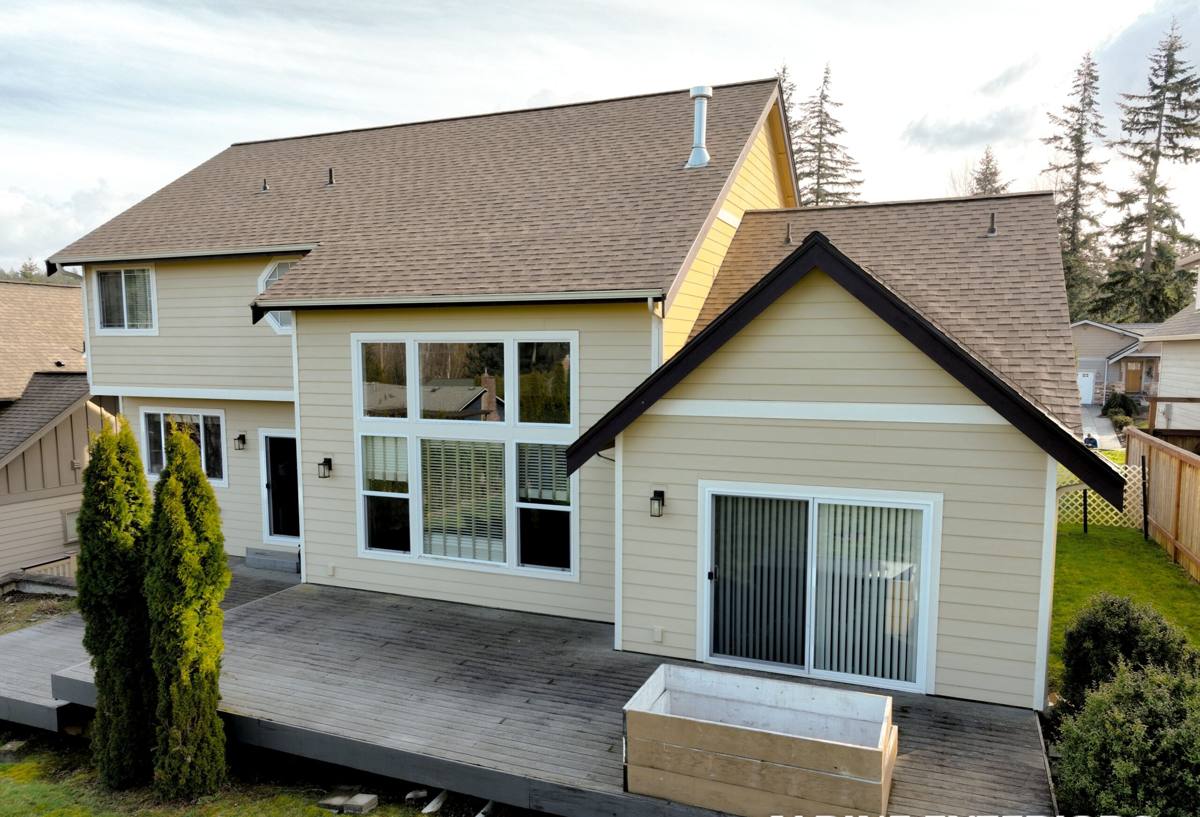
Signs a Birch Bay Roof Needs Replacement, Not Just Repair
Not every roof problem calls for a full replacement, and we'll tell you honestly when a repair is the right call. But there are signs that point toward the roof being past the point where patching makes sense.
- Granules collecting in gutters or at downspout outlets in noticeable amounts, season after season
- Shingles that are cupping, curling at the edges, or cracking when you look closely from a ladder
- Moss that keeps coming back within a year or two of cleaning, especially on north-facing slopes
- Soft spots or slight give underfoot when walking the roof, which usually points to decking damage below
- Daylight visible through the attic sheathing, or damp insulation after a heavy rain
- Repeated leak calls in different spots each winter rather than one isolated failure
- A roof older than 20-25 years for asphalt, even if it "looks fine" from the ground
If you're only seeing one or two of these and the roof is under 15 years old, a targeted repair is often the more sensible move. We'd rather tell you that up front than sell a replacement you don't need yet.
What a Correct Replacement Actually Involves
Tear-Off and Deck Inspection
A proper replacement starts with a full tear-off down to the decking — not a layover on top of old shingles. Layovers are faster and cheaper, but they trap moisture against the deck and hide problems that a coastal, high-moisture climate like Birch Bay's tends to create. Once the old roofing is off, the decking gets inspected board by board. Any plywood or OSB that's soft, delaminating, or stained from long-term moisture intrusion gets replaced before anything new goes down. Skipping this step is one of the most common ways a "new roof" fails early.
Underlayment and Ice/Water Protection
Given how much wind-driven rain Whatcom County sees, underlayment choice matters more here than in a dry climate. We use a synthetic underlayment as the primary water-resistant layer, with self-adhering ice-and-water membrane at the eaves, valleys, and any roof-to-wall transitions — the spots where wind-driven rain is most likely to work its way backward under the shingle line.
Flashing
Flashing around chimneys, skylights, vents, and wall intersections is where most leaks actually start, not in the open field of the roof. In a salt-air environment, we pay close attention to flashing material and fastener choice, since corrosion-prone metal in these details will fail well before the field roofing does.
Ventilation
Balanced intake and exhaust ventilation keeps the attic close to outdoor temperature and moisture levels. That matters twice over in Birch Bay: it reduces the condensation that feeds rot and mold in a humid coastal climate, and it helps keep the roof deck cold enough in winter to avoid the freeze-thaw cycling that contributes to moss growth and shingle stress.
Material Options for a Salt Air, High-Moss Climate
There's no single "best" roofing material for every home — it depends on your roof's pitch, sun exposure, tree cover, and budget. Here's how the common options compare for a coastal Whatcom County property like a Birch Bay home.
| Material | Moss Resistance | Salt Air Durability | Typical Lifespan | Notes |
|---|---|---|---|---|
| Architectural asphalt shingle | Moderate — benefits from copper/zinc strips | Good with quality fasteners and flashing | 25-30 years | Most common choice; wide style and color range |
| Standing seam metal | Very good — sheds moss more easily | Very good with coastal-rated coatings and fasteners | 40-50+ years | Higher upfront cost, lower long-term maintenance |
| Synthetic/composite shake | Good | Good | 30-40 years | Good option for homes wanting a shake look without wood maintenance |
| Cedar shake | Poor without diligent upkeep | Fair — needs regular treatment | 20-30 years with maintenance | Highest maintenance burden in this climate; we're upfront about that tradeoff |
We install cedar shake when a homeowner wants that look and understands the maintenance commitment, but we won't pretend it's a low-maintenance choice this close to the water and under tree cover. Metal and quality architectural asphalt tend to be the better fit for most Birch Bay properties, largely because they hold up to moss and moisture with less ongoing attention.
A Note on Moss Prevention Built Into the Roof Itself
Zinc or copper strips installed near the ridge let rainwater carry trace metal ions down the roof slope each time it rains, which discourages moss growth without chemical treatments. It's a small addition during installation that pays off over the life of the roof, especially on shaded slopes.
Ventilation and Moisture: The Part Homeowners Often Skip
A lot of roof replacements focus entirely on the shingles or panels and treat ventilation as an afterthought. In a climate with this much annual rainfall and humidity, that's a mistake. Poor attic ventilation traps warm, moist air against the underside of the roof deck, which can lead to condensation, wood rot, and mold — problems that show up two or three years after a "successful" roof replacement and get blamed on the roofing material when the real cause was airflow.
We size intake (soffit) and exhaust (ridge or roof vents) to work together, not just install whatever vent looks good. On homes with additions, dormers, or complicated rooflines — common in this area — that sometimes means correcting ventilation that was never right to begin with, not just replicating what was there before.
Our Process, Start to Finish
- On-site inspection. We walk the roof, check the attic, and look at gutters and fascia — not just a drive-by estimate.
- Written estimate. Clear scope of work, material options, and pricing, with no pressure to decide on the spot.
- Scheduling around weather. We plan tear-off days around the forecast as closely as possible, since an open roof deck and Whatcom County rain don't mix.
- Tear-off and deck repair. Old roofing removed, decking inspected and repaired as needed, debris hauled off same-day where possible.
- Underlayment, flashing, and ventilation installed correctly — the parts that don't show but determine whether the roof actually performs.
- Final roofing material installed to manufacturer specification, which matters for keeping warranty coverage valid.
- Cleanup and magnetic sweep for nails and debris around the property, including landscaping and driveways.
- Final walkthrough so you can see the finished work and ask questions before we consider the job done.
What Affects the Cost of a Birch Bay Roof Replacement
We're not going to quote a price range that doesn't mean anything without seeing your roof, but these are the real factors that move the number up or down:
| Factor | Why It Matters |
|---|---|
| Roof size and number of planes | More material, more flashing detail, more labor hours |
| Pitch and accessibility | Steep or hard-to-access roofs take longer and require more safety setup |
| Existing deck condition | Rot or soft decking found during tear-off adds material and labor |
| Material choice | Asphalt, metal, and shake carry very different material and labor costs |
| Layers to remove | Multiple existing layers take longer to tear off and dispose of |
| Flashing and ventilation upgrades | Correcting old or undersized ventilation adds scope but prevents future problems |
The only way to get a number that actually applies to your home is a physical inspection — that's what our estimate visit is for.
Why It Matters to Hire a Crew That Already Works Birch Bay
Roofing crews that work all over Western Washington aren't wrong to do so, but there's real value in a crew that regularly works this specific stretch of coastline. We know which slopes in Birch Bay tend to hold moss longest because of tree shade and orientation. We know how much wind-driven rain a roof here typically takes in a January storm, and we detail flashing and underlayment accordingly. We're familiar with the permitting expectations in Whatcom County, and we're close enough to actually show up for a warranty callback without it being a half-day trip. None of that shows up in a glossy sales pitch, but it shows up in how the roof performs five and ten years out.
Ready to Talk About Your Roof?
If your roof is showing its age, holding moss it shouldn't, or just due for an honest look, we're happy to come take a look. The estimate is free, there's no pressure, and if a repair is the smarter call instead of a full replacement, we'll tell you that too. Fill out the form below to get started.