 Lynden Siding
 Metal Roofing in Birch Bay: A Different Roof for a Different Kind of Weather
Birch Bay sits right up against the water, and that changes what a roof has to deal with compared to a home a few miles inland in Lynden. The salt air coming off the shoreline, the driving rain that blows in sideways during winter storms, and the long stretch of gray, damp months that let moss take hold all add up to a harder job for any roofing material. Asphalt shingles can work here, but they show their age fast in this environment. A properly specified metal roof, installed the right way, is built to handle exactly this kind of exposure for decades.
This page is about metal roofing specifically for Birch Bay homes, not a general overview of metal roofing everywhere. The details that matter here — coatings, fastener choice, flashing, ventilation — are different from what you'd spec for a roof twenty miles inland, and getting them right is the difference between a roof that looks good for forty-plus years and one that's fighting rust and moss within a decade.
What Birch Bay's Climate Does to a Roof Over Time
Salt Air and Corrosion
Airborne salt from the water settles on every exterior surface, including the roof. On bare or poorly coated metal, that salt accelerates corrosion — breaking down protective coatings faster and giving rust a foothold at cut edges, fastener heads, and anywhere the finish gets scratched during installation. This is the single biggest reason metal roofing near the water needs a different spec than the same product installed further inland.
Wind-Driven Rain Off the Water
Storms coming off open water don't just drop rain straight down — they push it sideways, up under laps, and into any gap in flashing or underlayment that would stay dry in a calmer setting. Roofs in Birch Bay need tighter seams, properly lapped underlayment, and flashing details that assume water will be tested from more than one direction, not just gravity.
Moss, Shade, and Slow-Drying Roof Sections
Whatcom County's long wet season means any roof section that stays shaded or slow to dry becomes a candidate for moss and algae growth. On asphalt shingles, moss lifts and traps moisture against the roof deck. Metal roofing doesn't give moss the same foothold, but panel design, slope, and drainage still matter — flat or low-slope sections and areas under tree cover are where moss and organic buildup show up first, even on a metal roof.
Choosing a Metal Roofing System for a Birch Bay Home
Not all metal roofing is the same product wearing different colors. The panel style, seam type, and how the roof sheds water all affect how it performs against salt air and wind-driven rain.
| System | How It Handles Water | Best Fit For |
|---|---|---|
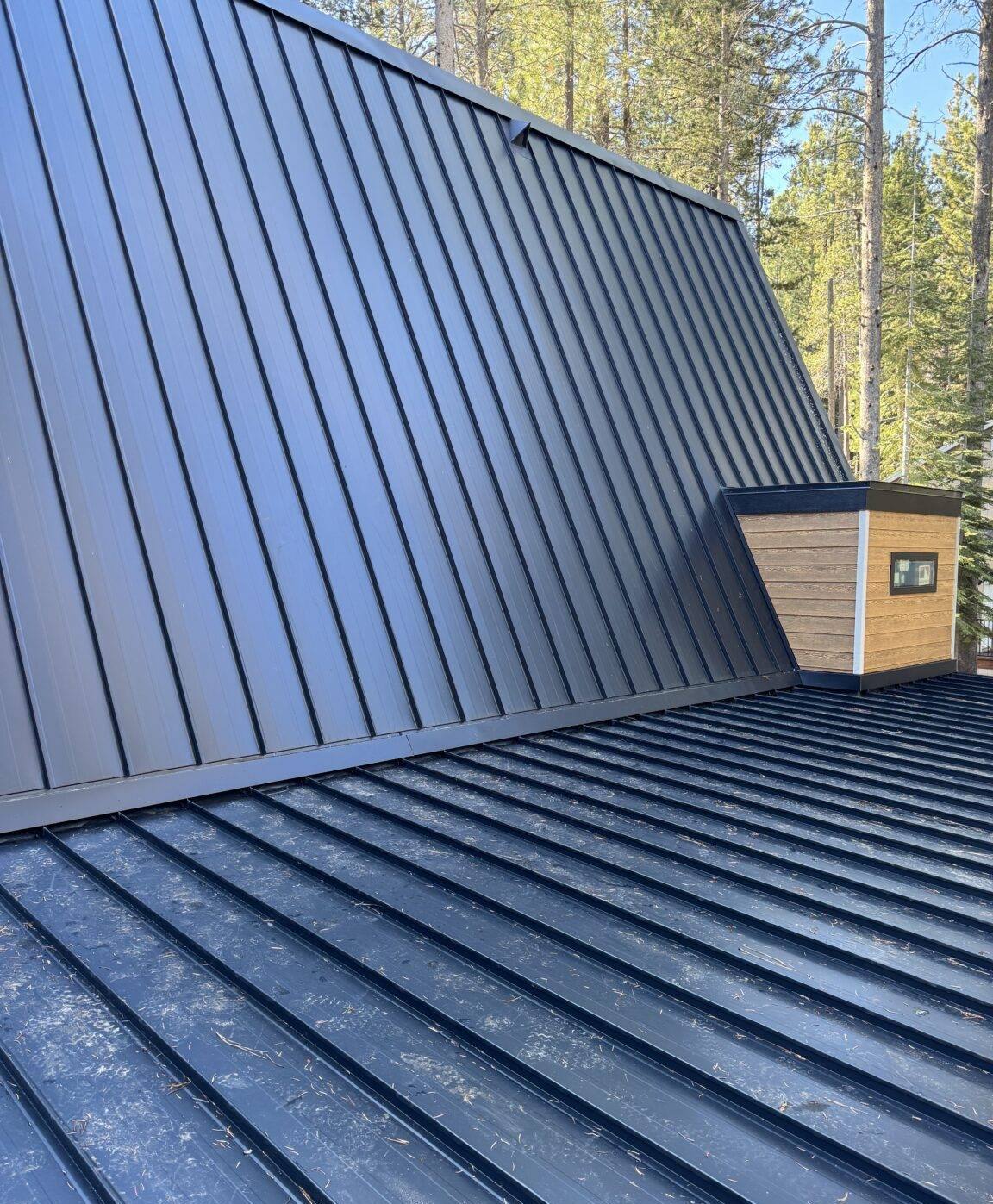
| Standing seam (concealed fastener) | Raised, interlocking seams with no exposed screws — the strongest defense against wind-driven rain and the lowest fastener corrosion risk | Full coastal exposure, ocean-facing roof planes, homes wanting the longest realistic service life |
| Exposed-fastener panel | Screws penetrate the panel face; relies on gasketed washers that need periodic checking | Lower-exposure sections, outbuildings, budget-conscious projects with realistic maintenance expectations |
| Stone-coated steel shingle/tile profile | Interlocking steel panels with a granule coating; sheds water like standing seam but reads as a shingle or tile from the street | Homeowners who want a traditional roofline appearance with metal's durability |
For homes with direct exposure to the water and prevailing wind, we generally steer clients toward standing seam. The concealed-fastener design removes the weakest point in a coastal metal roof — exposed screw penetrations — from the equation entirely.
Roof Slope, Wind Exposure, and Panel Orientation
Beyond panel type, the direction a roof plane faces relative to prevailing wind and water matters more here than it would inland. A roof plane that faces open water and catches the brunt of southwest storms deserves the highest level of detailing — standing seam, upgraded fasteners, a premium coating — even if the rest of the roof could get by with a lighter spec. Low-slope sections drain slower and hold moisture, wind, and salt film longer, which is exactly where moss and coating breakdown show up first. We look at each roof plane individually rather than treating the whole roof as one uniform surface.
Coatings and Fasteners: Where Coastal Roofs Are Won or Lost
Two roofs can use the same panel profile and perform completely differently over twenty years, purely based on coating quality and fastener spec.
Base metal: Aluminum doesn't rust and handles salt exposure better than steel by nature, which makes it a strong option for homes closest to the water. Steel panels can absolutely hold up in Birch Bay too, but they depend entirely on an intact protective coating — any bare steel exposed at a cut edge or scratch becomes a rust starting point.
Finish: A PVDF finish, often sold under names like Kynar 500, holds its color and resists chalking and corrosion far longer than a standard polyester coating, especially in salt air. It costs more up front. On a coastal Birch Bay roof, we consider it worth the difference.
Fasteners: Standard zinc-plated screws corrode faster in salt air than stainless steel or coated fasteners rated for coastal use. On an exposed-fastener system especially, using the wrong fastener is one of the most common reasons a coastal metal roof develops rust streaks years before it should.
What a Correct Installation Actually Involves
Metal roofing is unforgiving of shortcuts in a way asphalt shingles aren't. A poorly flashed valley or under-lapped seam on a shingle roof might weep slowly for years before anyone notices; the same mistake on a metal roof in a wind-driven rain event can let water in fast. A correct Birch Bay installation includes:
- Full synthetic underlayment, with self-adhered ice-and-water membrane at eaves, valleys, and any roof-to-wall transition
- Panel seams and laps oriented and sealed to shed wind-driven rain, not just straight-down rainfall
- Corrosion-rated flashing at every penetration — vents, chimneys, skylights — matched to the panel's metal type to avoid galvanic reaction between dissimilar metals
- Fasteners rated for coastal/marine exposure, torqued correctly so gaskets seal without crushing
- Proper ventilation at the ridge and eaves so moisture from inside the home doesn't condense against the underside of the panels
- Room left for thermal expansion and contraction in panel fastening, especially on longer runs
Skipping any one of these doesn't show up on day one. It shows up in year three or four, as a rust streak, a soft spot in the decking, or a leak that only happens during a hard southwest storm.
Our Process, Start to Finish
- Inspection and assessment. We look at the existing roof deck, current flashing, ventilation, and how exposed the roof is to prevailing wind and salt spray, since a roof facing open water gets specified differently than one tucked behind a windbreak.
- System recommendation. Based on that exposure, we recommend a panel type, metal, and coating — and explain the trade-offs in plain terms, including cost differences between standing seam and exposed-fastener options.
- Deck and structure check. Metal roofing is a long-term investment; it's not worth installing over a compromised deck. We flag any rot or soft sheathing before panels go on, not after.
- Installation. Underlayment, flashing, and panels installed in sequence with attention to every penetration and transition — the details that actually determine how the roof performs in a storm.
- Final walk-through. We go over the finished roof with the homeowner, including what routine maintenance looks like going forward.
What It Costs to Get Right
Metal roofing is a bigger upfront investment than asphalt shingles, and in a place like Birch Bay that investment only pays off if the spec matches the exposure. A standing seam roof with marine-grade fasteners and a premium coating costs more than a basic exposed-fastener panel with standard coatings, but on a home taking the full force of salt air and wind-driven rain, the cheaper spec often ends up costing more over time in repairs and a shortened service life. We'd rather walk a homeowner through those trade-offs honestly up front than sell a spec that won't hold up to the exposure their home actually faces.
Living With a Metal Roof Through Birch Bay's Moss Season
Metal roofing is genuinely low-maintenance compared to asphalt, but "low-maintenance" doesn't mean "no-maintenance," especially this close to the water. A little seasonal attention keeps a metal roof performing the way it's supposed to for its full service life.
- Clear debris — needles, leaves, moss fragments — from valleys and around penetrations each fall, before the wet season sets in
- Rinse accumulated salt residue off the roof surface periodically if the home has direct water exposure
- Check that gutters and downspouts stay clear so water isn't backing up under eave flashing
- Watch shaded, slow-drying sections for early moss or algae growth and address it before it spreads
- After major windstorms, take a quick visual check for lifted flashing or loosened fasteners — it's worth the five minutes
Why Hiring a Crew That Already Works Birch Bay Matters
Metal roofing specs that work fine in a dry inland climate can fall short right on the Birch Bay shoreline, and a crew that mostly works away from the coast may not think to upgrade fastener grade, coating type, or flashing detail for that exposure. We work throughout Whatcom County, including Lynden and coastal communities like Birch Bay, so we spec each roof for the conditions it will actually face — not a generic default. That means knowing which roof planes catch the worst of the wind-driven rain, which sections sit in enough shade to grow moss first, and which fastener and coating upgrades are worth the added cost here versus optional elsewhere.
If you're weighing metal roofing for a Birch Bay home, we're happy to walk the roof, talk through what your specific exposure calls for, and put together a straightforward, no-pressure estimate — no inflated urgency, just a clear look at what the job actually needs. The form below is a good place to start.