 Lynden Siding
 Why Siding Around Wiser Lake Wears Differently
Homes around Wiser Lake sit in a pocket of Whatcom County that holds onto moisture longer than you'd expect. The lake itself keeps humidity elevated at ground level, morning fog lingers under the tree cover that rings much of the shoreline, and the open water and surrounding fields give wind a clear run at exposed walls during winter storms. Add in the marine air that rides inland off the Puget Sound region on a regular basis, and you've got a climate that never really lets siding dry out completely between rain events.
That combination — standing moisture, driving rain, and a long moss season that can stretch from fall through spring — is harder on siding than a straightforward "it rains a lot here" summary suggests. It's not just about how much water hits the wall. It's about how long that water stays in contact with the material, and what's happening behind the surface while it does.
The Lake-Effect Moisture Problem
Properties close to the water or under heavy conifer canopy dry out slower than homes in open, sunny parts of Lynden. North- and east-facing walls in particular can stay damp for days after a storm, which is exactly the environment moss, algae, and mildew need to take hold. On siding that's already got a compromised seam, a cracked board, or failed caulking, that extended dampness turns a small cosmetic issue into a real moisture intrusion problem much faster than it would on a drier lot across town.
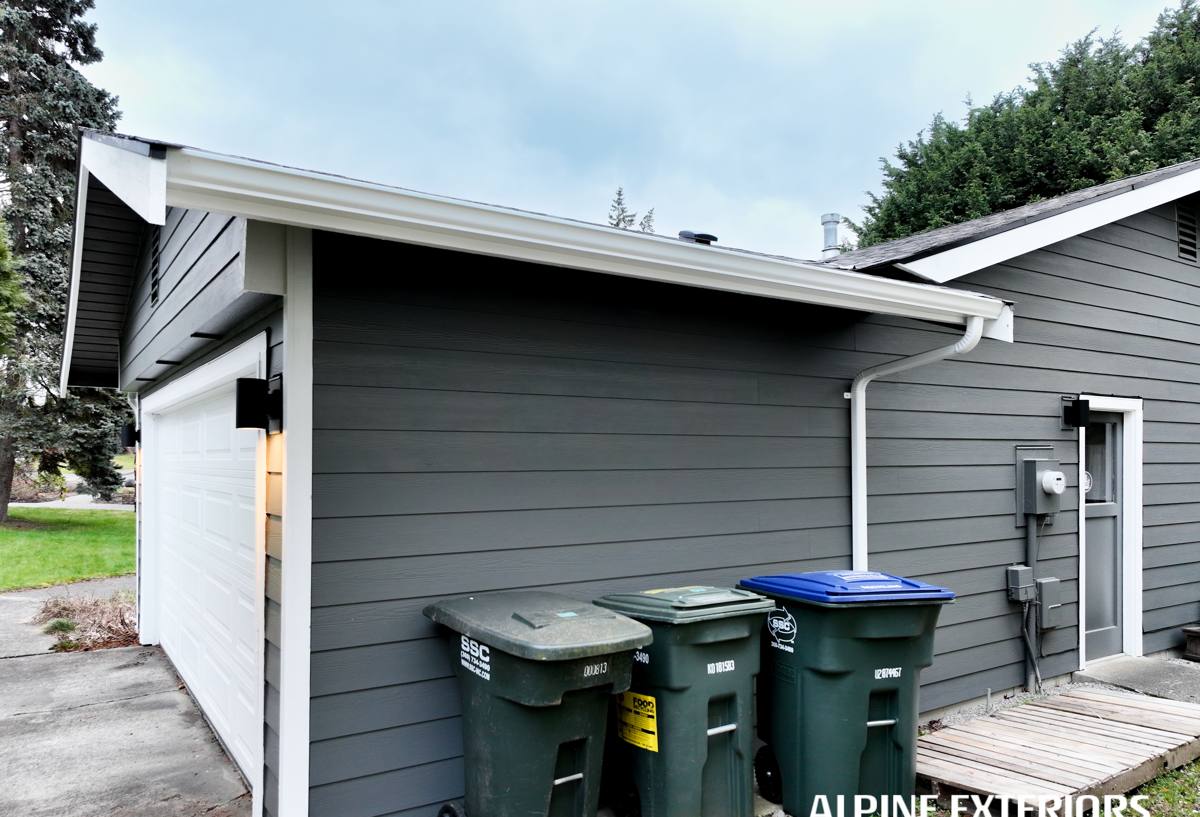
Warning Signs a Repair Is Actually Needed
Not every stain or streak means trouble, but around Wiser Lake we see a consistent set of early indicators that a repair — not just a wash — is overdue.
- Soft or spongy spots when you press on siding near the bottom edge or around windows and doors
- Persistent dark streaking or green growth that comes back within weeks of cleaning
- Visible gaps, cracks, or buckling at panel seams and corner trim
- Peeling or bubbling paint/finish concentrated on one side of the house (usually the shaded or windward side)
- A musty smell near exterior walls inside the home, especially in closets or along baseboards
- Caulking that's dried, cracked, or pulled away from joints and trim
Any one of these on its own might be minor. Two or three together, especially on the shaded or lake-facing side of a house, usually means water has been getting behind the siding for a while.
What a Correct Siding Repair Actually Involves
A lot of "siding repair" in this region amounts to caulking over a crack and calling it done. That approach might hide a problem for a season, but it doesn't fix what's causing it — and around Wiser Lake, where wall assemblies rarely get a real chance to dry out, papering over damage tends to come back worse.
Diagnosing Before Cutting Anything
A correct repair starts with figuring out why the damage happened, not just where it shows. That means checking for failed flashing above windows and doors, gaps in house wrap or building paper, poor drainage at grade level, and vegetation or gutters directing water where it shouldn't go. If the underlying cause isn't addressed, the same board will fail again regardless of what material replaces it.
Repairing to the Framing, Not Just the Surface
When siding has been wet long enough to soften, the damage often extends past the visible board into the sheathing or framing underneath. A repair that only replaces the cosmetic layer without checking what's behind it is a repair that gets redone in a year or two. Correct work means opening up the affected area far enough to find dry, solid material, addressing any rot or moisture barrier failure, and then rebuilding the water management detail — not just the siding — before anything new goes back on.
Matching Material and Finish
On any home with painted or factory-finished siding, matching color and texture on a patch repair is its own challenge. Sun-faded boards next to a fresh patch stand out, and mismatched profiles or reveal widths are obvious from the street. Good repair work accounts for this up front — sourcing matching material where possible, or being upfront with the homeowner about where a seamless match isn't realistic and a small section replacement makes more sense than a patch.
Repairing Different Siding Materials: What's Realistic
What a repair can accomplish depends heavily on what's actually on the wall. We work primarily with James Hardie fiber cement, but Wiser Lake has a mix of siding types on homes of different ages, and it's worth being honest about what each one can and can't take.
| Siding Type | How It Handles This Climate | Repair Reality |
|---|---|---|
| James Hardie fiber cement | Non-combustible, engineered for Pacific Northwest moisture; holds paint and factory finish well | Damaged boards can usually be cut out and replaced individually; ColorPlus finish matching is easiest when the home isn't heavily sun-faded |
| Vinyl | Doesn't rot, but can crack in cold snaps and warp near heat sources; doesn't stop water from reaching sheathing behind it | Individual panels are replaceable if the exact profile is still available; underlying moisture damage is common and often the bigger issue |
| Wood (cedar) and primed spruce/LP-style products | Most vulnerable to the lake's extended damp periods; needs consistent maintenance to resist rot and moss | Repairs are frequent if maintenance has lapsed; often the honest answer is a full section replacement rather than a patch |
When we find failure-prone wood or engineered wood siding during a repair visit, we'll say so plainly. Our company installs only James Hardie fiber cement going forward because it holds up to this exact climate with far less ongoing maintenance — but that's a conversation for when repair no longer makes sense, not a reason to push replacement on a wall that can still be legitimately fixed.
What Drives Repair Cost
There's no honest flat number for siding repair — the range depends on a handful of factors that are worth understanding before you get a quote.
| Factor | Why It Matters |
|---|---|
| Extent of hidden damage | What's behind the siding often determines the real scope — sheathing or framing repair adds time and material beyond the visible boards |
| Siding material and age | Discontinued colors or profiles may require a larger replacement area to keep the repair from standing out |
| Access and height | Second-story work, steep grades near the lake, or areas requiring staging take longer than ground-level repairs |
| Root cause work | Fixing flashing, drainage, or moisture barrier issues alongside the siding itself adds labor but prevents a repeat repair |
Our Repair Process for Wiser Lake Homes
- Inspection and moisture check — we look beyond the visible damage, checking moisture levels in adjacent boards and sheathing where accessible.
- Root cause identification — flashing, caulking, drainage, and vegetation contact are all checked, since these are the usual culprits in this area.
- Honest scope discussion — we tell you what's a straightforward patch, what needs a wider section replaced, and what's better addressed now than in two years.
- Repair to code, not just to look — proper flashing, house wrap integrity, and fastening practices go back in before new siding does.
- Finish and cleanup — matched material, sealed joints, and a final check for any other early-warning spots on the same wall.
Why a Crew That Already Works Wiser Lake Matters
Siding repair isn't a one-size-fits-all trade, and a crew that mostly works drier, more open parts of Whatcom County can miss things that are obvious to someone who's worked lake-adjacent properties regularly. Knowing which walls are shaded long enough to hold moss growth, recognizing when moisture behind a board is a lake-humidity issue versus a flashing failure, and understanding how much drying time a wall realistically gets between storms all shape how a repair should be done — not just where.
There's also a practical side: a crew familiar with the area knows what era of home construction is common around the lake, what siding materials and details tend to show up, and what's likely to be found once a wall is opened. That familiarity means fewer surprises, fewer change orders, and a repair that accounts for the site instead of treating every job the same.
When Repair Isn't Enough
Sometimes a service call turns up damage extensive enough — or frequent enough — that continuing to patch the same wall stops making financial sense. If multiple boards on a shaded or lake-facing elevation have failed, or if the underlying material simply can't handle sustained moisture no matter how well it's maintained, replacing that section (or the whole elevation) with James Hardie fiber cement is usually the more durable long-term answer. We'll only recommend that when the numbers and the condition of the wall actually support it — not as an upsell on a routine repair.
If you're seeing signs of trouble on your Wiser Lake home, or just want a second opinion on whether a spot needs attention now or can wait, we're happy to take a look. Fill out the form below for a free, no-pressure estimate.