 Lynden Siding
 Roofing a Home Near Birch Bay Is a Different Job Than Roofing One Inland
A new roof in Birch Bay has to deal with conditions that a roof twenty minutes inland never sees in the same combination. You've got salt-laden air coming off the water, wind-driven rain that doesn't just fall straight down but gets pushed sideways into eaves and wall-roof intersections, and long stretches of shade and dampness that keep moss and moisture active for most of the year. None of that means a Birch Bay roof needs to be exotic or overbuilt — it means the ordinary parts of the job (flashing, fasteners, ventilation, underlayment) have to be done right the first time, because this climate finds every shortcut eventually.
This page covers what we look at specifically for new roof installations in the Birch Bay area, what a correct job actually involves, and what to ask before you hire anyone to do it.
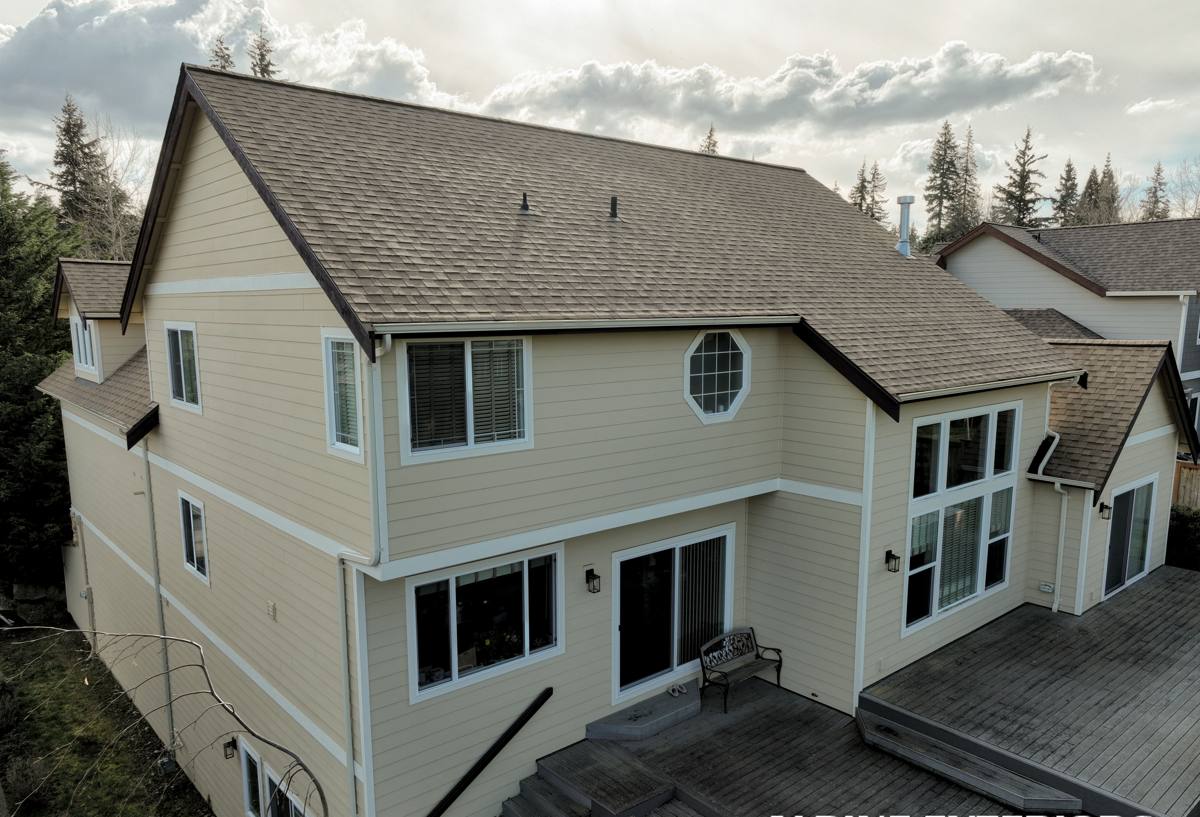
What Coastal Whatcom County Conditions Do to a Roof
Salt Air and Corrosion
Airborne salt from the bay accelerates corrosion on anything metal — nail heads, flashing, gutter fasteners, roof vents, even the metal straps and clips hidden under the shingles. On a roof that's twenty miles inland, a standard fastener might last the life of the roof without issue. Near the water, the same fastener can start showing rust streaks or weakening well before the shingles themselves wear out. This is one of the most common causes of premature leaks we see in waterfront and near-waterfront homes: it's rarely the shingle that fails first, it's the metal underneath or around it.
Driving Rain
Rain that comes in at an angle behaves differently than straight-down rain. It gets pushed up under shingle edges, into valleys, and around penetrations like plumbing vents and chimneys. A roof system that relies on gravity alone to shed water — rather than proper underlayment, sealed laps, and correctly integrated flashing — is more likely to develop hidden leaks in a home exposed to wind off the bay than in a more sheltered inland location.
A Long Moss Season
Cool, damp, and often shaded conditions in this part of Whatcom County give moss a long window to establish itself — sometimes nearly year-round on north-facing slopes or roofs under tree cover. Moss isn't just cosmetic. It holds moisture against the roofing material, lifts shingle edges as it grows, and can work its way under caps and flashing over time. A new roof installed without moss-resistant details or adequate airflow is fighting this from day one.
Signs a Repair Won't Cut It Anymore
Not every roof problem means a full replacement, but in this climate certain signs point that direction reliably:
- Granule loss heavy enough that you can see bare shingle mat, especially on south- and west-facing slopes exposed to weather off the water
- Soft spots in the decking when walked, which usually means water has been getting under the roofing for a while
- Rusted or deteriorating flashing around chimneys, skylights, and roof-wall intersections
- Curling, cracking, or cupping shingles across large sections rather than a single isolated area
- Repeated moss removal that keeps coming back within a season or two, suggesting the underlying moisture problem hasn't been solved
- Interior staining on ceilings or in the attic that shows up after wind-driven storms specifically
If you're only seeing one or two of these in a small area, a repair may still make sense. If several are showing up together, or the roof is already past its expected service life, a new installation is usually the more honest recommendation — and often the more economical one once you account for repeated patch work.
Choosing the Right Roofing System for a Birch Bay Home
There's no single "best" roofing material for every home — it depends on your roof's exposure, your budget, and how much long-term maintenance you want to take on. Here's how the common options actually compare for a coastal Whatcom County property:
| Material | Salt Air / Corrosion Behavior | Moss & Moisture Resistance | Wind Performance | Typical Maintenance |
|---|---|---|---|---|
| Architectural asphalt shingle | Good, when paired with corrosion-resistant fasteners and flashing | Moderate — benefits from added ventilation and periodic cleaning | Good with proper nailing pattern and sealing | Low to moderate |
| Standing seam metal | Very good with the right coating and fastener spec | Very good — moss struggles to grip smooth metal panels | Very good | Low |
| Synthetic/composite shingle | Good — resists corrosion since the material itself doesn't rust | Good, varies by product | Good | Low to moderate |
For most Birch Bay homes, a quality architectural asphalt shingle with corrosion-resistant hardware remains the most cost-effective choice. Metal roofing costs more up front but can make sense on homes with heavy wind or salt exposure, steep pitches, or owners who want the lowest possible long-term maintenance. We'll walk through the actual trade-offs for your specific roof rather than push one system as a default.
What a Correct New Roof Installation Actually Involves
Tear-Off and Deck Inspection
We remove the old roofing down to the deck rather than layering over it. This lets us inspect the sheathing for rot, soft spots, or old water damage that's invisible from above — issues that are common on homes that have had slow, hidden leaks around flashing or valleys for years. Any damaged decking gets replaced before anything new goes down; installing a new roof over a compromised deck just hides the problem instead of fixing it.
Underlayment and Water-Resistant Barrier
Given how much wind-driven rain this area gets, we pay close attention to underlayment coverage — full synthetic underlayment across the field, with self-adhering ice-and-water barrier at vulnerable spots like eaves, valleys, and around penetrations. This is the layer that protects the deck if wind ever pushes water past the shingles themselves.
Flashing Details
Flashing around chimneys, skylights, sidewalls, and roof valleys is where most leaks actually start, not in the open field of the roof. We use corrosion-resistant flashing material and integrate it properly with the underlayment — meaning water is always directed onto the next layer down, never into a seam. Given the salt air here, we don't cut corners on flashing material grade.
Fasteners and Hardware
Every nail, screw, and clip on a coastal-exposed roof matters more than it would inland. We use fasteners rated for corrosion resistance appropriate to the material and exposure level, because a roof is only as durable as its weakest hardware.
Ventilation
Proper intake and exhaust ventilation keeps the underside of the roof deck dry and reduces the conditions moss and mildew need to thrive. It also extends shingle life by keeping attic heat and moisture from cooking the roofing material from below. On a lot of older Birch Bay-area homes, ventilation was undersized or blocked over the years — a new roof installation is the right time to correct that.
Wind and Storm Considerations Specific to This Area
Homes with direct or near-direct exposure to the water see stronger, more consistent wind loading than the same style of home set back among trees inland. That affects a few practical details of the installation: nailing patterns and fastener counts should match the manufacturer's high-wind specification rather than the minimum standard pattern, starter strips and ridge caps need to be properly sealed rather than just tacked down, and edge metal needs to be secured well enough to resist uplift. These aren't upgrades — they're what a correct installation looks like for a roof in this kind of exposure, and they cost little extra when planned from the start rather than added after storm damage.
Our Installation Process
- On-site assessment — we look at the existing roof, decking condition, ventilation, and any problem areas specific to your home's exposure and layout.
- Written estimate — covering material options, scope of work, and a clear price, so there are no surprises once work starts.
- Permitting — we handle the required permit through the appropriate local authority before work begins.
- Tear-off and deck repair — old roofing removed, deck inspected, any damaged sheathing replaced.
- Underlayment, flashing, and ventilation install — the parts of the job that determine whether the roof actually performs in this climate, not just how it looks.
- Roofing material installation — installed to manufacturer spec and adjusted for wind exposure where relevant.
- Final walkthrough — we go over the completed roof with you, including care and maintenance specific to your material choice.
What to Check Before Hiring a Roofing Crew in the Birch Bay Area
Roofing has a low barrier to entry, and coastal properties in particular attract crews who don't have real experience with salt-air and wind-driven-rain conditions. Before hiring anyone for a new roof installation, it's worth confirming:
- Current Washington State contractor license and active liability insurance, verifiable independently rather than just taken on their word
- Manufacturer training or certification for the specific roofing product being installed
- A written warranty that covers both materials and workmanship, with the terms spelled out rather than implied
- Familiarity with local permitting requirements for the jurisdiction your home falls under
- A willingness to explain flashing, ventilation, and fastener choices specific to your home rather than a one-size-fits-all pitch
- References or completed work you can actually see, not just photos
A crew that already works regularly in and around Birch Bay will generally know these details without being prompted — because they've already seen what happens to roofs that skip them.
Cost Factors for a New Roof Installation
Every roof is priced individually, but the factors that move the number up or down are consistent. Broadly, a full asphalt shingle roof replacement on an average single-family home in this region runs from the mid-single-digit thousands into the low double-digit thousands, with metal roofing typically landing higher; the table below breaks down why.
| Factor | Why It Matters |
|---|---|
| Roof size and pitch | More square footage and steeper pitches mean more material and labor time, plus additional safety measures on steep sections |
| Number of existing layers | Tearing off multiple old layers takes longer and generates more disposal cost than a single-layer tear-off |
| Decking condition | Rotted or soft sheathing found during tear-off needs to be replaced before new roofing goes on |
| Material choice | Asphalt, synthetic, and metal roofing carry different material and installation costs |
| Roof complexity | Valleys, dormers, skylights, and chimneys all add flashing work and labor time |
| Ventilation upgrades | Adding or correcting intake/exhaust ventilation adds some cost but reduces long-term moisture and moss issues |
| Access and staging | Steep lots, limited driveway access, or difficult material staging can add labor time |
Maintaining a New Roof in a Salt Air, High-Moss Climate
A properly installed new roof still benefits from some basic upkeep in this environment. Keeping gutters clear so water isn't backing up under the eaves, trimming back overhanging branches that keep sections of the roof shaded and damp, and having moss growth addressed early rather than left to spread are the main things that extend a roof's service life here. None of this is difficult, but it does matter more on a coastal or near-coastal property than it would further inland — the climate that made a correct installation important in the first place is the same climate that rewards a little ongoing attention.
If you're weighing a repair against a full new roof for a home in the Birch Bay area, or you just want a straight answer on what your roof actually needs, we're glad to take a look. The estimate is free, there's no pressure, and you'll get a clear explanation of what we find and why — just fill out the form below.