 Lynden Siding
 Siding Repair in Maple Falls: A Different Job Than a Full Re-Side
Siding repair is its own trade, not a smaller version of a full re-side. It asks a crew to diagnose a problem correctly, match an existing product without leaving an obvious patch, and know when a section can genuinely be fixed versus when a repair is just delaying a bigger job. We get calls from Maple Falls homeowners at every stage of that spectrum — a single cracked board after a wind event, a stretch of siding that's stayed damp and soft for a season, or trim that's pulling away at a corner. Each one needs an honest look before we recommend anything.
Maple Falls sits up the Nooksack River valley toward Mount Baker, well inland from the water, but Whatcom County's marine weather pattern still reaches this far up the valley. Driving rain moves through on the same storm systems that hit the rest of the county, and the heavy tree cover common on foothill and wooded lots here keeps shaded walls damp longer than they'd stay in open, sunny exposure. That combination — rain, shade, and a long moss season — is the backdrop for almost every repair call we take in this area.
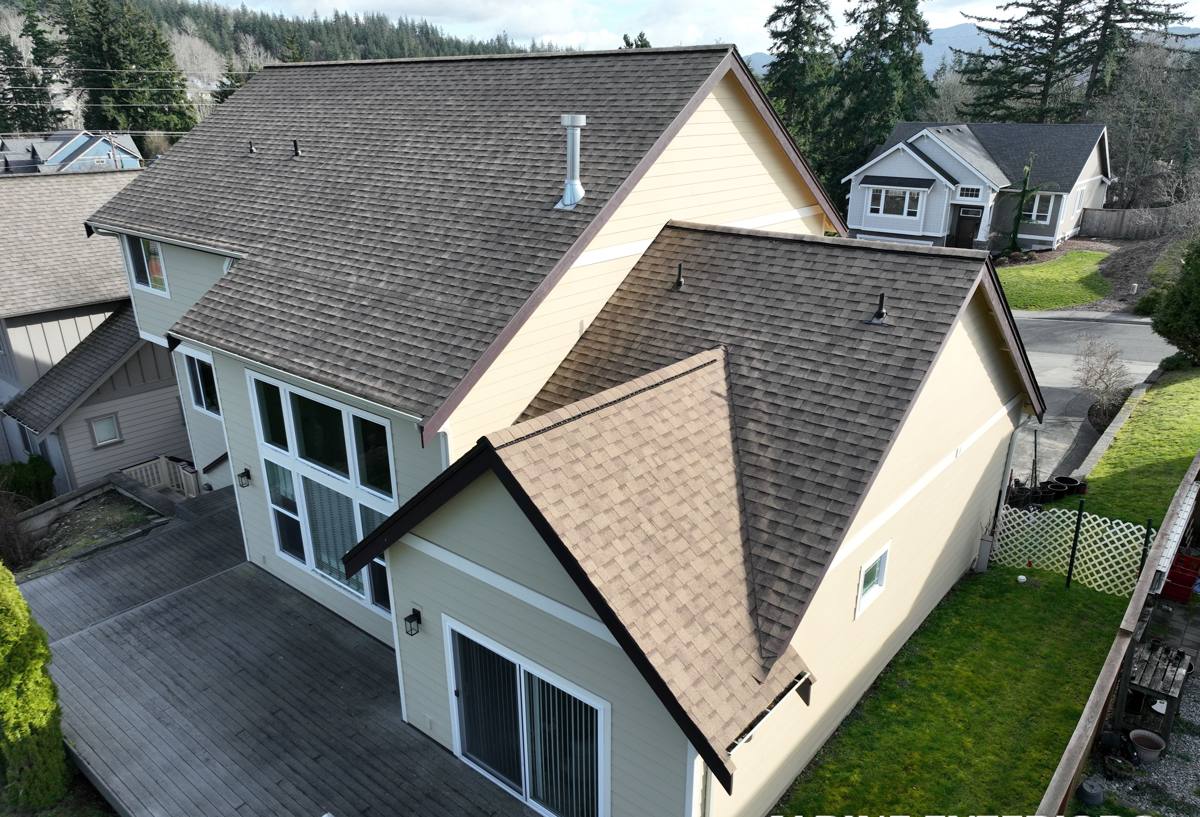
What Local Conditions Actually Do to Siding Here
Driving Rain and Wind-Driven Storms
Rain that comes in sideways rather than straight down finds its way into laps, seams, and trim joints that were only ever designed to shed water moving downward. Over years, that steady pressure is what turns a small gap in caulking or flashing into an actual point of moisture entry, usually well before it's visible from the ground.
Heavy Tree Cover and a Long Moss Season
Wooded and tree-lined properties are common around Maple Falls, and shade is good for a lot of things but not for siding. Walls that stay damp under tree cover support moss and mildew growth across most of the year, and organic growth on a siding surface holds moisture against the wall behind it far longer than an exposed, sun-drying wall would ever sit wet.
Freeze-Thaw Cycling at Elevation
Sitting higher in the foothills toward Mount Baker means Maple Falls sees more freeze-thaw cycling through the winter than lower-elevation, coastal parts of the county. Water that's worked its way into a crack, a fastener hole, or a compromised joint can expand when it freezes, which is exactly the kind of slow, repeating stress that turns a hairline problem into a real one over a few winters.
Repair or Replace? How We Actually Make That Call
Not every damaged section needs to come off the wall, and not every repair is worth doing instead of planning for a fuller replacement. We walk through a few honest questions on every repair estimate before recommending either path.
| Factor | Points Toward Repair | Points Toward Replacement |
|---|---|---|
| Extent of damage | Isolated to one or two boards, panels, or trim pieces | Spread across multiple walls or courses |
| Cause | Impact damage, a failed caulk joint, a single missed flashing detail | Widespread moisture intrusion behind the siding |
| Age and condition of the rest of the siding | Siding is otherwise sound and within its expected service life | Siding is near the end of its life or already showing wear elsewhere |
| Sheathing condition underneath | Substrate is dry and intact once opened up | Sheathing is soft, discolored, or shows rot |
| Material match | Existing product and finish can be closely matched | Product is discontinued or too weathered to match convincingly |
The one step we won't skip is opening the area up to actually look, rather than estimating from the surface. A cracked board is straightforward. A soft spot near a window is not something we'll bid sight-unseen, because what's happening behind the siding determines the entire scope of the repair.
Common Repair Triggers We See on Foothill and Wooded Properties
- Impact damage from falling branches or storm debris, common on tree-covered lots
- Cracked or split boards from age, freeze-thaw stress, or a hard impact
- Caulk and sealant that's shrunk, cracked, or pulled away at trim, corners, and window and door edges
- Soft or discolored siding near ground contact, decks, or roof-to-wall intersections where water tends to collect
- Moss or mildew buildup on shaded, north-facing, or tree-covered walls that's held moisture against the surface for an extended stretch
- Corroded or backed-out fasteners that have lost their holding strength
- Gaps or separation at seams and corners where flashing or trim has moved over time
Most of these show up gradually. A homeowner usually notices one visible symptom — a stain, a soft spot, a piece of trim that looks off — without realizing it's often the most visible sign of something that's been developing for a while.
What a Correct Siding Repair Actually Involves
A repair that just covers up the visible symptom without addressing what caused it tends to fail again, often faster than the original problem took to develop. A repair worth doing includes a few things every time:
- Removing enough surrounding material to see the actual extent of the damage, not just the piece that looks bad
- Checking the water-resistive barrier and sheathing underneath for moisture or soft spots before closing anything back up
- Replacing damaged fasteners and re-securing surrounding boards that may have loosened
- Correcting the flashing or caulking detail that let water in, not just replacing the board it damaged
- Matching replacement material to the existing siding's profile, exposure, and finish as closely as possible
- Resealing and re-finishing cut edges to manufacturer spec so the repaired section performs like the rest of the wall
Skipping that last step — sealing cut edges properly — is one of the most common shortcuts we see on repair work done elsewhere, and it's often why a "repaired" section fails again within a year or two.
Why We Only Repair With James Hardie-Matched Materials
We install James Hardie fiber cement exclusively, and that standard carries over to repair work. We won't patch a Hardie wall with a mismatched product, cover a moisture problem with caulk instead of addressing the source, or use a repair as a shortcut around a fix that actually needs more scope. If your home already has Hardie siding, matching the existing profile and ColorPlus finish as closely as possible keeps the repair from standing out and keeps the wall performing as one consistent system rather than a patchwork of materials with different moisture behavior.
If your current siding is a different product — vinyl, engineered wood, cedar, or another fiber cement brand — we'll still assess and repair it honestly, but we'll also give you a straight read on how much longer that material is likely to hold up given what we see, and what replacing the damaged section with Hardie would look like if you're weighing a longer-term fix instead of a repeat repair down the road.
Our Process for a Maple Falls Repair Call
Repair calls move differently than a full siding estimate, and we keep the process straightforward:
- Walk the property. We look at the damage you called about and check nearby areas that take similar exposure, since related problems often show up close together.
- Open up what needs opening. If there's any sign the damage goes past the surface, we'll take a section apart to actually see the sheathing and barrier underneath before quoting anything.
- Give you a straight scope and price. You'll know whether it's a contained repair or something that points toward a larger project, and why, before any work starts.
- Complete the repair to spec. Matched material, correct fasteners, corrected flashing or sealant detail, and properly finished cut edges.
- Leave the site clean and walk you through what was found and what was done, so you're not left guessing what's behind the new section.
Signs Your Maple Falls Home May Need Siding Repair
- A cracked, split, or visibly damaged board or panel
- Soft spots or slight give when you press near a window, door, or corner trim
- Persistent moss or dark staining on shaded or tree-covered walls
- Caulk that's cracked, shrunk, or missing at trim lines and penetrations
- Rust streaks below fasteners or visible corroded hardware
- A section of siding that looks or feels different from the wall around it
- Musty smells or discoloration on an interior wall near an exterior trouble spot
Any one of these is worth a look. None of them automatically means a full re-side, and part of an honest repair estimate is telling you clearly when it doesn't.
Why a Crew That Already Works Maple Falls Matters for Repair Work
Repair work rewards local familiarity in ways a full installation sometimes doesn't. Knowing how a specific product has weathered on wooded, foothill lots after a few years — how the finish ages under heavy shade, which wall orientations take the worst of the driving rain, where moss tends to establish first — shapes how we diagnose and match a repair the moment we're on site. A crew that hasn't worked properties like these before is starting that assessment from scratch on your dime.
It also matters after the work is done. A repair is only as good as the diagnosis behind it, and if a similar issue shows up again in a different spot, you want a contractor who's still around, still working in the area, and willing to look at it rather than a name from an old invoice. That kind of accountability is part of what a genuine local presence in this community is supposed to mean.
If you've got a section of damaged, aging, or suspicious-looking siding on your Maple Falls home, we're glad to come take an honest look and tell you exactly what we find. Reach out using the form below to schedule a free, no-pressure estimate.