 Lynden Siding
 Why Ferndale Windows Wear Out Faster Than the Warranty Card Suggests
Ferndale sits close enough to the water that salt-laden air is a real factor in how fast window hardware and finishes break down. Combine that with driving rain off the Salish Sea and a moss season that can stretch from fall through spring, and you have a climate that's genuinely tougher on window assemblies than the sales literature accounts for. None of this is dramatic on its own — it's the slow, cumulative kind of wear that shows up as a window that's suddenly hard to latch, a sill that stays damp two days after the rain stops, or a frame corner that's gone soft.
We've worked on enough homes around Ferndale and the rest of Whatcom County to know the failure patterns are consistent: corroded hardware on the weather side of the house, seal failure in older double-panes that lets moisture fog the glass, and rot starting at the bottom corners of frames where water sits longest. Understanding those patterns is what separates a window replacement that lasts twenty-plus years from one that starts having problems in five.
Salt Air and Metal Hardware Don't Mix Long-Term
Cranks, locks, and hinges on older windows are often steel or lower-grade aluminum. In a coastal-influenced climate like Ferndale's, that hardware pits and corrodes years before it would inland. Once hardware seizes or the latch won't seat, the window stops sealing tightly — which means air and moisture get in even if the glass itself is fine.
Driving Rain Exposes Weak Flashing Fast
Wind-driven rain off the water doesn't just fall on a window — it gets pushed sideways and up under trim and flashing that would be fine in a calmer climate. If a window wasn't flashed correctly when it was installed, driving rain will find that gap. It might take a few years, but it will find it.
Moss Season Means Longer Wet Periods
The stretch of the year when everything stays damp — the same conditions that grow moss on a roof — also keeps window sills, sashes, and the wood or composite trim around them wet for longer. Wood that never fully dries out is wood that eventually rots, and that's especially true at the bottom of a window frame where water naturally collects.
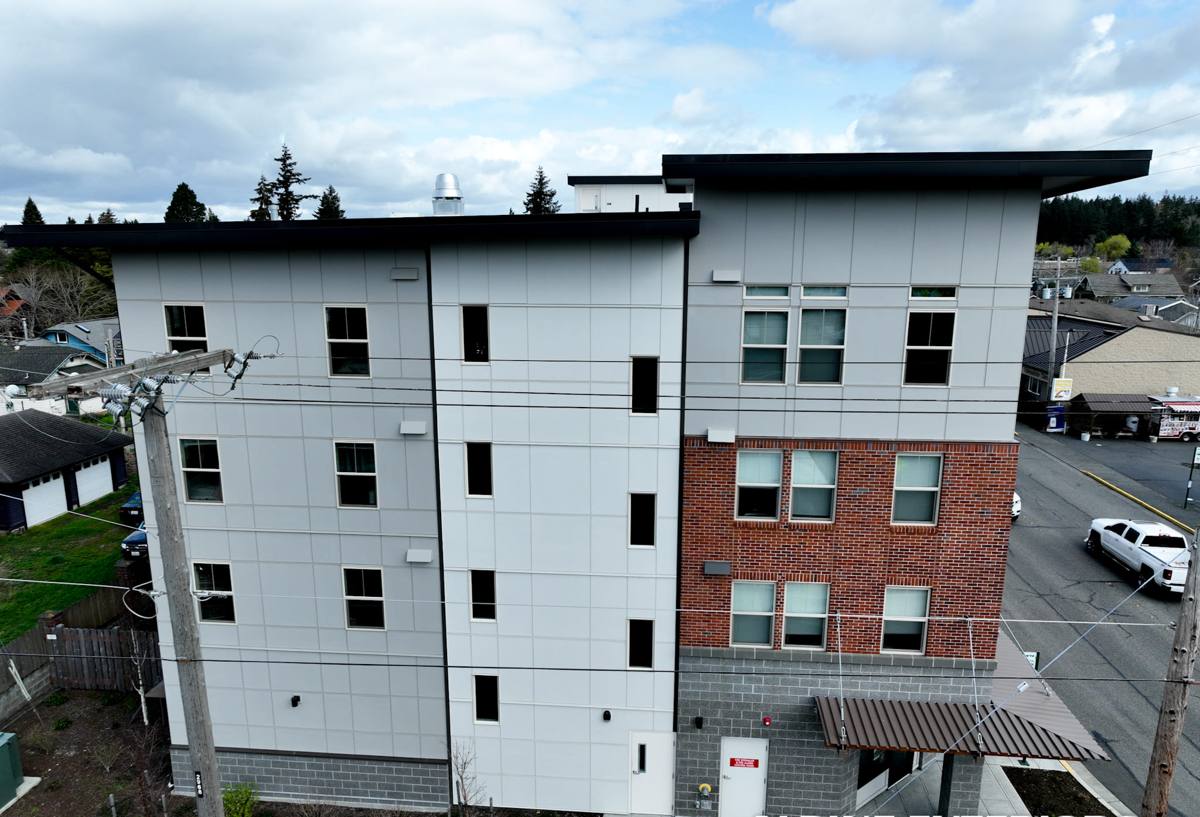
What a Correct Window Installation Actually Involves
A window replacement looks simple from the outside — old window out, new window in — but the parts that determine whether it holds up in this climate happen where you can't see them once the trim goes back on.
- Careful removal that doesn't tear the surrounding siding or weather-resistive barrier, since that barrier is your home's real defense against driving rain.
- Sill pan flashing installed so any water that does get past the window sheds outward, not into the wall framing.
- Proper integration with the water-resistive barrier, shingled correctly (upper layers overlapping lower ones) so water always drains down and out.
- Shimming and leveling so the sash operates smoothly and the seal compresses evenly all the way around — an out-of-square window will fail its seal at the corners first.
- Backer rod and sealant at the exterior joint, sized and applied correctly rather than just caulked over gaps.
- Insulation in the gap between the window frame and the rough opening, without overstuffing it in a way that bows the frame.
Skip any one of these steps and the window can still look fine for a couple of years. The problems that show up later — soft framing, interior staining, drafts you can feel with your hand — almost always trace back to something in this list that was rushed or skipped.
Choosing Frame Material for a Coastal-Influenced Climate
There's no single "best" window material for every home — it depends on your budget, the age and style of the house, and how much upkeep you want to take on. But some materials handle salt air, moisture, and long wet stretches better than others, and that's worth weighing seriously in this part of Whatcom County.
| Frame Material | Salt Air / Corrosion Resistance | Moisture Tolerance | Maintenance |
|---|---|---|---|
| Vinyl | Good — won't corrode | Good, doesn't rot | Low; occasional cleaning |
| Fiberglass | Very good — dimensionally stable | Very good | Low |
| Aluminum-clad wood | Good on the exterior face; hardware still needs quality components | Good if flashed correctly; wood core depends on seal integrity | Moderate |
| Bare wood | Poor without diligent upkeep | Requires regular repainting/sealing to avoid rot | High |
| Aluminum (non-clad) | Poor — prone to pitting and corrosion near salt air | Prone to condensation without thermal breaks | Moderate |
For most Ferndale homes, we steer people toward vinyl or fiberglass for straightforward replacements, and quality aluminum-clad wood when the homeowner wants a real wood interior and is comfortable with the added upkeep. We don't recommend bare aluminum frames or unclad wood on the weather-exposed sides of a house here — not because the material is bad everywhere, but because this specific combination of salt air and sustained moisture asks more of a frame than those materials are built to give without constant maintenance.
Glass Packages: What Actually Matters in This Climate
Western Washington's marine climate is milder than most of the country, but it's also wetter and greyer for longer stretches. That changes which glass specs are worth paying for.
- U-factor (how well the window resists heat loss) matters more here than solar heat gain — you're trying to keep the heat you have inside during long damp winters, not block intense summer sun.
- Low-E coatings help retain interior heat and reduce condensation on the glass, which is a bigger day-to-day comfort issue here than in drier climates.
- Argon or krypton gas fill between panes adds meaningful insulation value for a modest cost increase, and holds up well over time in a stable coastal temperature range.
- Warm-edge spacers reduce the cold ring of condensation you sometimes see at the edge of older double-panes during cold, damp mornings.
Triple-pane glass is worth discussing for north-facing rooms or homes right along the water where wind exposure is highest, but for most Ferndale homes a well-built double-pane unit with a good Low-E coating and gas fill hits the right balance of performance and cost.
Our Process for a Ferndale Window Replacement
We keep the process straightforward because window replacement doesn't need to be complicated when it's done right the first time.
- On-site assessment — we look at existing frame condition, flashing, and any rot or moisture damage before quoting anything, since that affects both scope and price.
- Product selection — we walk through frame material and glass options based on your budget, the window's exposure (weather side vs. sheltered side), and how the house is used.
- Precise measurement — every rough opening is measured individually; older Whatcom County homes are rarely perfectly square, and assuming otherwise causes fit and seal problems later.
- Removal and prep — careful teardown, inspection of the framing and sheathing underneath, and repair of any hidden rot before a new window ever goes in.
- Installation with full flashing detail — sill pan, water-resistive barrier integration, shimming, insulation, and sealant, done to the standard described above, not shortcuts.
- Interior and exterior trim, cleanup, and walkthrough — we test operation on every window and walk you through anything you should know about care going forward.
Signs Your Windows Are Due for Replacement
Not every window problem means full replacement — sometimes it's a hardware fix or a re-seal. But these are the signs worth having a professional look at before they turn into a bigger repair:
- Fog or moisture trapped between panes of glass (a failed seal that can't be fixed, only replaced)
- Visible gaps, drafts, or a noticeable temperature difference near the window in winter
- Wood trim or sill that feels soft, spongy, or discolored
- Windows that are difficult to open, close, or lock — often a sign of hardware corrosion or a frame that's shifted
- Paint or finish that's peeling or bubbling specifically around the window, which usually points to trapped moisture
- Visible mold or persistent condensation on interior trim, especially during the wetter months
- Noticeable noise transfer that seems worse than it used to be, suggesting the seal has degraded
Why It Matters to Hire a Crew That Already Works in Ferndale
Window replacement done by someone unfamiliar with this specific coastal-influenced stretch of Whatcom County tends to under-build for the conditions — using standard sealant schedules, standard flashing details, or hardware that's rated for a drier, calmer climate than Ferndale actually has. A crew that works this area regularly already knows which sides of a house take the worst of the driving rain, how long moss season actually keeps things wet, and where salt air causes the earliest hardware failures.
There's also a practical coordination benefit: window replacement and siding work touch the same flashing and water-management details. Our crews are based in Lynden and work throughout Whatcom County, including Ferndale, so if your windows and siding both need attention, we can plan the work together rather than having two separate contractors each assume the other handled the flashing transition between window and wall.
Get a Straightforward Estimate
If your windows are drafty, foggy, hard to operate, or just old enough that you're wondering whether repair still makes sense, we're happy to take a look. There's no pressure and no obligation — just a straight assessment of what your Ferndale home actually needs, using the form below to get started.