 Lynden Siding
 Why Board & Batten Behaves Differently in Ferndale's Climate
Board and batten is a vertical siding style — wide flat panels with narrow battens covering each seam — and that vertical orientation changes how water moves across a wall compared to standard horizontal lap siding. Water doesn't shed sideways off overlapping courses; it runs straight down the face of the panel and has to get past, or around, every batten joint on the way. In most of the country that's a minor detail. In Ferndale, a few miles inland from the Salish Sea coastline in Whatcom County, it's a design decision that either holds up for decades or creates problems in five to ten years.
Three things stack up against siding here: salt-carrying air off the nearby water that accelerates corrosion on anything metal, driving rain that comes in sideways during fall and winter storms rather than falling straight down, and a long stretch of the year — roughly October through May — when shaded, north-facing, and low-airflow wall sections simply don't dry out between rain events. That last one is what drives moss and algae growth. Board and batten siding, done wrong, gives all three of those forces extra places to work: vertical seams that catch wind-driven rain, batten fasteners exposed to salt air, and flat batten tops that hold moisture longer than a sloped lap course would.
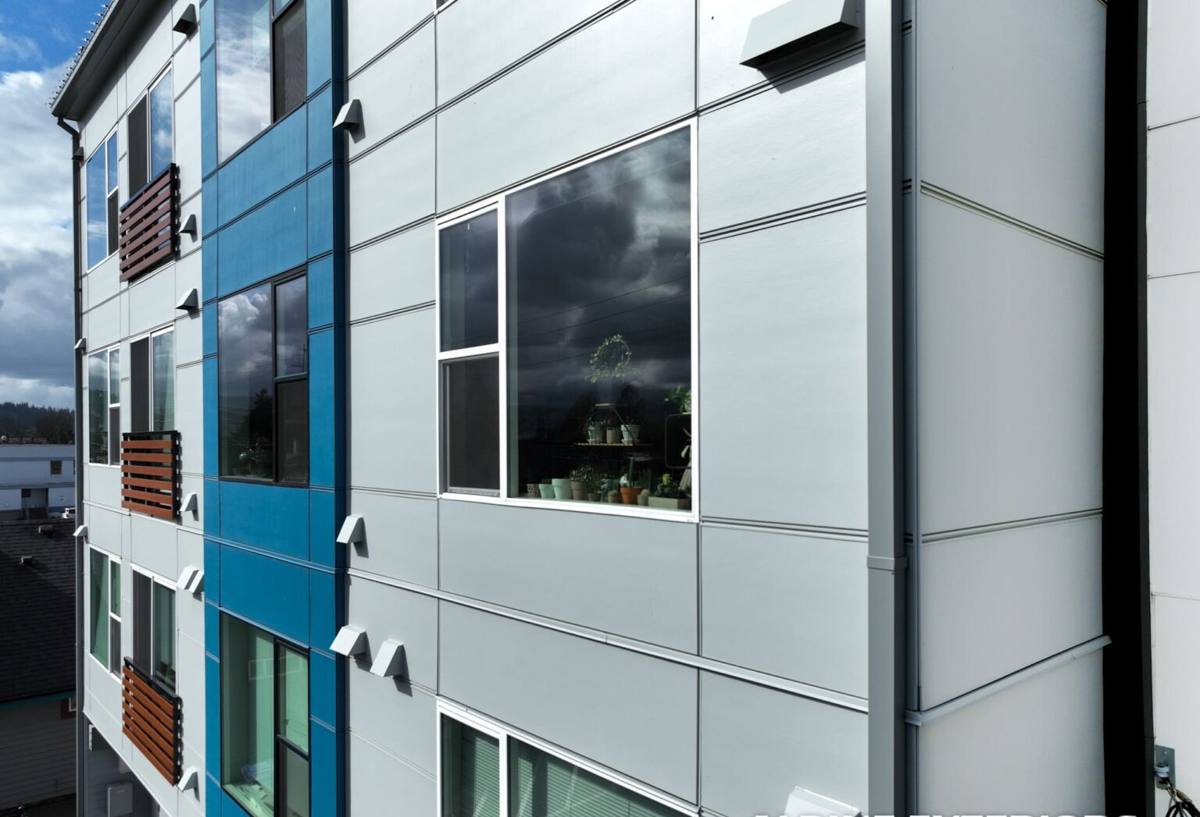
What Salt Air, Driving Rain, and Moss Season Actually Do Over Time
None of this shows up in year one. It shows up in year six or seven, and by then it's a repair job instead of a maintenance item. The pattern we see on board and batten walls in this area is consistent:
- Fastener heads at batten strips start to bleed rust through the paint film, usually before anything else fails
- Battens loosen as the fasteners holding them corrode or back out from repeated wet-dry cycling
- Moss and dark algae streaking take hold first at the base of walls, under eaves with poor overhang, and on north or west-facing elevations that stay shaded
- Field-applied paint at seams and cut ends chalks and thins faster than factory finish on the flat panel field
- Water that gets behind a seam with no drainage path stays there, which is where rot or panel swelling actually starts — not at the visible surface
The homes that avoid this aren't lucky. They were built with material and fastening choices that anticipated exactly this climate.
What a Correctly Installed Board & Batten Job Involves
Panel Layout and Batten Spacing
Batten spacing is partly aesthetic and partly structural — wider spacing means more unsupported panel between fastening points and more surface exposed to wind-driven rain per seam. Layout also has to account for window and door openings so battens land in a sensible, intentional pattern rather than being cut to fit awkwardly at the last stud bay. This is a step that's easy to rush and hard to fix after the fact.
Fastening and Flashing at Every Seam
Every batten seam is a potential water entry point, so it needs to be treated like one. That means corrosion-resistant fasteners driven at the correct depth and spacing — not just enough to hold the batten on — and flashing or a compatible sealant system at panel joints and around every penetration (hose bibs, light fixtures, vents). Caulk alone is not a substitute for proper flashing; it's a wear item that fails long before the siding does, and in a climate with this much seasonal rain, relying on caulk as the primary water barrier is a decision that catches up with a homeowner.
A Drainage Gap Behind the Panel
Correct installation includes a drainage gap — furring strips or a purpose-built rainscreen mat — between the siding and the water-resistive barrier underneath. Any water that does get past the outer surface has somewhere to go instead of sitting against the sheathing. In a region with Ferndale's rain volume, this gap is one of the biggest differences between siding that lasts and siding that doesn't, and it's completely invisible once the job is finished — which is exactly why it's worth asking your contractor about before work starts.
Why We Only Install James Hardie for This Style
We install James Hardie fiber cement exclusively — no vinyl, no LP SmartSide, no primed wood, no cedar. For board and batten specifically, that choice matters more than it does for some other styles, because vertical siding puts more stress on the material's dimensional stability and finish durability than horizontal lap does.
HardiePanel Vertical Siding System
HardiePanel is engineered fiber cement — sand, cement, and cellulose fiber cured into a rigid, non-combustible panel that doesn't expand and contract with moisture the way wood-based products do. That stability matters at every batten seam: a panel that swells and shrinks with the seasons works its fasteners loose over time, which is exactly the failure pattern that shows up on wood-based board and batten in wet climates. Fiber cement doesn't rot, and it won't feed moss and algae growth the way an organic wood substrate can.
ColorPlus Factory Finish
James Hardie's ColorPlus finish is baked on at the factory under controlled conditions, not brushed or sprayed on-site. It resists fading, chipping, and the chalky breakdown that field-applied paint goes through faster in a wet, low-sun climate. It also comes with a longer, transferable finish warranty than what field painting can offer. Cut edges and any field-touched areas still need proper edge sealing during installation — that's a detail we don't skip, because an unsealed cut edge is a weak point regardless of how good the rest of the panel is.
Comparing Your Board & Batten Material Options
| Material | Behavior in Salt Air & Driving Rain | Moss/Algae Resistance | Long-Term Maintenance |
|---|---|---|---|
| James Hardie fiber cement | Dimensionally stable, non-combustible, doesn't rot | Non-organic substrate; factory finish resists growth better than field paint | Occasional wash; repaint only if ever desired, not required for protection |
| Vinyl board & batten | Can warp or become brittle with temperature swings; seams rely on overlap, not flashing | Grows moss/algae similarly to any surface that stays damp; harder to clean without damage | Low upkeep but limited repairability if a panel cracks |
| Primed wood or engineered wood | Organic substrate; most vulnerable to swelling, delamination, and rot at exposed seams | Most susceptible — wood-based product is a food source for moss and fungal growth | Regular repainting and edge sealing required to keep ahead of moisture |
Our Process for a Ferndale Board & Batten Project
The steps don't change from job to job, because skipping one is where problems start:
- On-site assessment of the existing wall assembly, current siding condition, and any moisture or moss issues already present
- Removal of old siding and inspection of sheathing for hidden rot or damage before anything new goes up
- Installation or repair of the water-resistive barrier and flashing at all windows, doors, and penetrations
- Installation of a drainage gap behind the panel line
- HardiePanel installation with batten layout planned around openings, using corrosion-resistant fasteners at correct spacing
- Sealing of all cut edges and seams per manufacturer specification
- Final walkthrough covering care and what to watch for in the first year
Living With Board & Batten in a Moss-Prone, Salt-Air Environment
Even correctly installed siding benefits from basic upkeep in this climate. A homeowner-friendly checklist:
- Rinse siding annually, focusing on shaded and north-facing walls where moss tends to establish first
- Trim back vegetation and tree cover that keeps any wall section shaded and damp for extended periods
- Check gutters and downspouts before the fall rains — overflow at a corner is a common source of concentrated water hitting one section of siding repeatedly
- Look at fastener heads and seams every year or two for early rust staining, since it's the earliest visible warning sign on any board and batten wall
- Avoid pressure washing directly into seams; a soft wash from a moderate distance is enough for fiber cement
None of this is heavy maintenance — it's the kind of thing that takes an hour a year and prevents the kind of damage that takes weeks and real money to fix.
Why a Crew That Already Works Ferndale Matters
Board and batten detailing that works in a dry climate isn't automatically right for Whatcom County. A crew that installs siding across different climate zones has to relearn the local failure points every time, or worse, apply a generic spec and hope it holds. We're based in Lynden and work throughout the surrounding communities, including Ferndale, so the fastener choices, flashing details, and batten spacing decisions on your home aren't guesses — they're the same details we've applied on the last job down the road, adjusted for your home's specific exposure to wind, rain, and shade.
If you're planning new siding, replacing a failing board and batten wall, or just want a straight answer on whether your current siding is holding up the way it should, we're happy to take a look. Reach out for a free, no-pressure estimate — we'll walk the property, tell you what we see, and give you an honest read on what your home actually needs.