 Lynden Siding
 Siding That Has to Work Year-Round in Everson
Everson sits in the part of Whatcom County where marine air off the Salish Sea, river-bottom humidity from the Nooksack, and a heavy fall-through-spring rain season all show up on the same exterior wall. Homes here don't get a break between weather events the way homes further inland or further south do. Siding that looks fine in a showroom can start failing within a few years once it's dealing with Everson's actual conditions: prolonged dampness, wind-driven rain hitting the same wall faces repeatedly, and long stretches where surfaces simply don't dry out fast.
That's the backdrop for every siding decision we make on a project in this area. We install James Hardie fiber cement siding exclusively, and on homes near Lynden and Everson specifically, the reasons for that standard aren't abstract — they're visible on older homes up and down the same streets, where wood-based and lower-grade siding products are already showing rot, moss staining, and paint failure well before their expected lifespan.
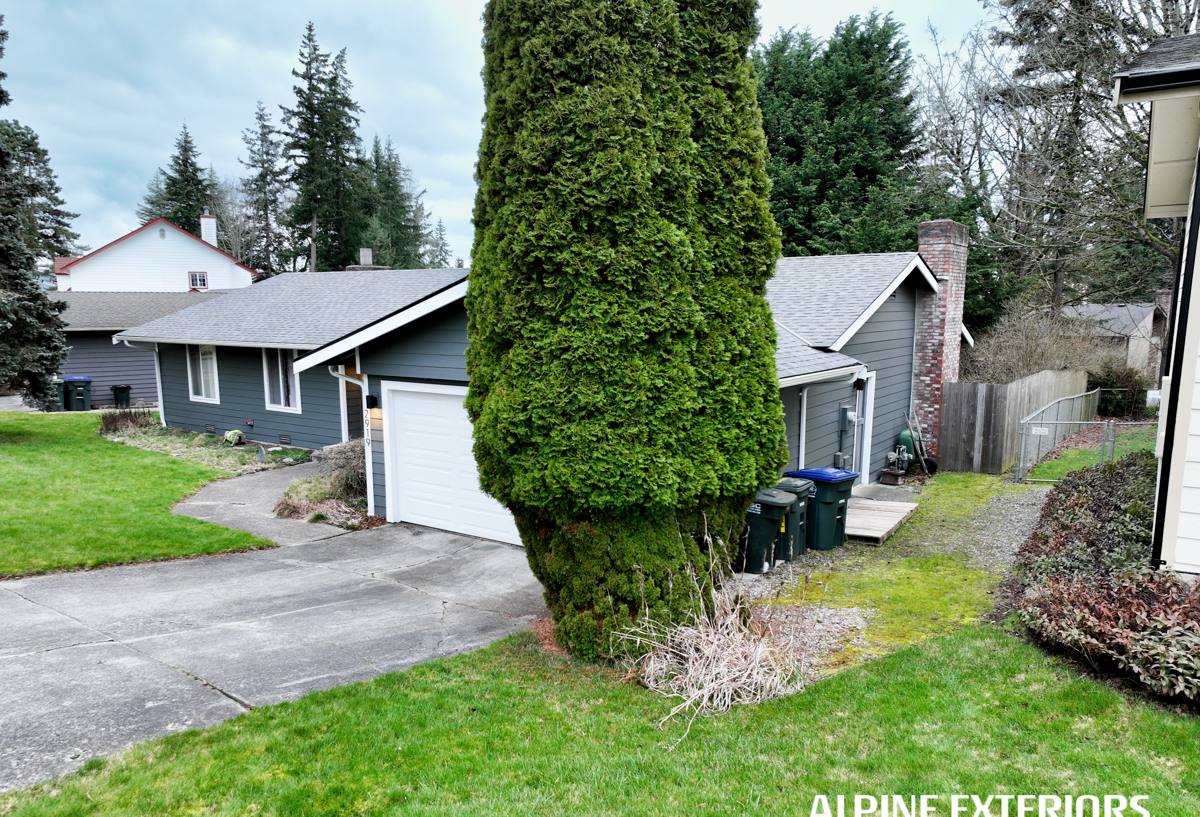
What This Climate Actually Does to a Wall
Three conditions define siding performance in the Everson area, and each one stresses a different weakness in cheaper or less climate-appropriate products:
- Salt-influenced marine air — accelerates corrosion of fasteners, trim, and any exposed metal, and keeps humidity elevated even on days without active rain.
- Driving rain — wind-driven storms push water sideways into laps, seams, and butt joints, not just straight down the wall face. Siding and flashing details that only handle vertical water flow fail here.
- A long moss and mildew season — shaded, north-facing, and tree-close walls in this area can stay damp for weeks at a time in fall and winter, which is exactly the environment moss, algae, and mildew need to establish and spread across a wall surface.
Put together, this means a siding product's water tolerance and finish durability matter more here than in drier parts of the state. A product that's rated for a national average climate isn't necessarily rated for a Whatcom County wall that stays wet for a week straight in December.
Why We Install James Hardie and Nothing Else
We don't install LP SmartSide, vinyl, Cemplank, Allura, primed spruce, or cedar. That's a deliberate standard, not a lack of options. Each of those products has legitimate strengths, but each also has a real-world trade-off that shows up faster in a climate like Everson's: engineered wood products remain wood at the core and are vulnerable at cut edges and fastener penetrations once moisture gets in; vinyl can warp and doesn't hold paint if a homeowner ever wants a color change; cedar and primed spruce require an ongoing maintenance commitment most homeowners don't sign up for once the reality of yearly upkeep sets in; other fiber cement brands vary in formulation and factory finish quality.
James Hardie is fiber cement — sand, cement, and cellulose fiber — which means it doesn't absorb and swell the way wood-based products do, and it doesn't soften or become brittle the way some vinyl formulations can in temperature swings. It's also non-combustible, which matters increasingly to insurers and to homeowners thinking about long-term risk. For Everson's specific mix of dampness and driving rain, the water and moss resistance of Hardie's engineered board, combined with a factory-applied finish, is the difference that shows up on the wall five and ten years down the road.
HZ5 Engineering for This Region
James Hardie manufactures its siding in climate-specific formulations called HZ (HardieZone) products. Homes in the Pacific Northwest, including the Lynden and Everson area, fall into the HZ5 zone, engineered specifically for regions with sustained moisture exposure and freeze-thaw cycling. That's a meaningfully different product than what gets installed in a dry-climate state, and it's part of why we specify HZ5 boards on every project in this service area rather than treating siding as a one-size-fits-all material.
ColorPlus Finish and the Moss Problem
A lot of the moss and algae staining homeowners see on older siding isn't really a "moss problem" — it's a finish problem. Field-applied paint is porous at a microscopic level and breaks down under UV and moisture cycling, which gives organic growth something to grip onto and gives water somewhere to sit. James Hardie's ColorPlus Technology is a factory-applied, baked-on finish that's substantially more resistant to fading, chipping, and the kind of surface breakdown that lets moss and mildew take hold. On a wall that's damp for weeks at a stretch every winter, that difference in finish integrity is one of the biggest factors in how the siding looks after year five, not just year one.
What Correct Installation Requires Here
Even the right product fails early if it's installed wrong, and siding installation mistakes are usually invisible until years later when water damage shows up. On Everson-area homes, the installation details that matter most are:
| Detail | Why It Matters in This Climate |
|---|---|
| Proper flashing at windows, doors, and penetrations | Driving rain finds any gap; flashing directs water back out instead of behind the siding |
| Correct fastener type and placement | Marine air accelerates corrosion of the wrong fastener grade; placement affects water intrusion at each panel |
| Minimum clearance from grade, roofing, and decks | Keeps the bottom edge of siding out of standing moisture and splash-back |
| Correct lap and joint treatment | Poorly sealed joints are the number one entry point for wind-driven rain |
| Rainscreen or drainage plane where called for | Lets any moisture that does get behind the siding actually dry out instead of sitting against the sheathing |
James Hardie publishes detailed installation specifications for exactly this reason, and following them isn't optional if you want the warranty to mean anything. A rushed or spec-deviating install voids the protection the product is supposed to provide, which is one of the most common ways homeowners end up disappointed by a material that, installed correctly, would have performed well.
How We Approach a Siding Project in the Everson Area
- On-site assessment — we look at the home's specific exposure: which walls take the worst driving rain, where moisture is already collecting, and where prior siding or trim has failed.
- Moisture and sheathing check — before new siding goes up, we confirm what's underneath is sound. Covering damaged sheathing with new siding just hides a bigger problem.
- Product and color selection — HZ5 James Hardie boards in the plank, shingle, or panel profile that fits the home, with a ColorPlus finish chosen for the property.
- Installation to manufacturer spec — proper flashing, fastening, clearances, and joint treatment, not shortcuts that save an afternoon and cost a homeowner years later.
- Final walkthrough — we go over the finished work and what maintenance, if any, the homeowner should expect going forward.
Ongoing Care: What Homeowners Actually Need to Do
One of the practical advantages of James Hardie siding in a climate like this is how little upkeep it demands compared to wood-based alternatives. That said, "low maintenance" isn't "no maintenance." A simple seasonal routine keeps a Hardie installation performing at its best:
- Rinse the exterior once or twice a year, focusing on shaded or tree-close walls where moss is most likely to start
- Keep gutters and downspouts clear so water isn't overflowing onto siding below
- Trim back vegetation and tree cover that keeps a wall section perpetually damp
- Check caulking at trim and penetration points periodically and re-seal if it's cracking or pulling away
- Address any impact damage or chipping promptly rather than letting it sit through a wet season
Why Local Experience with This Product Matters
James Hardie siding performs the way it's designed to when the installer understands both the product and the specific conditions it's going into. A crew that regularly works in Everson and around Lynden already knows which walls on a typical local lot take the worst weather, how the area's moisture patterns affect drying time, and where prior installations in this climate tend to have been cut short. That's the kind of judgment that doesn't come from a spec sheet alone — it comes from having done this work, on homes like yours, in this exact climate, repeatedly.
James Hardie also backs its products with a strong transferable limited warranty, which matters to homeowners thinking about resale as well as those planning to stay long-term. That warranty is only as good as the installation behind it, which is why we treat manufacturer spec compliance as non-negotiable on every project, not a box to check.
Get an Honest Look at Your Home
If you're weighing siding options for a home in the Everson or Lynden area, we're glad to come take a look, walk you through what your specific walls and exposure actually need, and give you a straightforward estimate — no pressure, no upsell into a product we don't believe belongs on homes in this climate. Fill out the form below to get started.