 Lynden Siding
 Siding Built for Custer's Coastal-Edge Climate
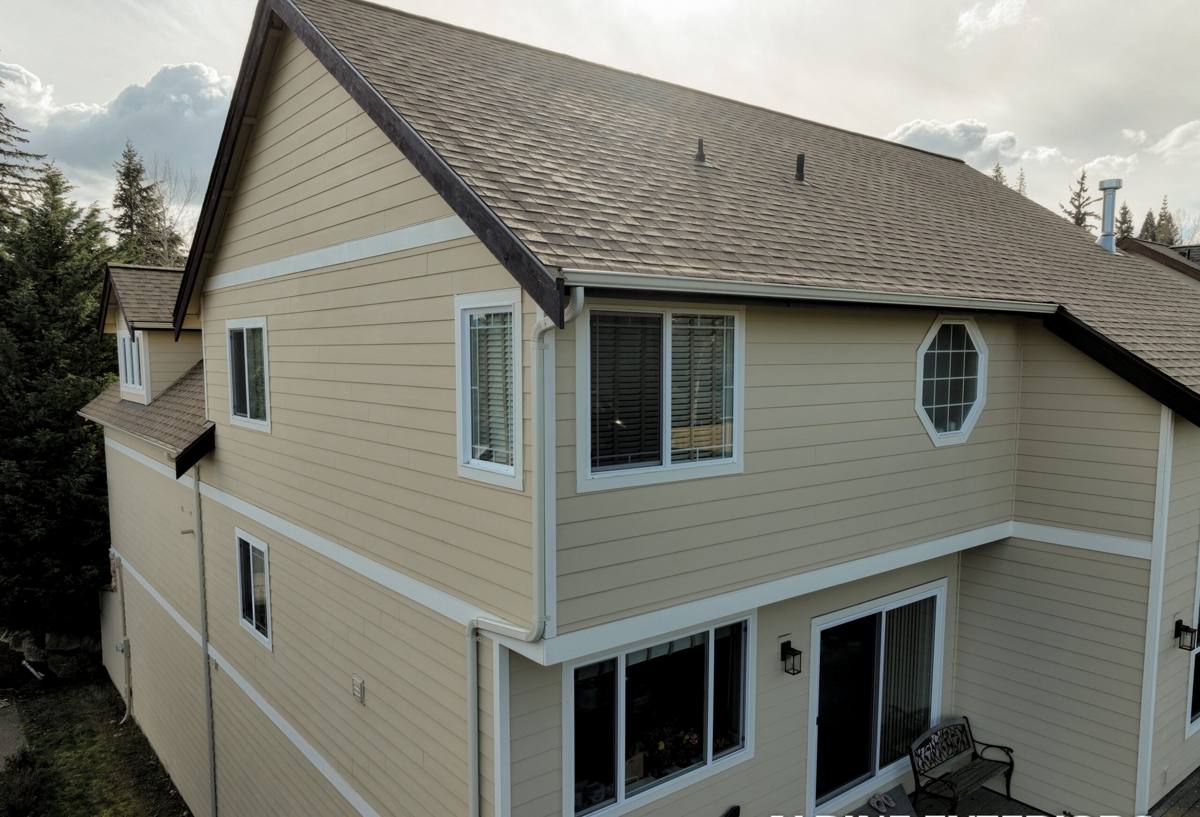
Custer sits in that stretch of northwest Whatcom County where the marine layer off Birch Bay and the Strait of Georgia meets the everyday grind of Pacific Northwest weather. Homes here take a different kind of beating than a house twenty minutes inland. Salt-laced air corrodes fasteners and finishes faster than owners expect. Driving rain, pushed sideways by wind off the water, finds every gap in a wall assembly that wasn't detailed correctly. And the long gray stretch from October through April gives moss, algae, and mildew months of uninterrupted growing time on any siding that holds moisture against its surface.
None of that is exotic. It's just consistent, and consistency is what wears siding out. A siding system that looks fine on a spec sheet can still fail on a Custer home in eight or ten years if it wasn't chosen and installed with this specific combination of salt, rain, and moss in mind. This page is about what that actually requires — not marketing language, but the real mechanics of a siding job that holds up here.
What Custer's Weather Actually Does to a Wall
Salt air and corrosion
Being close to Birch Bay and the broader coastline means airborne salt is a real factor, even a few miles inland. Salt accelerates corrosion in exposed metal fasteners, flashing, and trim connectors. Cheap or under-spec'd fastening hardware can start rusting and staining a wall years before the siding material itself would ever fail. This is one of the most overlooked failure points in coastal-adjacent siding jobs — the material gets the attention, the fasteners get an afterthought.
Driving rain and wind-driven moisture
Rain that falls straight down is relatively easy to shed. Rain that's pushed sideways by wind works its way behind laps, around trim, and into any seam that wasn't flashed or caulked correctly. Whatcom County's exposure to storms rolling in off the water means driving rain isn't an occasional event here — it's a seasonal pattern the wall assembly has to be built to handle every year.
Moss, algae, and the long wet season
Custer's growing season for moss and algae runs long. Any siding material that stays damp for extended periods, or that has a porous surface texture, gives moss spores and algae exactly what they need to take hold. Once established, moss holds moisture directly against the siding surface, which compounds every other durability problem — it's not just a cosmetic issue, it's a moisture-retention issue.
What a Correct Siding Installation Involves
Siding is a system, not a single product. The board or panel is the visible part, but the parts nobody sees — the water-resistive barrier, the flashing details, the fastening pattern, the clearances — determine whether that system actually performs for the next 30-plus years. A correct installation for a Custer home includes:
- A continuous, properly lapped water-resistive barrier (house wrap) installed shingle-style so water sheds outward, never inward
- Flashing at every window, door, and penetration, integrated with the house wrap — not just caulked over the top
- Correct fastener type, length, and spacing for the specific siding profile, matched to the substrate
- Proper clearance between the siding's bottom edge and grade, decks, patios, and roof lines — typically a minimum of 6 inches from grade and 1-2 inches from horizontal surfaces, per manufacturer specs
- Factory-primed or factory-finished cut edges sealed in the field, not left raw and exposed to moisture
- Ventilation gaps maintained where required so trapped moisture has somewhere to go
Skip any one of these and the siding may still look right on installation day. The problems show up two, five, or ten years later — usually as rot at a window corner, staining below a butt joint, or a soft spot near grade — and by then it's a repair job, not a warranty claim.
Why We Install Only James Hardie Fiber Cement
We made a deliberate decision to install one siding system: James Hardie fiber cement. We don't install vinyl, LP SmartSide, primed spruce, cedar, Cemplank, or Allura. That's not because those products have no merit — vinyl is inexpensive and low-maintenance in mild climates, engineered wood has a warmer look, cedar has real natural appeal. It's because, weighed against Custer's specific combination of salt air, driving rain, and moss exposure, none of them hold up as consistently as fiber cement over a full ownership cycle.
Fiber cement is non-combustible, doesn't swell or delaminate when it takes on moisture the way engineered wood products can, and doesn't become brittle or distort in temperature swings the way vinyl can. It also takes a factory-applied finish — ColorPlus Technology — that resists fading and holds up to repeated wet-dry cycling far better than field-applied paint. For a house that's going to spend six months a year in damp, marine-influenced weather, that combination matters more than any single feature on a spec sheet.
The HZ5 climate-engineered line
James Hardie engineers its siding by climate zone, not as a one-size-fits-all product. The HZ5 line is engineered specifically for regions like the Pacific Northwest, where moisture exposure and moderate-to-freezing temperature swings are the dominant stress factors. That's the product line we install on Custer homes. It's built to resist moisture intrusion and hold its dimensional stability through the wet season without the swelling or cracking that wears down less climate-specific materials.
Our Installation Process
A siding job is only as good as the sequence it's installed in. Rushing or skipping steps is where most premature failures start. Here's how a full replacement runs on a Custer home:
- Assessment and tear-off. We remove the existing siding down to the sheathing and inspect for hidden rot, especially around windows, doors, and any area where prior flashing was missing or failed.
- Sheathing repair. Any damaged or soft sheathing is replaced before anything else goes on the wall. Installing new siding over compromised sheathing just hides a bigger problem.
- Water-resistive barrier. A new house wrap is installed with correct overlaps and taped seams, shingle-style, so it sheds water the way it's designed to.
- Flashing. Window and door flashing, along with flashing at any roof-wall intersections, is installed and integrated into the water-resistive barrier — this is the step that prevents the driving-rain intrusion Custer homes are prone to.
- Furring or direct application. Depending on the wall assembly and whether rainscreen venting is called for, siding is either applied directly or over vertical furring strips that create a drainage gap behind the material.
- Hardie installation. Panels or lap siding go on with manufacturer-specified fastener spacing, clearances from grade and adjacent surfaces, and correctly staggered joints.
- Trim, caulking, and touch-up. Cut edges are sealed, trim is installed and caulked at appropriate joints only (not everywhere — over-caulking can trap moisture rather than shed it), and any factory finish touch-up is completed.
- Final walkthrough. We walk the exterior with the homeowner before calling the job done.
Common Signs Custer Homeowners Should Watch For
Not every issue means a full replacement, but these are the signs worth having a professional look at, especially on a home that's had siding for 15+ years:
| What you see | Likely cause | What it means |
|---|---|---|
| Dark streaking or green tint on north-facing walls | Moss or algae growth from prolonged moisture retention | Surface issue now; can become a moisture problem if left untreated |
| Soft or spongy spots near the bottom of walls | Rot from inadequate grade clearance or failed flashing | Active moisture intrusion — needs inspection soon |
| Rust streaks below fastener heads or trim | Corroding fasteners or trim hardware, accelerated by salt air | Cosmetic at first, but signals hardware nearing end of service life |
| Peeling or bubbling paint on wood or engineered wood siding | Moisture trapped beneath the finish | Often indicates the substrate underneath is already absorbing water |
| Visible gaps or separation at butt joints and corners | Material movement or shrinkage over time | Entry points for wind-driven rain |
What Drives the Cost of a Siding Installation
Every home is different, so we won't quote a number without seeing the house, but these are the factors that move the price up or down on a typical Custer project:
| Factor | Why it matters |
|---|---|
| Extent of tear-off and sheathing repair | Hidden rot found during tear-off adds material and labor that isn't visible until the old siding comes off |
| Home size and wall complexity | More corners, dormers, and roof-wall intersections mean more flashing detail and cut work |
| Siding profile chosen | Lap siding, panel systems, and shingle-style Hardie products differ in material and labor cost |
| Trim and accent work | Custom trim details, board-and-batten accents, or color-matched trim add scope |
| Access and site conditions | Steep grades, tight setbacks, or limited equipment access affect labor time |
Why Hiring a Crew That Already Works in Custer Matters
Siding installation isn't just a product decision — it's a judgment call made a hundred times over the course of a job: how tight to run a flashing lap, how much clearance to leave at a deck ledger, whether a wall needs a rainscreen gap or not. A crew that already works Whatcom County homes has made those calls on houses facing the same salt exposure, the same storm patterns, and the same moss season your home deals with every year. That's not a substitute for manufacturer specs — it's what makes sure those specs get applied correctly to your specific wall, roofline, and site conditions.
It also means fewer surprises. A contractor who's unfamiliar with this stretch of coastline might not think to double-check fastener corrosion resistance or grade clearance the way a crew that installs here regularly will, by default.
Maintaining Your Siding After Installation
James Hardie siding is low-maintenance, not no-maintenance. A simple annual routine keeps it performing the way it's designed to in this climate:
- Rinse the exterior once or twice a year to remove salt residue, pollen, and early moss growth before it establishes
- Keep gutters clear so overflow doesn't run down the wall face repeatedly in one spot
- Trim back vegetation and landscaping that holds moisture against the siding or blocks airflow
- Inspect caulking at trim joints every couple of years and have any cracked or missing sections redone
- Watch for and address moss promptly rather than letting it establish over a full wet season
Get a Straightforward Estimate
If your Custer home's siding is showing its age, or you're planning ahead before the next wet season sets in, we're happy to take a look and give you an honest read on what it needs. There's no pressure and no obligation — just a clear estimate based on what your home actually requires. Use the form below to request a free estimate.