 Lynden Siding
 Custer Decks Face a Tougher Climate Than Most Homeowners Realize
Custer sits close enough to the water that salt-laden air is simply part of daily life here. Combine that with the driving rain that rolls through Whatcom County most of the year and the long stretch of gray, damp months when moss and algae take hold of anything horizontal, and you have a set of conditions that ages a deck faster than the manufacturer's brochure ever suggested. Fasteners corrode sooner. Ledger boards trap moisture longer. Railings that look fine from a distance can be soft underneath the paint. None of this means a deck in Custer is doomed — it means the repair work has to account for what the climate is actually doing to the structure, not just what's visible on the surface.
We work on decks throughout Lynden and the surrounding Whatcom County area, and Custer properties consistently show a specific pattern of wear: corrosion at metal connectors before the wood itself fails, moss buildup in shaded or low-airflow sections, and soft spots where water has been sitting rather than draining. Understanding that pattern is the difference between a repair that holds for another decade and one that's patching a symptom while the real problem keeps working underneath.
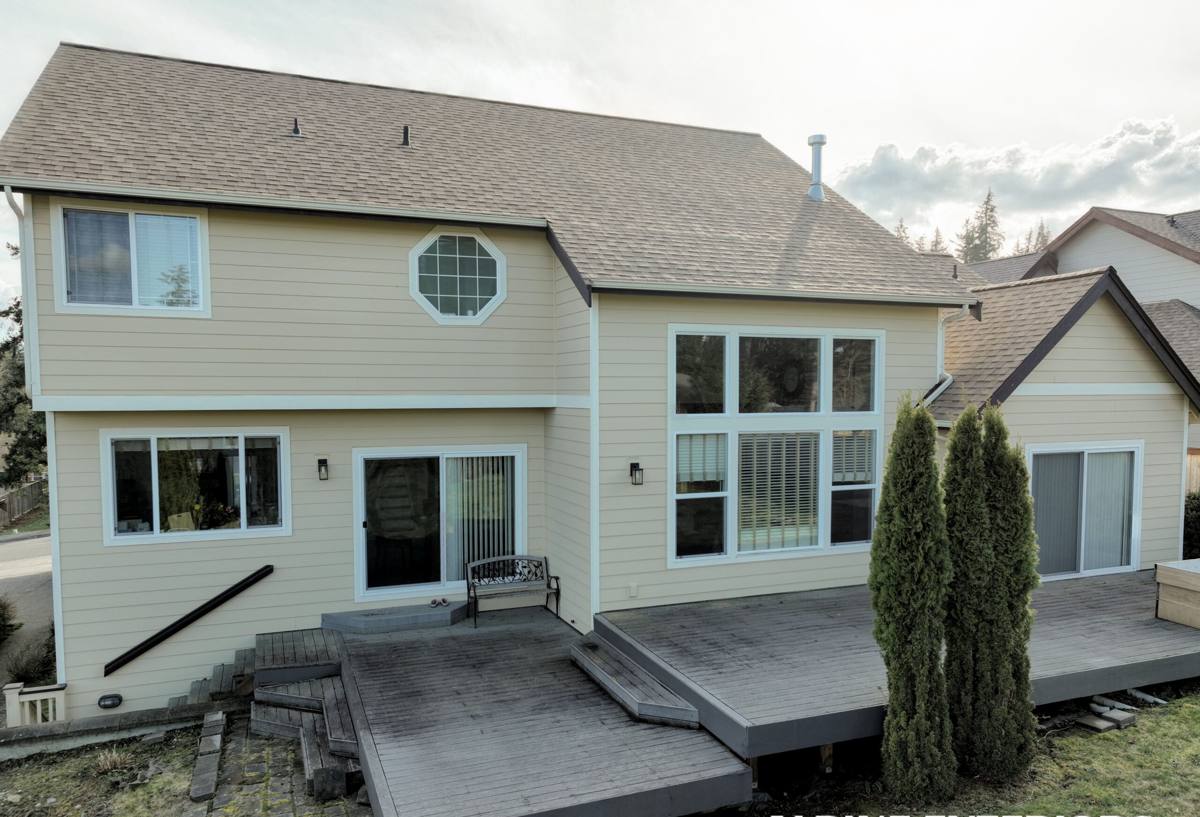
Why Salt Air, Rain, and Moss Attack a Deck From Different Angles
Salt Air and Metal Fatigue
Salt in the air accelerates corrosion on anything metal — nails, screws, joist hangers, bolts, and railing hardware. Once a fastener starts rusting, it loses holding strength long before it looks obviously bad. A joist hanger that's rusted through can fail structurally while the wood around it still looks solid. This is one reason we always inspect hardware directly, not just the decking boards on top.
Driving Rain and Water Intrusion
Rain that comes in at an angle, rather than falling straight down, gets pushed into places a deck wasn't necessarily built to shed water from — under railing posts, behind ledger flashing, into end-grain cuts that were never sealed. Over years, that intrusion rots framing from the inside while the surface stays deceptively dry-looking between storms.
Extended Moss and Algae Season
Whatcom County's long damp season gives moss and algae months to establish themselves on deck surfaces, especially in shaded corners or areas with poor airflow underneath. Beyond being slippery and unattractive, moss holds moisture directly against the wood surface, which speeds up rot in exactly the boards it's growing on.
Signs a Custer Deck Needs Repair — Not Just a Pressure Wash
Homeowners often call us after noticing something cosmetic, and then we find the real issue underneath. Here's what actually signals it's time for a repair assessment:
- Boards that feel spongy or flex noticeably when you walk across them
- Rust streaks running down from screws, nails, or metal connectors
- Railings that wiggle or feel less solid than they used to
- Persistent moss or black algae that comes back within weeks of cleaning
- Gaps opening up between deck boards, or boards that have started to cup or crown
- Soft or discolored wood where the deck meets the house (the ledger board area)
- Stair stringers that show cracking or separation at the connection points
- A general "give" underfoot near deck posts, especially after heavy rain
Any one of these on its own might be minor. Several together, especially near the ledger or stair connections, usually mean the structure needs attention beyond a surface clean.
What a Correct Deck Repair Actually Involves
A repair that holds up in this climate goes beyond swapping out the boards that look bad. We look at the whole system, because a deck is only as good as its weakest connection point.
Structural Inspection First
Before replacing anything, we check the ledger board attachment, the posts and footings, joist condition, and all metal hardware. This is where hidden rot and corrosion actually live, and it's the part a quick visual scan from the yard will miss entirely.
Fastener and Hardware Upgrades
If we're opening up a section for repair, we replace corroded fasteners with hardware rated for coastal and high-moisture exposure, not the standard-grade hardware that may have been used originally. This matters more in Custer than it would further inland.
Proper Flashing and Water Management
Where the deck meets the house, correct flashing keeps water from working its way behind the ledger board — the single most common point of hidden rot we find on older decks. We also check that the deck surface has adequate slope and drainage so water isn't pooling anywhere.
Board Replacement Done Right
Cut ends get properly sealed, not left raw to soak up moisture. Replacement boards are matched for proper spacing to allow airflow and drainage, since tight, moisture-trapping gaps are part of what accelerates moss growth in the first place.
Railing and Stair Safety
Railings and stairs take the most direct structural stress and the most direct weather exposure. We treat these as safety items, not cosmetic ones, and won't leave a railing "good enough" if the posts underneath are compromised.
Decking Material Trade-Offs for a Salt Air, High-Rain Climate
When repair involves replacing sections of decking, homeowners often ask what material makes sense going forward. There's no single right answer — it depends on budget, how much upkeep you want to do, and how the deck is used.
| Material | How It Handles This Climate | Maintenance Reality |
|---|---|---|
| Pressure-treated wood | Holds up well if properly sealed and fasteners are corrosion-resistant; vulnerable to moss and rot if neglected | Needs re-sealing every 1-2 years in this climate to stay ahead of moisture |
| Cedar | Naturally rot-resistant and handles moisture reasonably well, but softer surface can hold moss if not cleaned | Periodic cleaning and oiling; ages gracefully if maintained |
| Composite decking | Resists rot and doesn't need sealing, but can still grow surface algae/moss in shaded, damp spots | Low upkeep overall; periodic cleaning still needed to prevent surface buildup |
We install and repair all three, and we'll give you a straight answer about which fits your situation rather than pushing whichever costs more. The right call often depends on how shaded the deck is and how much time you want to spend on upkeep.
Our Repair Process
- On-site inspection: We check the full structure — decking, framing, ledger, posts, footings, railings, and hardware — not just the parts that look worn.
- Honest assessment: We tell you what's actually failing, what's still sound, and what can reasonably wait versus what shouldn't.
- Clear scope and estimate: You get a plan that separates must-fix safety items from optional cosmetic upgrades, so you can decide what fits your budget.
- Repair work: Corroded hardware is replaced with corrosion-resistant fasteners, damaged framing and boards are properly cut and sealed, and flashing is corrected where needed.
- Final walkthrough: We check the repaired deck for solid footing, proper drainage, and secure railings before we consider the job done.
Mistakes We Commonly Find in Prior Repairs
A fair number of our Custer calls involve fixing a repair someone else already attempted. The recurring issues:
- Standard fasteners used instead of corrosion-resistant hardware, leading to rust returning within a year or two
- New boards installed over rotted framing without addressing what's underneath
- Cut ends left unsealed, which lets moisture back in immediately at the new joints
- Railings reattached to posts that were already compromised
- No correction to drainage or flashing, so the same section fails again in the same spot
These aren't necessarily signs of bad intentions — they're often what happens when a repair is treated as a quick patch rather than a look at the whole system. It's also exactly why we inspect thoroughly before quoting, even on jobs that sound simple over the phone.
What Deck Repair Typically Costs — and What Drives the Range
| Factor | Why It Affects Cost |
|---|---|
| Extent of hidden rot/corrosion | Framing and hardware replacement adds labor and material beyond surface boards |
| Ledger board condition | Fixing water intrusion at the house connection is more involved than swapping deck boards |
| Material choice | Composite typically costs more upfront than pressure-treated wood; cedar falls in between |
| Railing and stair scope | Safety-critical elements often need full replacement rather than partial repair |
| Deck size and accessibility | Larger decks and harder-to-access sites increase labor time |
Small repairs — a handful of boards, some hardware, minor railing tightening — are generally a modest expense. Larger jobs involving framing, ledger work, or full railing replacement cost more, but they're also addressing the failures that cause repeat problems. We'll always break this down clearly rather than giving one vague number.
Why Hiring a Crew That Already Works in Custer Matters
A contractor who works this specific area regularly already knows what a Whatcom County deck looks like after a few winters of driving rain and salt air — where the moss tends to establish, which connection points fail first, and which materials genuinely hold up versus which ones look good in the showroom and struggle here. That local pattern recognition means a faster, more accurate diagnosis and a repair built for the conditions your deck actually faces, not generic conditions from a manual written somewhere else.
It also means accountability. We're not driving in from out of the area for one job — we're a Lynden-based crew that continues to work in this community, and we stand behind the repairs we do here.
Ready for a Straight Answer About Your Deck?
If your Custer deck has soft spots, rust stains, stubborn moss, or railings that don't feel as solid as they used to, it's worth a proper look before those small issues turn into a bigger structural repair. We offer free, no-pressure estimates — we'll walk the deck with you, tell you honestly what needs attention, and give you a clear plan with no obligation. Use the form below to get started.