 Lynden Siding
 Sumas Homes Face a Tougher Climate Than the Siding on Most of Them Was Built For
Sumas sits in a part of Whatcom County where weather doesn't let up for long. Marine air pushes inland off the Sound, rain comes in sideways more often than straight down, and the shoulder seasons stretch into months of grey, damp days where surfaces rarely get a real chance to dry out. Add in the salt content that rides along with that coastal air and you have a combination that is genuinely hard on exterior building materials — especially anything wood-based or anything that depends on a painted surface to keep water out.
Most siding products were engineered and tested somewhere drier. When they're installed here, the difference shows up early: swelling at the bottom edge of lap boards, paint that fails years ahead of schedule, and a north or west wall that never seems to fully dry before the next system rolls through. None of that is really the homeowner's fault — it's a mismatch between the product and the place.
This page is about one thing specifically: installing siding correctly on a Sumas home, in this climate, with a product built to actually hold up to it.
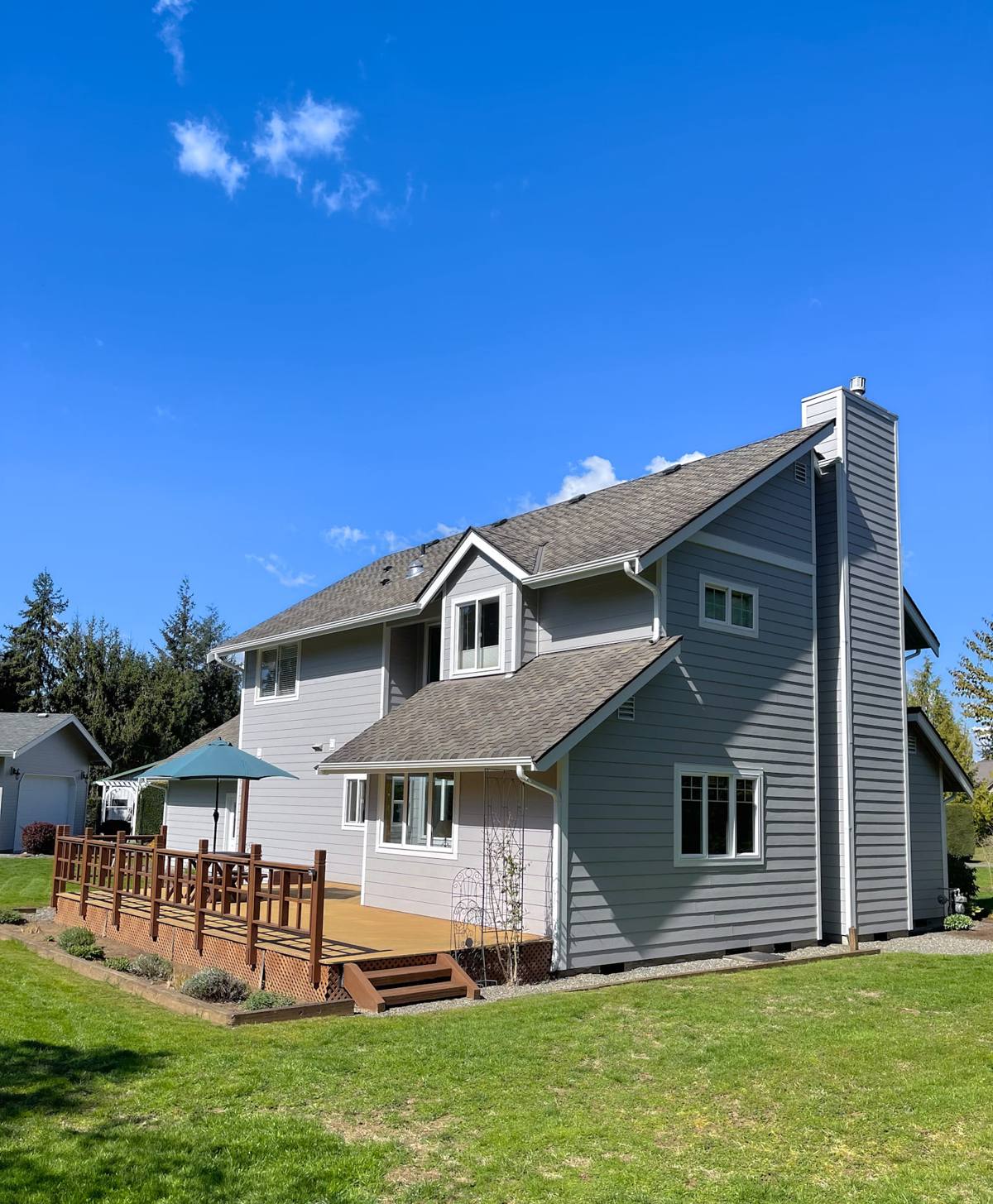
What Driving Rain, Salt Air, and Moss Season Actually Do to Siding
Driving Rain
Wind-driven rain doesn't just wet the surface of a wall — it gets pushed up under laps, into seams, and behind trim if those details weren't built correctly in the first place. Over years, that intrusion is what causes rot in wood-based products and delamination in lower-grade composites. The siding material matters, but so does whether the water-resistive barrier, flashing, and lap spacing behind it were done right.
Salt-Laden Air
Airborne salt accelerates corrosion on fasteners, trim, and any metal flashing that isn't rated for it, and it speeds up the breakdown of lower-quality paint films. A siding system that isn't formulated to resist this kind of exposure will chalk, fade, and lose its protective coating faster than the manufacturer's own literature would suggest for a "typical" installation.
Moss Season
Whatcom County's moss season isn't a few weeks — on shaded, north-facing, or tree-lined walls it can run most of the year. Moss and algae hold moisture directly against the siding surface for extended periods, which is exactly the condition that rots wood, feeds mold behind poorly ventilated systems, and stains porous or absorbent claddings permanently. Siding that resists moisture absorption at the material level, not just at the paint layer, handles this far better.
Why We Install Only James Hardie Fiber Cement
We don't install vinyl, LP SmartSide, primed spruce, cedar, or off-brand fiber cement. That's a deliberate standard, not a sales pitch, and it comes directly from what we see on homes in this climate. Wood-based products depend on a paint film staying intact to keep moisture out — once that film fails, the substrate underneath starts absorbing water, and in a climate with this much sustained dampness, that failure point arrives sooner than most homeowners expect. Vinyl handles moisture fine but moves with temperature, can look flat and plasticky up close, and isn't rated to hold up to real wind-driven storms the way a heavier-gauge product is.
James Hardie fiber cement is engineered from cement, sand, and cellulose fiber — it doesn't rot, it isn't a food source for pests, and it's non-combustible. Its ColorPlus factory finish is baked on under controlled conditions rather than field-applied, which matters directly here: a factory finish is far more consistent and far more resistant to the salt-air fading and chalking that shortens the life of a job-site paint job. Hardie also builds specific product lines engineered for different exposure conditions, which lets us match the product to what a given wall actually faces rather than using one generic board everywhere on the house.
What a Correct Siding Installation Involves — Not Just the Boards
The siding material is maybe half of what determines how a wall performs over the next 30 years. The other half is installation detail, and it's the part homeowners can't easily inspect after the fact:
- Weather-resistive barrier: a continuous, correctly lapped water barrier behind the siding, with seams sealed and no gaps at penetrations.
- Flashing at every horizontal transition: windows, doors, decks, and roof lines all need flashing detailed to shed water outward, not just caulk relied on to do that job long-term.
- Proper clearance and gaps: Hardie's own installation instructions specify minimum clearance from grade, roofing, and decks, and gapping at butt joints and trim — skipping these is the single most common cause of early moisture problems on fiber cement jobs.
- Correct fastener pattern and type: fasteners rated for the exposure, driven to the manufacturer's specified depth and spacing — overdriven or underdriven nails are a quiet, common defect that shows up as cracking or loosening years later.
- Field-cut edge sealing: any board cut on site needs its edge sealed to match the factory-finished edges, or that cut edge becomes the weak point in the whole wall.
Any of these done wrong can undercut the performance of even the best material. It's why we treat installation sequencing as seriously as the product choice itself.
How the Process Works on a Sumas Project
1. On-Site Assessment
We walk the exterior, check the condition of the current siding and the sheathing/framing underneath where accessible, and look specifically at how the house has been handling moisture — staining patterns, moss growth, soft spots, and paint failure all tell us something.
2. Product Selection
We match Hardie product lines and profiles to the exposure each side of the house actually faces, and to the look the homeowner wants — lap, shingle, or panel profiles are all available in the ColorPlus finish line.
3. Tear-Off and Substrate Check
Old siding comes off and we inspect the sheathing underneath before anything new goes on. Any rot or damage gets addressed before a new water barrier and siding go over it — covering a problem doesn't solve it.
4. Water Barrier and Flashing
This is the step that matters most and shows the least once the job is done. We install and detail the water-resistive barrier and flashing to manufacturer spec before a single piece of siding goes up.
5. Installation
Siding is installed to Hardie's fastening, clearance, and gapping specifications — the details covered above — with attention to trim, corners, and penetrations.
6. Final Walkthrough
We walk the finished exterior with the homeowner, checking caulking, trim lines, and finish before calling the job complete.
Comparing Siding Options for a Sumas Exposure
| Factor | James Hardie Fiber Cement | Vinyl | Wood / Engineered Wood |
|---|---|---|---|
| Moisture resistance | Does not rot; factory finish resists moisture-driven failure | Water-resistant material, but seams and J-channels can trap moisture | Depends on paint film staying intact; vulnerable once it fails |
| Salt air / coastal exposure | Formulated finish holds color and integrity | Can chalk and become brittle over time | Paint fails faster; substrate then absorbs moisture |
| Moss and prolonged dampness | Non-organic material, doesn't feed mold or rot | Resists rot but moss growth still requires cleaning | Organic substrate is directly vulnerable to sustained moisture |
| Fire resistance | Non-combustible | Combustible | Combustible |
| Finish longevity | Factory-applied ColorPlus finish, long warranty | Color molded in, can fade unevenly | Field-applied paint, shorter repaint cycle |
Signs an Existing Sumas Home Needs New Siding
Not every issue means a full replacement, but these are the signals worth a real inspection rather than another round of caulk and touch-up paint:
- Soft or spongy spots when you press on the siding, especially near the bottom courses or below windows
- Paint that's peeling or blistering repeatedly in the same spots year after year
- Visible warping, cupping, or buckling of boards
- Persistent moss or dark staining on shaded or north-facing walls that keeps coming back after cleaning
- Gaps opening up at trim, corners, or seams
- Rising energy bills that track with drafts near exterior walls
Why a Crew That Already Works in Whatcom County Matters
Siding installation isn't identical everywhere — the correct clearance, flashing detail, and product selection for a home in a dry inland climate isn't automatically right for a Sumas exposure. A crew that regularly works this part of Whatcom County already knows which walls take the worst of the driving rain, how much clearance actually matters given the moss season here, and where the salt-influenced air tends to hit hardest. That local pattern recognition shows up in the small decisions during a job — the ones that determine whether a siding installation is still performing well in year 20, not just year one.
If you're planning a siding project on a Sumas home, we're happy to walk the property, look at what your current siding is telling you, and talk through what a correctly installed James Hardie system would look like for your specific exposure. Reach out for a free, no-pressure estimate using the form below.