 Lynden Siding
 Composite Decking for Sumas Homes
Sumas sits at the edge of Whatcom County, close enough to the border and the foothills that its weather carries the same marine-influenced moisture that shapes decks all across our service area — salt-tinged air moving in off the Sound, driving rain for months at a stretch, and a moss season that can run from October well into spring. A deck out here isn't a fair-weather feature. It's outdoor living space that has to survive standing water, freeze-thaw swings, and constant dampness underfoot, year after year.
We build and replace composite decks for homeowners in and around Sumas as part of our regular Lynden-area work. This page walks through what that climate actually does to a deck, what a correct composite installation looks like here, and how our process works from first look to final walkthrough.
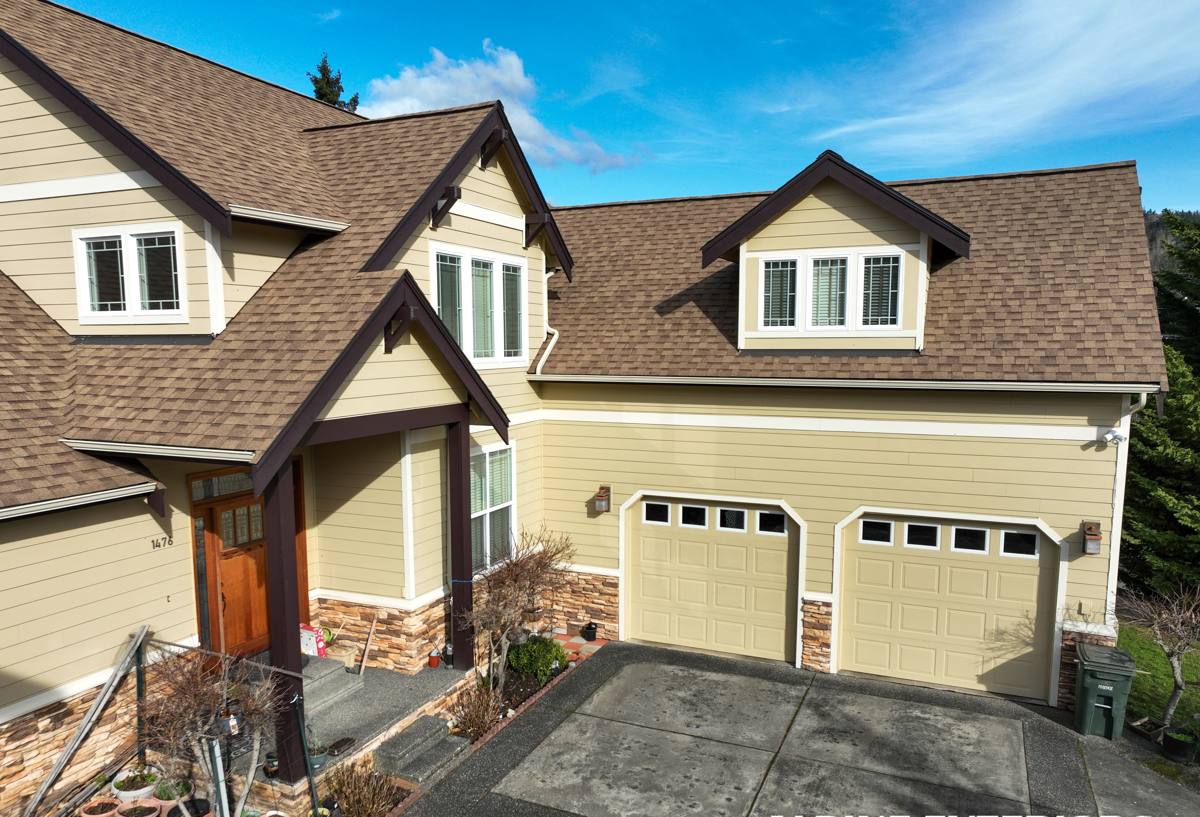
What Sumas' Climate Actually Does to a Deck
Every deck material eventually answers to the weather. In Sumas and the surrounding parts of Whatcom County, that means dealing with a handful of specific, predictable stresses:
- Persistent moisture: Long stretches of rain keep deck surfaces wet far more often than they're dry, which is what allows moss, algae, and mildew to establish and spread.
- Moss and organic growth: Shaded decks, north-facing decks, and decks under trees stay damp long enough for moss to take hold in the board grain and in fastener heads — moss holds moisture against the surface, which accelerates rot in untreated wood and staining on any material.
- Freeze-thaw cycling: Whatcom County gets enough cold snaps to freeze trapped water in ledger connections, joist hangers, and board gaps. Water that can't drain and freezes will expand and work fasteners loose over time.
- Salt-laden marine air: Airborne salt from the Sound corrodes exposed fasteners and hardware faster than it would inland, which is why fastener selection matters as much as the decking material itself.
None of this is unusual for the Pacific Northwest, but it does mean a deck built to a generic national spec — rather than to this climate — will show problems within a few seasons: soft spots, board cupping, corroded screws, and moss that keeps coming back no matter how often it's scrubbed.
Why Composite Makes Sense for This Climate
We install wood decking too, and it has its place. But for homeowners in Sumas who want a deck they're not refinishing or patching every year, composite decking solves several of the problems the local climate creates. The core advantage is that composite boards don't absorb water the way wood fibers do, so they don't swell, cup, splinter, or rot from the inside the way untreated or under-maintained wood eventually does.
| Factor | Wood Decking | Capped Composite Decking |
|---|---|---|
| Moisture absorption | Absorbs and releases water, causing swelling and cupping | Minimal absorption with a capped surface |
| Moss and mildew resistance | Grain holds moisture, favors moss growth | Smoother, capped surface sheds growth more easily |
| Maintenance routine | Annual cleaning, sealing, or staining | Periodic washing, no sealing or staining |
| Fastener corrosion risk | Depends entirely on fastener choice | Same risk — hidden fastener systems still need marine-grade hardware |
| Upfront cost | Lower material cost | Higher material cost, offset by lower upkeep |
| Expected lifespan with correct install | Long, but maintenance-dependent | Long, less maintenance-dependent |
The trade-off is honest: composite costs more upfront and it isn't maintenance-free — it still needs periodic washing and the substructure underneath still needs to be built and fastened correctly. What it removes is the annual sanding, sealing, and staining cycle that wood decking demands to keep moss and rot at bay in a climate this wet.
Where We Still Recommend Wood
If a homeowner wants a specific real-wood look, has a tight budget for the initial build, or is doing a smaller deck they're comfortable maintaining closely, wood decking is still a sound choice when it's built and finished correctly. We'll give you a straight answer on which material fits your situation rather than pushing one product across the board.
What a Correct Composite Deck Installation Involves
The decking boards get the attention, but most composite deck failures we're called to look at start below the surface — in the framing, drainage, and fastening, not the boards themselves. A correct install in this climate covers:
Structure and Framing
Joist spacing has to match the manufacturer's specification for composite boards, which is often tighter than standard wood-decking spacing because composite behaves differently under load and temperature change. Ledger board attachment to the house needs proper flashing so water is directed away from the wall assembly, not into it — this is one of the most common places we find water damage on older decks.
Drainage and Airflow
Composite decking still needs a gap between boards for drainage and expansion, and the space underneath the deck needs enough airflow to let moisture escape rather than pool. A deck built low to the ground or against a foundation without ventilation traps humidity underneath, which shows up eventually as mold or a persistently damp crawlspace.
Fasteners and Hardware
Given the salt-influenced air in this region, we use corrosion-resistant, marine-grade fasteners and hidden fastener systems rated for the specific composite product being installed. Mismatched or budget hardware is one of the fastest ways a deck starts showing rust streaks and loose boards within a couple of years.
Edge and Fascia Detailing
Cut ends and fascia boards need to be finished according to the manufacturer's guidance — exposed, unfinished composite edges can wick moisture differently than the capped face, which affects both appearance and longevity at the perimeter of the deck.
Our Process for Sumas Deck Projects
Because we already work throughout the Lynden area, a Sumas deck project follows the same process we use everywhere nearby — no special mobilization, no guessing at local conditions.
- On-site assessment: We look at the existing structure (if there is one), grade and drainage around the deck footprint, sun and shade exposure, and how the deck ties into the house.
- Material walkthrough: We go over composite options, board profiles, and color choices in person, including the honest maintenance expectations for each.
- Written estimate: A clear scope and price before any work starts — no verbal-only agreements.
- Demolition and framing (if needed): Old decking and any compromised framing is removed and replaced to current structural standards, not just patched over.
- Installation: Framing, flashing, fastening, and board installation done to the manufacturer's specification for our climate.
- Final walkthrough: We check the deck with you before calling the job done, including drainage, fastener finish, and edge detailing.
Composite Decking Options We Work With
Composite decking isn't a single product — board composition, cap technology, and warranty structure vary between manufacturers and product tiers. We'll walk through which options are available and appropriate for your project and budget rather than defaulting to one brand.
| Consideration | Entry-Tier Composite | Premium Capped Composite |
|---|---|---|
| Surface finish | Basic cap or partially capped | Fully capped on all sides |
| Fade and stain resistance | Moderate | Higher, with longer warranty coverage |
| Texture and color range | Limited | Wider range of wood-look textures and tones |
| Typical warranty length | Shorter, often prorated | Longer, often includes fade/stain coverage |
| Relative cost | $ | $$–$$$ |
Living With Composite Decking in a Moss-Prone Climate
Composite decking is lower-maintenance than wood, not maintenance-free. In a climate that grows moss on almost anything left damp long enough, a simple seasonal routine keeps a composite deck looking and performing the way it should:
- Sweep off leaves, needles, and debris regularly, especially in fall — trapped organic matter holds moisture against the board surface.
- Wash the deck surface a few times a year with a soft-bristle brush and a cleaner rated for composite decking; avoid pressure washers on high settings, which can damage the cap layer.
- Check under-deck ventilation isn't blocked by stored items, plants, or debris that trap humid air underneath.
- Look at fastener heads and edge trim once or twice a year for early signs of corrosion or loosening.
- Keep gutters and downspouts near the deck clear so roof runoff isn't dumping extra water onto or under the deck structure.
Why a Crew That Already Works in Sumas Matters
A composite deck built to a generic spec sheet, without accounting for this region's rain volume, moss pressure, and marine air, tends to reveal its shortcuts within a few years — usually in the framing or fasteners rather than the boards themselves. Working with a crew that already builds decks throughout the Lynden area and greater Whatcom County means the framing spacing, flashing details, and hardware choices are already dialed in for exactly this climate, not adapted after the fact from a drier region's standard.
It also means straightforward accountability. We're not a crew passing through — we're already doing this work in your area, and we stand behind what we build here.
If you're planning a new composite deck or replacing an aging one in Sumas, we're happy to take a look and walk you through your options. Reach out for a free, no-pressure estimate using the form below.