 Lynden Siding
 Siding Replacement for Everson, Built Around This Climate
Everson sits along the Nooksack River in northern Whatcom County, and homes here take on the same weather load as the rest of the region: salt-laden marine air, rain that comes in sideways more often than straight down, and a moss and mildew season that can run most of the year on shaded walls. Add river-adjacent humidity into that mix and it's not surprising that older siding in this area often shows problems years before a homeowner expects to be replacing it — swollen panels, chalky or peeling paint, soft spots at the bottom courses, or dark streaking that keeps coming back no matter how many times it's washed off.
This page is specifically about full siding replacement for Everson homes — not a general overview of siding, and not a repair page. If your siding is failing in a way that a patch or partial re-side won't actually fix, this is what a correct replacement job looks like, why the climate here drives certain decisions, and how we run the project from first look to final walk-through.
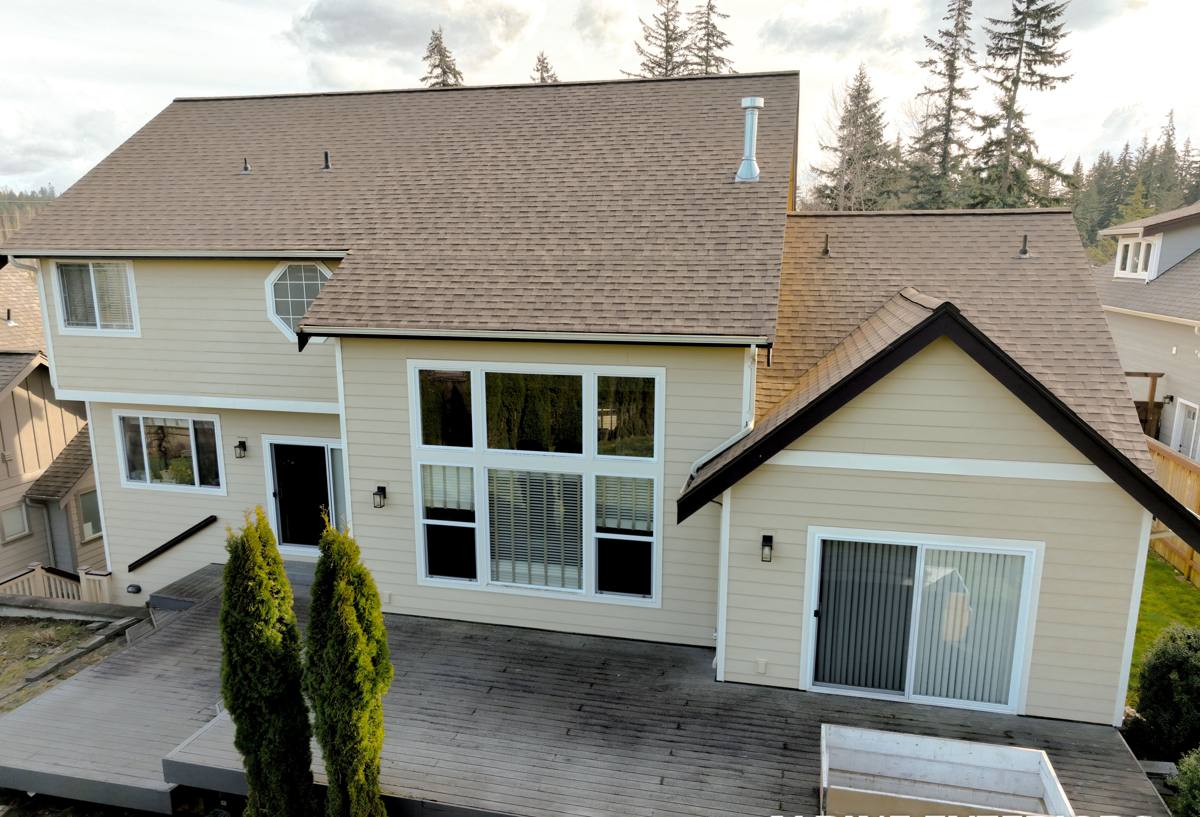
What Everson's Climate Actually Does to Siding
Salt Air Off the Sound, Still Working Inland
Everson isn't a coastal town, but marine air moves well inland across this part of Whatcom County, and over years it takes a toll on fasteners, flashing, and lower-grade trim hardware. It's a slower process than you'd see right on the water, but it's real, and it's one reason cheap fastener and flashing choices tend to age badly here even when the siding material itself is fine.
Driving Rain Off the Nooksack Valley
Wind through the river valley pushes rain into wall assemblies at an angle, not straight down. That matters most at the details — window and door flashing, the transition where roofline meets wall, and any horizontal trim that can catch water instead of shedding it. A siding job that only accounts for gravity, and not wind-driven rain, tends to develop hidden leaks long before the siding itself looks worn.
A Long Moss Season
Between river humidity, tree cover on many Everson lots, and Whatcom County's mild, wet stretch from fall through spring, shaded walls can stay damp for months at a time. Any siding material that holds moisture against the substrate, or that's porous enough to let algae and moss take hold, becomes a maintenance problem that never really goes away — pressure washing knocks it back for a season, then it returns.
What This Adds Up To
None of these three factors is unique to Everson on its own. It's the combination — sustained moisture, wind-driven rain, and enough tree cover on many lots to slow drying — that makes material choice and installation detail matter more here than they would in a drier, more open part of the state.
Signs an Everson Home Needs Full Replacement, Not a Patch
- Panels that are soft, swollen, or crumbling when pressed, especially near the bottom courses or under windows
- Paint that keeps failing within a couple years of repainting, which usually points to moisture moving through the siding rather than a surface-level paint problem
- Visible gaps, warping, or cupping across multiple panels rather than one isolated area
- Persistent moss or dark streaking on shaded walls that returns quickly after cleaning
- Soft or discolored sheathing visible at panel seams or corners once a section is pulled back
- Siding that's simply reached the end of its practical service life, even if it isn't dramatically failing yet
A single soft board or a cracked panel from an impact can often be repaired. Widespread moisture damage, recurring paint failure, or rot showing up at multiple points on the house usually means the underlying material or the original installation has run its course, and patching just delays a bigger repair.
Why We Install Only James Hardie Fiber Cement
We install James Hardie fiber cement siding exclusively. We don't install LP SmartSide, vinyl siding, Cemplank, Allura, primed spruce, or cedar. That's a professional standard, not a sales pitch, and it's worth explaining plainly rather than just asserting it.
- Non-combustible core: Fiber cement doesn't feed a fire the way wood-based or wood-strand siding products can, which matters for both safety and, often, insurance underwriting.
- Factory-applied ColorPlus finish: The color is baked on under controlled factory conditions rather than field-applied, so it holds up far better against sustained moisture and UV than a job-site paint job.
- Climate-engineered HZ product lines: Hardie's HZ5 formulation targets regions with heavy moisture exposure and freeze-thaw cycling — a close match for Everson and the rest of northern Whatcom County.
- Dimensional stability: Fiber cement doesn't swell, cup, or warp through repeated wet-dry cycles the way engineered wood products can.
- A strong transferable warranty: Hardie backs the product with a robust warranty structure, provided installation follows their published specifications.
Each of the products we don't install has legitimate uses and plenty of satisfied owners elsewhere. Our reasoning is specific to this climate: with the moisture load Everson sees for a good part of the year, we'd rather commit to one system we can install and back consistently than offer a lower-cost option that quietly shifts maintenance risk onto the homeowner a few years out.
Trade-Offs of Common Alternatives in This Climate
| Product | Common trade-off in a wet, river-valley climate |
|---|---|
| Vinyl siding | Panel seams and gaps give wind-driven rain a path in; can warp under sustained UV and temperature swings |
| LP SmartSide / engineered wood | Wood-strand core is more sensitive to moisture at cut edges and fastener points than fiber cement |
| Primed spruce or cedar | Requires ongoing paint and moisture upkeep to avoid rot; real long-term cost is higher than the upfront price implies |
| Other fiber cement brands | May not offer a climate-specific HZ-style formulation or the same factory-finish warranty depth as James Hardie |
What a Correct Replacement Job Involves
Full Tear-Off, Not a Cover-Up
Replacement means removing the existing siding down to the sheathing, not installing new panels over old ones. Covering up old siding hides problems instead of fixing them, and it's a common shortcut that causes headaches later — trapped moisture, uneven surfaces, and no chance to catch hidden rot until it's much worse.
Sheathing and Moisture Barrier Inspection
Once the old siding is off, the sheathing underneath gets a real inspection. Soft, delaminated, or rotted sheathing gets replaced before anything new goes up — installing new siding over compromised sheathing just resets the clock on the same failure. A properly lapped weather-resistive barrier goes on next, since that layer, not the siding itself, is the primary defense against bulk water reaching the wall assembly.
Flashing at Every Penetration
Windows, doors, hose bibs, vents, and roof-to-wall transitions all need correctly lapped flashing before siding closes over them. Given how much wind-driven rain this area sees, flashing detail is where a lot of failures actually originate — the siding gets blamed years later for a leak that started at a poorly flashed window.
Correct Fastening and Clearances
James Hardie's installation spec calls for specific fastener types, spacing, and clearances from grade, roof lines, and other transitions. Skipping these details is exactly the kind of shortcut that voids a warranty and shortens the real service life of the material, regardless of how good the product itself is.
Trim, Caulking, and Final Finish
Trim gets installed and sealed at the joints that actually need it — not everywhere, since over-caulking can trap moisture instead of shedding it. The finished job should look clean and consistent across every wall, not just the ones visible from the street.
How the Project Runs for an Everson Home
Inspection and Estimate
We start with a real look at the house: current siding condition, any signs of trapped moisture or sheathing damage, and how sun, shade, and wind exposure differ across each wall. That inspection drives the estimate — not a flat per-square-foot number pulled from an online calculator.
Scope and Product Selection
We walk through the Hardie product line, profile, and color options that fit the home and its exposure, and put together a scope that covers tear-off, sheathing repair if needed, flashing, and the finished install.
Permitting
Whatcom County jurisdictions generally require a permit for full siding replacement. We handle that process as part of the project so it's not something the homeowner has to navigate separately.
Tear-Off and Sheathing Repair
Old siding comes off, sheathing gets inspected, and any damaged sections are replaced before the weather-resistive barrier goes on.
Installation
Siding goes up to James Hardie's published spec — fastening, clearances, and flashing at every penetration — rather than a faster approach that trades long-term performance for a shorter install timeline.
Final Walk-Through
We walk the finished job with the homeowner, wall by wall, before calling it done.
Cost Factors for an Everson Siding Replacement
| Factor | Why it moves the price |
|---|---|
| Extent of sheathing damage | Rot or delamination found during tear-off adds material and labor that can't be fully priced until the old siding is off |
| House size and wall complexity | More corners, gables, and trim transitions mean more cutting, flashing, and labor time |
| Siding profile and accessories | Lap width, trim style, and accent details all affect material cost |
| Access and site conditions | Tree cover, fencing, or tight lot lines can slow staging and scaffolding |
| Existing paint or finish removal | Some tear-off situations require extra care or disposal handling depending on the age of the home |
We don't quote a project without seeing the house, because the biggest cost swing on most siding replacements is what's found once the old siding comes off — not the siding material itself.
Checklist: What to Ask Before Hiring for a Siding Replacement
- Does the estimate include a full tear-off, or does it cover over existing siding?
- Who inspects the sheathing once the old siding is removed, and how is damage priced if it's found?
- Does the contractor pull their own permits?
- What specific siding product and profile is being quoted, and why?
- How is flashing handled at windows, doors, and roof-to-wall transitions?
- What does the warranty actually cover, and does it require the manufacturer's installation spec to stay valid?
Why a Crew That Already Works This Area Matters
Siding installed by someone unfamiliar with Whatcom County's moisture patterns tends to miss the details that matter most here — not because the material is wrong, but because the installation doesn't account for wind-driven rain, extended damp seasons, and salt-air exposure on hardware. A crew that already works in and around Everson has seen how these conditions play out on real homes, season after season, and builds the job around that instead of a generic install checklist.
If your Everson home needs siding replacement, we're happy to take a real look and put together a straightforward, no-pressure estimate — no guesswork, no upselling beyond what the house actually needs. Reach out using the form below to get started.