 Lynden Siding
 Ferndale's Climate Is Harder on Siding Than Most Homeowners Realize
Ferndale sits close enough to the Salish Sea that salt-laden air is a real factor in how exterior materials age here, not just a coastal buzzword. Add Whatcom County's long, wet fall-through-spring stretch of driving rain, and a shoulder season where north-facing walls and shaded siding barely dry out before the next system rolls through, and you have a climate that's genuinely tough on the outside of a house. Moss doesn't just grow on roofs in this part of Washington — it colonizes siding laps, trim edges, and anywhere moisture sits against a surface for weeks at a time.
None of that is a reason to panic about your siding. It's a reason to be deliberate about what goes on the wall and how it's installed. A product and installation approach that works fine in a drier inland climate can underperform here, and the failures usually show up slowly — a soft spot behind a window, a section of trim that's swelled, paint that's chalking years ahead of schedule — long after the crew that installed it has moved on.
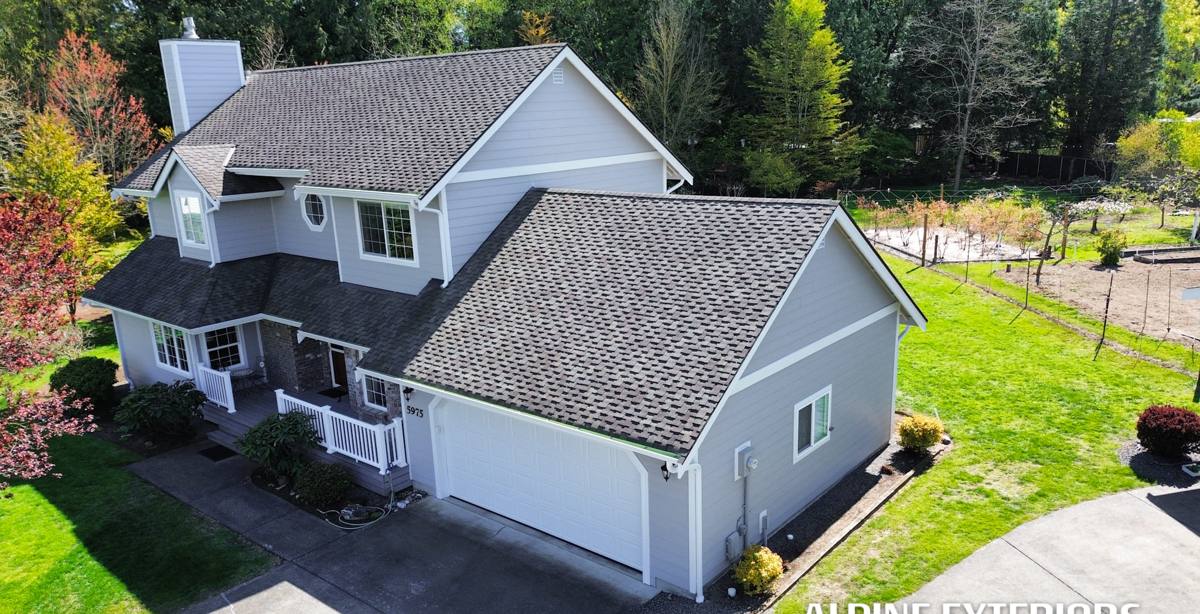
What Ferndale Homes Actually Need From Their Siding
Working in and around Lynden and Ferndale for years has taught us what actually holds up here versus what looks fine on installation day and struggles by year five. Three things matter most:
- Genuine moisture resistance — not just a coating, but a material that doesn't swell, rot, or delaminate when it stays damp for extended periods
- A finish that resists salt exposure and UV — coastal air accelerates fading and chalking on lower-grade paint systems
- Installation details that manage water on purpose — correct flashing, drainage planes, and clearances matter more here than in a dry climate where a small mistake might never get tested by the weather
This is exactly why we standardized on James Hardie fiber cement siding and stopped installing the alternatives. It's not a marketing position — it's a response to what we've seen hold up in Whatcom County weather and what hasn't.
Why We Only Install James Hardie in This Area
James Hardie fiber cement is engineered specifically for climate zones like ours. The HZ5 product line is formulated for the Pacific Northwest's combination of moisture, temperature swings, and coastal exposure — it isn't a one-size-fits-all national product with a regional sticker slapped on it. Fiber cement itself is non-combustible and dimensionally stable, meaning it doesn't swell and shrink with moisture the way wood-based or wood-adjacent products can, which matters enormously in a place where siding spends a good chunk of the year damp.
ColorPlus, Hardie's factory-applied finish, is baked on under controlled conditions rather than field-sprayed or brushed. That matters near saltwater: field-applied paint systems are more prone to early fading and chalking under salt and UV exposure, and touch-ups rarely match the original finish. ColorPlus is backed by its own finish warranty separate from the substrate warranty, which gives homeowners a real remedy if the finish underperforms — not just goodwill.
We get asked fairly often why we won't install LP SmartSide, vinyl, or primed wood species instead, especially when a homeowner has a specific budget or aesthetic in mind. The honest answer: we've made a professional judgment that those products carry real trade-offs in this climate — moisture sensitivity, maintenance burden, or a finish system that doesn't hold up to salt air and constant rain as well as we're comfortable standing behind. We'd rather turn down work than install something we don't believe will perform on a Ferndale house for the next several decades.
What a Correct Siding Installation Actually Involves
Siding installation quality is decided mostly by things you'll never see once the job is done. The material is only half the equation — the other half is the water management system underneath it.
Water-Resistive Barrier and Drainage
Every wall needs a continuous, correctly lapped weather-resistive barrier before a single piece of siding goes up. In a climate with as much sustained rain as Whatcom County gets, we also pay close attention to drainage — giving bulk water a path to escape rather than trapping it flat against the sheathing, which is one of the most common causes of hidden rot behind older siding jobs.
Flashing at Every Penetration
Windows, doors, hose bibs, light fixtures, vents — anywhere something interrupts the siding plane is a place water can get behind it if flashing isn't done correctly. This is the single most common source of siding failure we find on tear-offs, and it has nothing to do with the siding material itself.
Fastening and Clearances
James Hardie has specific fastening patterns and minimum clearances from grade, roofing, and decking that are engineered into the product's warranty. Skipping them doesn't just risk a callback — it can void coverage. We follow Hardie's installation specifications exactly, not "close enough."
Caulking and Joint Treatment
Butt joints, corners, and trim intersections need to be sealed with the right products, not just caulked shut and painted over. Done wrong, these are where moss and moisture find a foothold first — exactly the failure pattern common on siding jobs in this part of the county.
How We Approach a Ferndale Siding Project
| Step | What Happens |
|---|---|
| Initial walk-through | We inspect existing siding, sheathing condition where visible, trim, and problem areas — moss buildup, staining, and soft spots tell us a lot before we even talk product |
| Estimate and product selection | We walk you through Hardie's lines and colors relevant to your home, with a straightforward written estimate — no pressure, no inflated "today only" pricing tactics |
| Tear-off and sheathing check | Old siding comes off and we inspect the sheathing underneath for rot or damage before anything new goes up — this step catches problems a surface-level look never would |
| Water-resistive barrier and flashing | Correct lapping, drainage, and flashing at every penetration, done to spec rather than rushed |
| Hardie installation | Fastened, clearanced, and joint-treated per James Hardie's published specifications so the product warranty stays intact |
| Final walk-through | We review the finished work with you directly and address anything before we consider the job done |
Signs a Ferndale Home May Need New Siding Soon
Because moisture damage in this climate tends to build slowly and quietly, it's worth knowing what to watch for:
- Soft or spongy sections when pressed, especially near the bottom of walls or under windows
- Persistent moss or dark streaking that keeps coming back after cleaning
- Paint that's peeling, bubbling, or chalking noticeably faster than the rest of the house
- Visible gaps, warping, or separation at butt joints and corners
- A musty smell near exterior walls inside the home, which can point to moisture getting behind the siding
- Rising energy bills that don't match usage — a sign the wall assembly may no longer be sealing properly
Any one of these on its own isn't necessarily an emergency, but a combination is usually a sign it's time for a real inspection rather than another round of caulk and paint.
What to Ask Before Hiring a Siding Contractor Here
Whatcom County has no shortage of contractors willing to quote a siding job, but not all of them work regularly in coastal-adjacent conditions like Ferndale's. Before hiring anyone:
- Ask specifically how they handle flashing and drainage, not just "what siding do you install"
- Ask whether they're a certified or experienced James Hardie installer and can speak to HZ5 requirements
- Ask what happens if they find rot or damaged sheathing during tear-off, and how that's priced
- Ask for their approach to caulking, joint treatment, and touch-up on ColorPlus finishes
- Ask how they handle warranty claims — both the manufacturer's and their own labor warranty
A contractor who works Ferndale and Lynden regularly should have straightforward, specific answers to all of these without hesitation.
Local Experience Matters More Than It Sounds Like It Should
A crew that mostly works drier, inland projects can do a technically fine installation and still miss details that matter specifically near the coast — drainage sizing, clearance from grade in a yard that stays damp longer, or which corners of a house take the worst of the driving rain off the water. Working Ferndale and the surrounding Lynden area consistently means we've seen how these houses actually weather over time, not just how they look on installation day.
If your siding is showing its age, or you're planning ahead rather than waiting for a problem, we're happy to take a look and give you a straightforward, no-pressure assessment of where things stand and what a correct James Hardie installation would involve for your home. Fill out the form below and we'll set up a free estimate.