 Lynden Siding
 Roof Repair in Kendall: Whatcom County Weather Doesn't Take a Season Off
Kendall sits out past the edge of Lynden, in the quieter, tree-heavy country toward the Mount Baker foothills. It's a different setting than town — bigger lots, more mature conifers, longer driveways, and roofs that spend a lot more time in shade. That combination changes how a roof ages out here. The same marine air that brings driving rain off the Pacific also carries enough moisture and salt-tinged humidity to keep organic growth active on shaded roof slopes for most of the year. Add a long Whatcom County moss season and a heavy canopy of overhanging trees, and you get roofs that fail in specific, predictable spots — long before the whole system is actually worn out.
That's the case for repair over replacement more often than people expect. A roof that's dumping water in one valley, or shedding shingles off one wind-exposed corner, isn't necessarily a roof that needs to come off. It's a roof that needs the right repair, done correctly, by someone who understands what Kendall's climate and tree cover are doing to it.
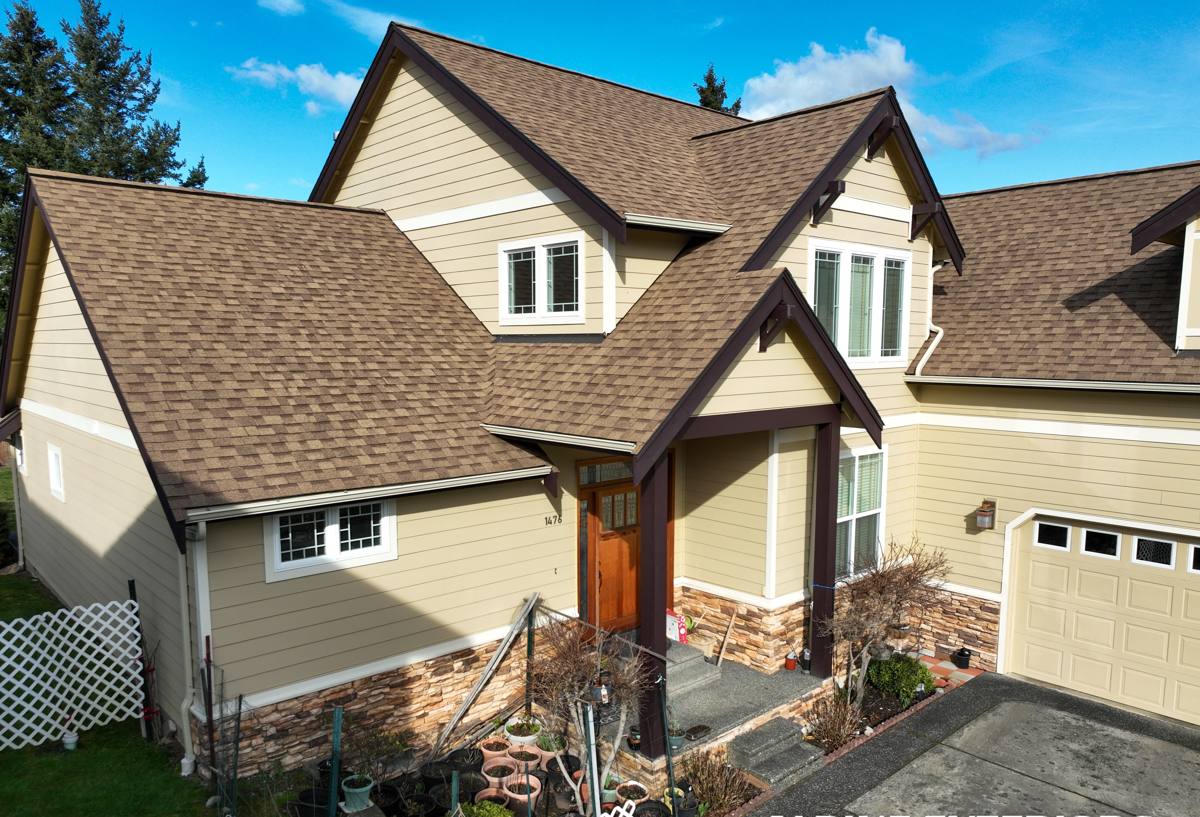
The Kendall Difference: Trees, Shade, and Rural Lots
Most of the roof problems we see out here trace back to the same root cause: shade and debris. Big firs and cedars overhanging a roofline mean needles and cones collecting in valleys and behind chimneys, gutters that clog faster than they would on an open lot in town, and roof sections that almost never get direct sun. Those shaded sections stay damp longer after every rain, which is exactly what moss, moss spores, and roof algae need to take hold.
On a more exposed Lynden in-town roof, you might get moss on the north slope only. On a Kendall property tucked under a stand of conifers, moss can spread across multiple slopes, work into the shingle mat, and start lifting tabs at the edges — which is when small leaks start. Rural lots also mean longer access routes and, sometimes, trickier staging for equipment. It's not a bigger job by default, but it's a different job, and it pays to have a crew that's used to working it.
Signs Your Kendall Roof Needs Repair
Most roof failures give warning signs well before there's a leak inside the house. Worth checking for, especially after a windy stretch or heavy rain:
- Granules collecting in gutters or at the base of downspouts — a sign shingles are wearing thin
- Dark streaking or a green-black tint on shaded slopes — early moss and algae growth
- Lifted, curled, or missing shingles, especially on corners and ridge lines exposed to wind
- Soft or spongy spots when walking the roof, which can mean the decking underneath is wet
- Rusted or lifted flashing around chimneys, skylights, and where roof planes meet
- Daylight visible through the roof deck from inside the attic
- Water stains on interior ceilings or attic framing, even faint ones
- Moss buildup thick enough to hold water against the shingle surface
Any one of these on its own is usually a repair, not a red flag for full replacement. The trouble comes when several of these sit unaddressed for a couple of wet seasons — that's when a contained problem turns into deck rot and a much bigger job.
What a Proper Roof Repair Actually Involves
A roof repair done right isn't just swapping out the shingles you can see are damaged. It means understanding why that section failed and fixing the cause, not just the symptom. On most Kendall repairs, that looks like:
Diagnosis before any material comes off
We find the actual entry point of a leak, which is often several feet from where the water stain shows up inside. Water travels along the underlayment and rafters before it drips, so tracing it back matters more than patching where the ceiling looks wet.
Removing compromised material completely
Damaged shingles, saturated underlayment, and any soft decking get pulled — not covered over. Roofing over wet decking traps moisture and guarantees the same repair fails again within a season or two.
Correcting flashing and transitions
A large share of the leaks we find in Kendall trace back to flashing, not shingles — around chimneys, skylights, dormers, and roof-to-wall transitions. Flashing that's rusted, undersized, or improperly lapped will keep letting water in no matter how new the shingles around it are.
Matching materials properly
Shingle color and profile fade and weather over time, so a patch never looks identical to a 10-year-old roof. We use the closest reasonable match and tie new material into the existing roof correctly at seams and courses, so the repair performs as one system rather than a patch sitting on top of another.
Repair or Replace? What Actually Drives That Decision
Homeowners in Kendall often assume any leak means a new roof. Usually it doesn't. The decision comes down to how much of the roof is affected, how old the existing roofing is, and whether the decking underneath is still sound.
| Factor | Points Toward Repair | Points Toward Replacement |
|---|---|---|
| Age of roof | Under roughly two-thirds of its expected lifespan | Nearing or past its expected lifespan |
| Extent of damage | Isolated to one slope, valley, or flashing detail | Widespread across multiple slopes |
| Decking condition | Solid, dry decking under the affected area | Soft, delaminated, or rotted decking in several spots |
| Moss/algae extent | Surface growth, shingles still intact underneath | Growth has lifted tabs and broken the shingle seal broadly |
| Typical cost range | Several hundred to a few thousand dollars, depending on scope | Several thousand dollars and up, whole-roof scale |
These are general guideposts, not a formula — the only reliable way to know is a physical inspection, including a look at the attic side of the decking where accessible.
Common Roof Problems We Find in Kendall
A few patterns show up often enough on Kendall roofs that they're worth calling out specifically:
Moss-driven shingle lift. Moss doesn't just look bad — as it grows, it works under shingle tabs and physically lifts them, breaking the shingle's wind seal and opening a path for water. On heavily shaded lots this can happen faster than homeowners expect.
Valley and debris buildup. Needles and small debris collect in roof valleys under tree cover and hold water against the shingles far longer than an open valley would. Over time this accelerates wear right at one of the most leak-prone parts of any roof.
Gutter overflow damage. Clogged gutters from overhanging trees back water up under the drip edge and fascia, which shows up as rot at the roof edge even when the field of the roof looks fine.
Flashing fatigue. Constant damp conditions accelerate corrosion on older or lower-grade flashing, especially around masonry chimneys, which are common on older Whatcom County farmhouses in this area.
Our Roof Repair Process
We keep the process straightforward, because a roof repair shouldn't require guesswork on the homeowner's end:
- Inspection. We walk the roof and check the attic where accessible, looking for both the visible damage and its underlying cause.
- Honest assessment. We tell you plainly whether it's a repair or something bigger, and why — including what happens if it's left alone through another wet season.
- Written scope. You get a clear description of what will be removed, repaired, and replaced, so there's no ambiguity about what the job includes.
- The repair itself. Damaged material out, decking checked and replaced where needed, flashing corrected, new material tied in properly.
- Cleanup and walkthrough. We clear debris from gutters and the ground, and walk the repair with you before we call it done.
Why a Crew That Already Works Kendall Matters
Roofing work in Kendall isn't identical to roofing work in downtown Lynden or in Bellingham. The access is different — longer driveways, more tree clearance to work around, sometimes gravel or unpaved approaches that affect how we stage material and equipment. The roofs themselves skew older on some properties and newer on others, with a real mix of shingle types and roof pitches across the area.
A crew that already works this part of Whatcom County knows what a Kendall roof under heavy tree cover looks like after five wet winters versus after fifteen, and doesn't need to guess at it. That matters when the decision is repair versus replacement — an inexperienced eye can miss early flashing failure or read surface moss as worse than it is, either of which leads to the wrong recommendation. It also matters for something as basic as scheduling: knowing which roofs in this area need attention before moss season sets in, rather than after the first leak shows up inside.
Keeping Your Roof Ahead of Moss Season
Between repairs, a little regular maintenance goes a long way on a shaded, tree-heavy Kendall lot:
- Clear gutters and valleys of needles and debris at least twice a year, more often under heavy conifer cover
- Trim back branches that overhang or touch the roof to cut down on shade and debris
- Address moss while it's still surface growth, before it lifts shingle tabs
- Check flashing and roof penetrations yearly, since these fail before the shingle field usually does
- Have any interior ceiling stain or attic dampness checked promptly rather than waiting to see if it gets worse
None of this replaces a proper inspection when something looks off, but it does stretch the life of a repair and reduce how often you need one.
If you've got a roof issue in Kendall — a leak, some moss you're not sure about, or damage after a windstorm — we're happy to take a look and give you a straight answer on what it actually needs. The estimate is free, there's no pressure, and you can use the form below to get started.