 Lynden Siding
 "Custom windows" gets used loosely in this business, so it's worth being clear about what it actually means for a homeowner out in Nooksack: any window that isn't a stock size or shape pulled straight off a manufacturer's shelf. That covers a lot of ground out here — a replacement opening in an older farmhouse framed decades before window manufacturers standardized their sizing, a bay window built out to catch more light on a newer build, an arched or oversized picture window matched to a remodel, or an egress opening added when a basement or upper room gets converted to livable space. Nooksack sits in farm country on the edge of Whatcom County, and the mix of older rural homes and newer construction means we run into all of those situations regularly, each with its own fit and weatherproofing challenge layered on top of the other.
Why Nooksack Homes Often Need Custom Sizing
A few things push window projects in this area out of stock-size territory more than they would in a newer subdivision. Farmhouses and outbuildings around Nooksack were framed to whatever dimensions made sense at the time, long before common window sizes were standardized, so a straight swap often isn't an option — it's either a custom-built unit or a reframe of the opening, and a reframe brings its own cost and timeline. Additions and converted spaces create openings that don't match anything original to the house. And plenty of homes in this part of Whatcom County were built or remodeled with picture windows, bay windows, or oversized openings meant to take advantage of the open farmland views, which by definition aren't stock sizes either.
None of that makes a project unusual for us — it's routine window work in this corner of the county. It does mean the job starts differently than a same-size replacement: careful measurement first, an honest conversation about what the opening can actually support, and realistic expectations on lead time, since a true custom unit is built to order rather than pulled from a warehouse shelf.
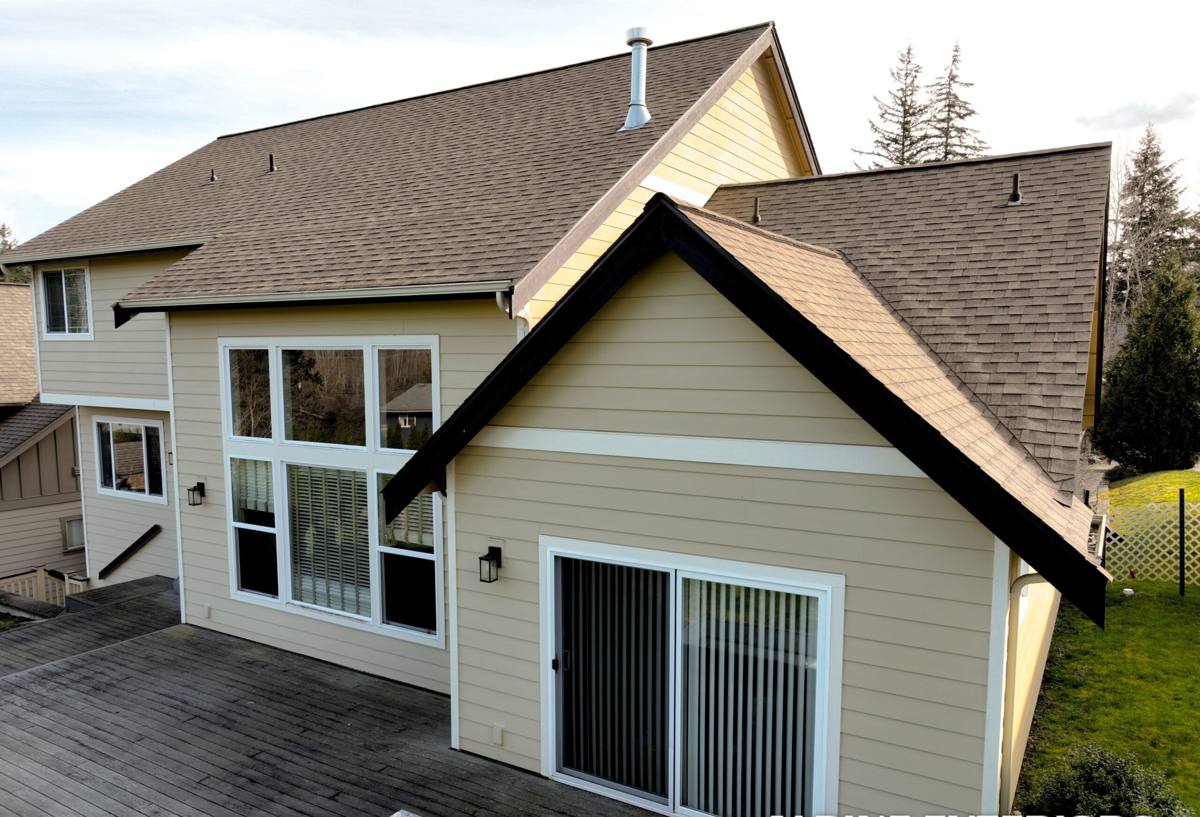
The Climate Factor: Salt Air, Driving Rain, and a Long Moss Season
Whatcom County's weather doesn't stop at the water's edge. Salt-tinged marine air moves inland with the prevailing wind, storms come through wet and sideways rather than falling straight down, and mild, damp conditions give moss and mildew a season that runs most of the year on anything shaded or slow to dry. Nooksack isn't a waterfront town, but it sits inside the same weather system, and that matters more on a custom window than a standard one, because a larger or oddly shaped opening usually means more perimeter to seal, more glass to load up against wind, and more places for water to collect if the flashing isn't built right.
Salt Air and Hardware Corrosion
Even away from open water, the marine air that moves through this part of the county carries enough salt to accelerate corrosion on window hardware, screen frames, and lower-grade fasteners over time. Cheaper finishes tend to show pitting or stiff-moving hardware first — often the earliest sign that a window wasn't built or installed with this region's air quality in mind.
Driving Rain and Flashing
Rain out here rarely falls straight down. Wind pushes it sideways into head flashing, jamb details, and the sill pan under the frame, and that sideways load tests the installation far more than it tests the window product itself. A modest window installed with correct flashing and a properly pitched sill pan will outperform a premium unit that was flashed carelessly. Most of the water damage we find around windows traces back to installation detail, not the window.
Moss, Mildew, and Sill Rot
Shaded walls and sills that don't drain well hold moisture longer here than they would in a drier climate, and that moisture feeds mildew growth and, on wood-framed windows, slow rot at the sill and lower corners. It's gradual — most homeowners don't catch it until paint starts failing or a sill feels soft underfoot, by which point the fix is bigger than it needed to be.
Custom Window Types We Build For
"Custom" isn't one thing — the approach changes depending on what's actually being built or replaced.
- Non-standard replacement sizes — matching an opening in an older farmhouse or outbuilding that predates modern sizing standards
- Bay and bow windows — projecting units that add interior space and light but require their own roof, support, and flashing system
- Picture and large-format windows — fixed units used to open up a view across open land, with more glass area to manage structurally
- Arched, angled, or specialty-shaped openings — architectural details that need custom-cut units and matching custom flashing
- Egress and code-driven openings — additions or converted basement and upper-level spaces where the opening size is set by code, not preference
- Matched sets for additions — new windows that need to sightline correctly with the existing windows on the rest of the house
What a Correct Custom Window Installation Involves
The window unit itself is only part of the job. What actually determines whether it performs for the next twenty years is the sequence around it:
- Accurate measurement of the existing opening — including checking for square, level, and any settling or rot that needs to be addressed before a new unit goes in
- Removal and inspection of the old window and surrounding framing — this is where hidden water damage from a prior installation often turns up
- Repair of any compromised framing or sheathing — installing a new window into a soft or rotted opening just repeats the same failure on a delay
- Correct flashing sequence — sill pan first, then jamb flashing, then head flashing, layered so water sheds outward at every level, not tucked in a way that traps it
- Proper shimming and fastening — so the unit stays square and operates correctly, without stress points that crack seals early
- Air sealing and insulation at the rough opening — gaps here cost energy efficiency and can create condensation points inside the wall
- Exterior trim and sealant detailing — the last line of defense, and the first thing that shows wear if it's rushed
Our Process for Nooksack Projects
We start with a walk-through of the actual opening, not a phone estimate — on custom work, guessing at dimensions or condition from a description leads to bad quotes and worse installs. From there we talk through what's realistic for the opening: whether it's a straightforward custom-size replacement or something that needs reframing, structural support, or code review for an egress requirement. We give you an honest read on lead time, since custom units are built to order and can take weeks longer than a stock window, and we schedule the install around that timeline rather than promising a date we can't hit. On install day, we protect the interior and surrounding exterior finishes, follow the flashing sequence above regardless of how routine the opening looks, and walk you through the finished work before we consider the job done.
Frame Materials and Cost Factors
Frame material matters more on a custom unit, since a larger or more exposed opening gives weather more surface area to work against. We'll go through the honest trade-offs for your specific project rather than defaulting to whatever's easiest to install.
| Material | Strengths | Trade-offs in This Climate |
|---|---|---|
| Vinyl | Lower cost, low maintenance, good energy performance | Larger custom sizes can need reinforcement; color options are limited compared to other materials |
| Fiberglass | Very stable in temperature swings, strong for larger custom units, low maintenance | Higher upfront cost than vinyl |
| Wood | Traditional look, especially on older farmhouses | Needs consistent exterior maintenance to hold up against driving rain and moss; a poor maintenance schedule shows up fast here |
| Wood-clad | Wood interior look with a more weather-resistant exterior shell | Cladding quality varies by manufacturer; exterior detailing still has to be done correctly at the flashing points |
What Drives Cost on a Custom Job
We won't quote a number without seeing the opening, but the factors that move price on custom work are consistent from job to job:
| Factor | Why It Matters |
|---|---|
| Size and glass area | More glass and larger units cost more to manufacture and are heavier to install |
| Shape complexity | Arched, angled, or bay shapes need specialty manufacturing and more flashing labor |
| Structural work | Bay windows and larger openings sometimes need added framing support |
| Opening condition | Rot, old flashing failures, or an out-of-square opening add repair work before the new unit goes in |
| Frame material | Vinyl, fiberglass, and wood-clad units differ in both material cost and long-term maintenance |
| Number of units | A matched set for an addition typically has better per-unit economics than a single window |
A Homeowner's Pre-Install Checklist
Before committing to a custom window project, it's worth going through a short list:
- Get the opening measured in person — not estimated from photos or a general size guess
- Ask what the realistic lead time is once the unit is ordered, and plan around it
- Confirm whether the opening needs any framing repair before the new window goes in
- Ask specifically how flashing will be handled for your window's shape, not just a general answer about "standard installation"
- Get clarity on what's covered under the window manufacturer's warranty versus the installer's labor warranty
- If it's an egress or code-driven opening, confirm the size meets current code before ordering
Why a Crew That Already Works Nooksack Matters
Manufacturer installation guides are written for average, standard conditions. Custom windows in Nooksack rarely fit that description, and the climate here doesn't either — driving rain and salt-tinged air stack the deck against a rushed installation more than they would somewhere drier and calmer. A crew that has actually reframed odd-sized openings, built out bay windows, and flashed arched units in this part of Whatcom County knows which steps in the manufacturer's guidance are non-negotiable here, and where extra time on flashing or sealant is worth it even when it's not strictly required elsewhere.
That experience shows up in decisions that never make it into a sales pitch — how much lap a flashing course needs on an arched opening, when a sill needs a sloped composite cap instead of relying on caulk, how a bay window's roof ties into the wall's water management. Those details decide whether a custom window is still performing cleanly in fifteen years or showing drafts and soft trim in five. We're a Lynden-area crew that already works this stretch of the county, which means less guesswork on your project and fewer surprises once the walls are opened up.
Ready to Talk About Your Opening
If you're planning an addition, replacing an odd-sized window in an older Nooksack farmhouse, or considering a bay or picture window for a remodel, it's worth having someone look at the actual opening before you start pricing units. We offer free, no-pressure estimates for custom window projects in Nooksack and the surrounding Lynden area — use the form below to get a time on the schedule.