 Lynden Siding
 Roofing Built for Laurel's Climate, Not Just Any Climate
Laurel sits in a part of Whatcom County where roofs work harder than the national averages on a shingle wrapper would suggest. The combination of near-constant fall and winter moisture, cooler marine air drifting in off the Sound, and long stretches of shade under mature trees creates conditions that push ordinary roofing decisions past their limits. A roof that would hold up fine in a dry inland climate can struggle here within a decade if it wasn't specified and installed with these local realities in mind.
Three factors define what a Laurel roof needs to survive long-term: driving rain that gets pushed sideways under poorly sealed edges and flashing, a moss season that stretches for much of the year and never fully lets up on shaded, north-facing slopes, and a steady dose of salt-tinged marine air that accelerates corrosion on fasteners, flashing, and any metal component that wasn't rated for it. None of these are dramatic on their own. Together, over years, they're exactly what separates a roof that lasts two decades from one that needs premature repairs.
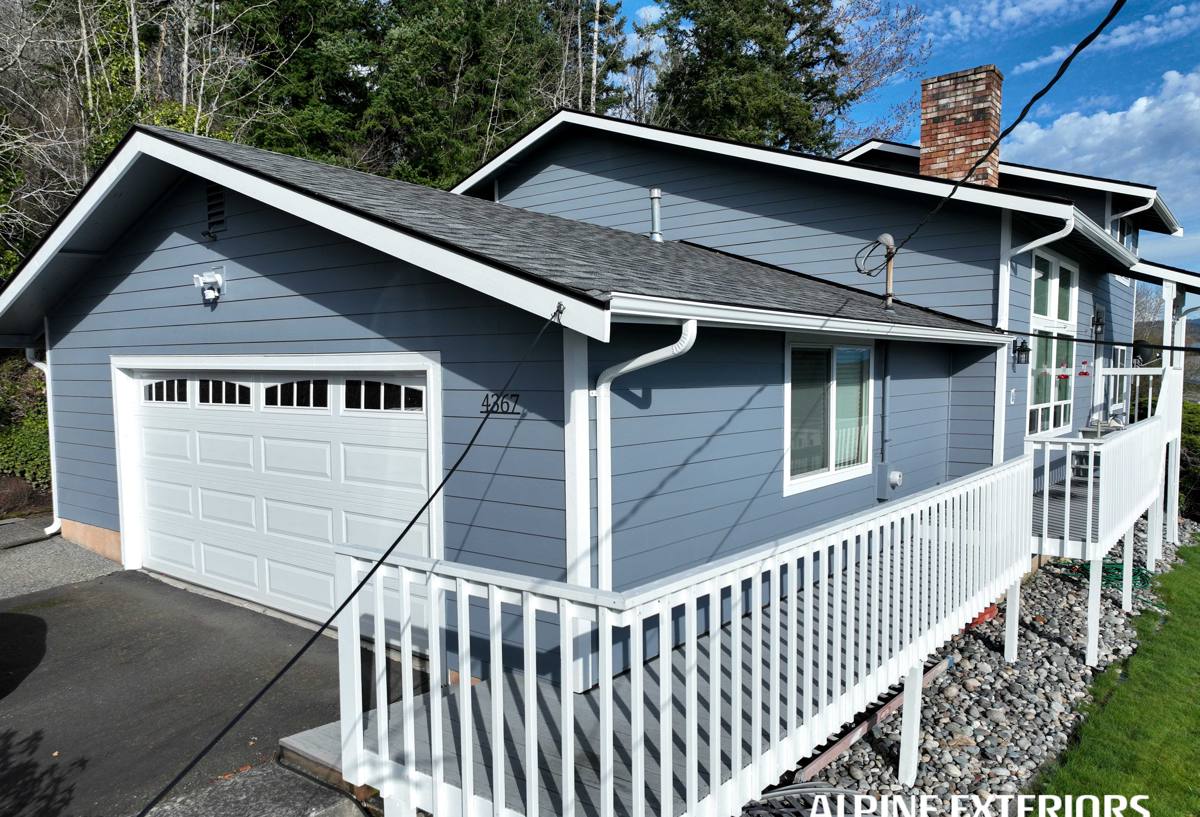
How This Climate Shows Up on Real Roofs
Homeowners in Laurel typically don't see catastrophic failure — they see slow, cumulative wear that's easy to underestimate until it isn't. Moss establishes itself in shaded valleys and north-facing slopes first, then spreads. It holds moisture against the shingle surface long after the rest of the roof has dried, which shortens the life of the granule layer and, eventually, opens the door to rot in the decking underneath. Driving rain finds any gap in flashing around chimneys, skylights, and roof-to-wall transitions, and it doesn't take a hurricane to do it — a sustained westerly wind during a normal winter storm is enough.
Salt-influenced air is the quieter problem. It doesn't announce itself the way a leak does. Instead it works on fasteners, drip edge, and any lower-grade metal flashing, corroding them faster than a spec sheet written for a different climate would predict. By the time rust stains show up on a fascia board or a nail head backs out, the damage has usually been building for a while.
Warning Signs Worth Acting On
- Moss or dark streaking concentrated on shaded or north-facing roof planes
- Granules collecting in gutters or at downspout outlets
- Shingles that look cupped, curled at the edges, or brittle
- Rust staining around flashing, valleys, or fastener heads
- Daylight visible through the attic roof deck, or damp insulation below it
- Interior ceiling stains that appear after wind-driven storms specifically
- Soft or spongy decking felt underfoot during any roof access
What a Correct New Roof Installation Actually Involves
A new roof is more than laying shingles over what's there. Done correctly for a Laurel property, the job addresses everything underneath and around the visible surface, since that's where most premature failures start.
Tear-Off and Deck Inspection
We remove the old roofing down to bare decking rather than layering over it. This is the only way to actually see the plywood or plank sheathing underneath — which is where moss-related moisture and old leaks tend to leave the real damage. Soft, delaminated, or rotted sections get replaced before anything new goes down. Skipping this step is the single most common reason a "new" roof fails early.
Underlayment and Ice-and-Water Protection
Given how much wind-driven rain this area sees, underlayment choice matters more here than in drier climates. We use synthetic underlayment as the general water-resistive layer and self-adhered ice-and-water shield at vulnerable points — eaves, valleys, and roof penetrations — where wind-driven rain is most likely to work its way backward under the shingle course.
Flashing Done Right
Flashing around chimneys, skylights, sidewalls, and valleys is where most leaks actually originate, not in the field of the roof itself. We use properly sized, corrosion-resistant flashing and step-flash roof-to-wall transitions individually rather than relying on caulk or a single long strip to do the job. Caulk is a maintenance item, not a waterproofing method, and we don't treat it as one.
Ventilation and Moisture Control
A roof that can't breathe traps moisture in the attic, which shortens the life of the decking and the shingles from underneath — invisibly, until it isn't. We balance intake (soffit) and exhaust (ridge or roof vents) so the attic space actually moves air, which also helps control the ice-damming risk on the rare hard-freeze days this area does get.
Choosing the Right Roofing Material for Laurel
There's no single "best" roofing material — there's the right material for a given roof pitch, budget, tree cover, and how long the homeowner plans to stay in the house. Here's how the common options compare for a property in this climate:
| Material | Moss Resistance | Wind/Rain Performance | Typical Lifespan Here | Relative Cost |
|---|---|---|---|---|
| Architectural asphalt shingle | Moderate (better with algae-resistant granules) | Good when properly flashed and fastened | 20-30 years | $ |
| 3-tab asphalt shingle | Lower | Adequate, less wind-rated | 15-20 years | $ |
| Metal (standing seam) | High — sheds moss growth surface | Excellent | 40-50+ years | $$$ |
| Synthetic/composite shingle | Moderate to high | Good | 30-40 years | $$ |
Asphalt architectural shingles remain the most common choice for good reason — they perform well here as long as they're a quality product with algae-resistant granules and are installed with attention to the flashing and ventilation details above. We're selective about which shingle lines we install, favoring products with a track record in wet Pacific Northwest conditions over ones that look identical on a sample board but haven't been tested the same way. Metal is a strong option for homeowners planning to stay long-term or dealing with heavy tree cover and shade, since it sheds moisture and resists moss growth on the surface itself, though it comes at a higher upfront cost.
What Affects the Cost of a New Roof
Every roof is priced on its own specifics, but the main cost drivers are consistent from house to house:
| Factor | Why It Matters |
|---|---|
| Roof size and pitch | Steeper roofs take longer and require more safety setup |
| Number of layers to remove | Tear-off labor and disposal cost scale with what's already there |
| Decking condition | Rotted sections found during tear-off require replacement |
| Roof complexity | Valleys, dormers, skylights, and chimneys all add flashing work |
| Material selection | Asphalt, synthetic, and metal carry different material and labor costs |
| Ventilation upgrades | Adding or correcting intake/exhaust venting is sometimes needed |
We won't know exact numbers for your roof until we've actually looked at it — pitch, access, and decking condition all swing the final price, sometimes significantly. What we can promise is a written estimate that spells out what's included, with no surprise add-ons discovered mid-project that weren't discussed up front.
Our Process, Start to Finish
- On-site inspection — we walk the roof, check the attic if accessible, and note pitch, layers, flashing points, and any visible problem areas.
- Written estimate — a clear scope of work and price, with material options explained rather than just listed.
- Scheduling — timed around Whatcom County's weather windows, since roofing during an active storm system isn't good practice for anyone.
- Tear-off and deck inspection — old roofing removed, decking checked and repaired as needed before anything new is installed.
- Underlayment, flashing, and material installation — installed to the standards described above, not shortcuts specific to speed.
- Ventilation check — intake and exhaust venting confirmed or corrected.
- Final walkthrough — cleanup, magnetic nail sweep, and a review of the finished roof with the homeowner.
Why a Crew That Already Works Laurel Matters
Roofing crews who mostly work drier, milder climates tend to default to specs and shortcuts that don't hold up here — lighter underlayment, minimal flashing, ventilation as an afterthought. A crew that regularly works Whatcom County roofs already knows which slopes hold moss longest, which flashing details actually stop wind-driven rain, and which shingle products have a real performance history in marine-influenced weather rather than just a warranty document. That local pattern recognition is the difference between a roof that's technically installed to code and one that's actually built for what Laurel weather does to it, year after year.
It also matters for smaller, practical reasons: knowing realistic scheduling windows around the wetter months, understanding permitting expectations locally, and being reachable afterward if a question comes up — not a crew that did one job in the area and moved on.
Maintenance That Extends Roof Life Here
A correctly installed roof still benefits from basic upkeep in this climate, particularly around moss control. Keeping gutters clear of granules and debris, trimming back overhanging branches that keep shaded areas damp, and addressing moss growth before it spreads rather than after are the simplest ways to get the full lifespan out of a new roof. We're glad to walk through what makes sense for your specific roof and tree cover during the estimate.
If your roof is showing moss buildup, granule loss, or you're just planning ahead before the next storm season, we're happy to take a look and put together a straightforward, no-pressure estimate — no obligation, just an honest read on where your roof stands and what it would take to replace it right. Use the form below to get started.