 Lynden Siding
 James Hardie Siding, Installed for What Maple Falls Actually Deals With
Maple Falls sits up in the Whatcom County foothills, further inland and higher in elevation than the coastal towns where a lot of siding contractors do most of their work. That difference matters. Heavier tree cover, more shade, and a wetter, cooler microclimate than you'd find down on the flats around Lynden all change what a siding system needs to hold up over decades rather than years. We install James Hardie fiber cement siding exclusively, and this page is specifically about what that looks like for a Maple Falls home: what the local climate asks of a siding system, what a correct installation involves, and how our process runs on a property in this part of the county.
This isn't a general siding page with a city name swapped in. Maple Falls homes face a different mix of exposure than a house two blocks from the water, and the right siding decision accounts for that mix, not a generic version of "Pacific Northwest weather."
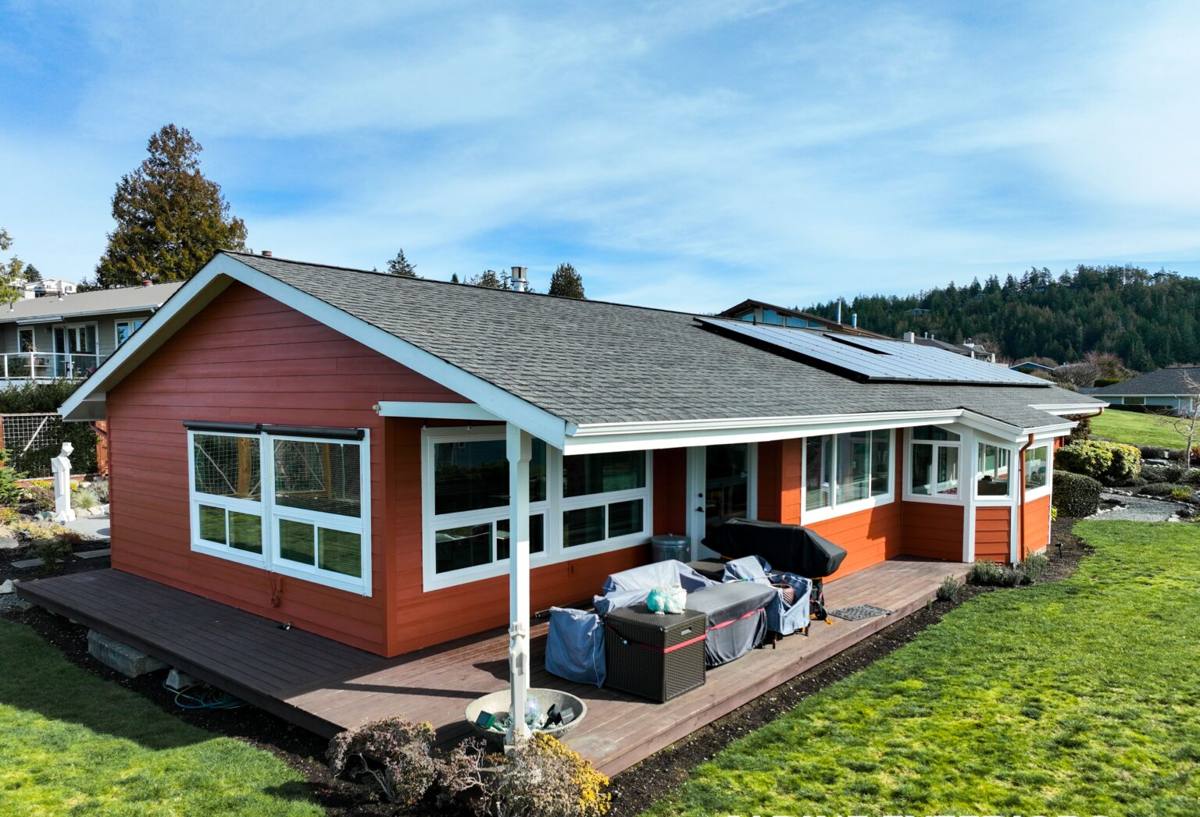
What Maple Falls' Climate Puts a Siding System Through
A Long, Heavy Moss Season
This is the dominant factor for most Maple Falls properties. Mature forest cover, shaded lots, and consistent moisture add up to a moss and mildew season that can run nearly year-round on north-facing and tree-shaded walls. Homes tucked back under fir and cedar canopy see less direct sun and slower drying after every rain than a comparable house on an open lot, which means any siding material that's even slightly porous or that traps moisture against the substrate becomes a growth surface faster here than it would in a more open, sun-exposed part of the county.
Driving Rain and Sustained Wet Weather
Rain through fall, winter, and spring in this part of Whatcom County rarely falls straight down for long. Wind pushes it sideways into wall assemblies, trim, and window flashing, and higher elevation properties often see a longer wet season with more total precipitation than the lowland towns nearby. That sideways load on a wall is the detail that separates a siding job built to shed water from one that lets it track in behind the cladding, regardless of what the material itself is rated to withstand.
Salt Air, at a Lighter but Still Real Reach
Maple Falls is well inland from the coast, so salt-laden marine air isn't the dominant exposure factor it is for waterfront Whatcom County properties. It's still part of the regional picture, carried on weather systems that move through the whole county, and it's one more reason fastener quality and finish durability matter on any exterior product installed up here, not just at the shoreline. We factor it in as a smaller but real piece of the exposure profile rather than ignoring it because a property isn't near the water.
Why James Hardie Is the Only Siding We Install
We used to install a wider range of siding products. We narrowed that down to one system after seeing, repeatedly, how different materials actually perform on shaded, moisture-heavy properties like the ones common around Maple Falls, versus how they look on a spec sheet.
- Non-combustible core: Fiber cement doesn't feed a fire the way wood-based siding can, which is worth weighing seriously for forest-adjacent properties.
- Factory-applied ColorPlus finish: The color is baked on under controlled factory conditions rather than brushed on in the field, which holds up longer against the fading and mildew staining that shaded, damp walls are prone to.
- Climate-engineered HZ product lines: Hardie's HZ5 formulation is built for regions with sustained moisture exposure and freeze-thaw cycling, which fits the wetter, cooler conditions typical at Maple Falls' elevation better than a product engineered for a drier or milder climate.
- Dimensional stability: Fiber cement doesn't swell, cup, or warp the way engineered wood siding can after repeated wetting cycles through a long, shaded wet season.
- A strong transferable warranty: Hardie backs the product with one of the more robust warranty structures in the industry, provided the installation follows their published spec.
We don't install LP SmartSide, vinyl siding, Cemplank, Allura, primed spruce, or cedar. Cedar in particular comes up a lot on wooded, foothill properties, because it fits the setting visually. It's a legitimate material and plenty of homeowners are happy with it, but it's organic, combustible, and dependent on a paint or stain schedule that has to be kept up consistently, and heavy shade with near-constant moisture is exactly the environment where that maintenance burden shows up fastest. Our decision to install only James Hardie is a professional standard, not a claim that every other product is worthless.
How Common Alternatives Hold Up in This Setting
| Product | Common trade-off in a shaded, high-moisture setting like Maple Falls |
|---|---|
| Cedar or primed spruce | Organic and combustible; needs a consistent paint or stain schedule that shaded, damp walls make harder to keep up with |
| LP SmartSide / engineered wood | Wood-strand core is more moisture-sensitive at cut edges and fastener points once the factory coating is compromised |
| Vinyl siding | Panel seams and J-channels give wind-driven rain an entry point; can warp or discolor under sustained UV and temperature swings |
| Other fiber cement brands | May lack a climate-specific HZ-style formulation or the same factory-finish warranty depth as James Hardie |
What a Correct Installation Involves
James Hardie's real-world performance depends heavily on installation quality, and that's especially true on a shaded, moisture-heavy property where any shortcut in the water management details gets tested constantly instead of occasionally.
| Installation Detail | Why It Matters for a Maple Falls Property |
|---|---|
| Rain screen or drainage plane behind the siding | Lets moisture that gets past the surface dry out instead of sitting against a wall that already gets limited sun exposure |
| Manufacturer-specified clearances at grade, roofline, and deck | Keeps splash-back and standing moisture off the board edge, especially where landscaping or forest duff builds up against a foundation |
| Correct fastener type, placement, and depth | Prevents cracking and preserves the weather-resistive barrier through repeated wet-dry cycling |
| Proper flashing at windows, doors, and roof-to-wall transitions | Directs wind-driven rain away from seams instead of letting it collect in a shaded corner |
| Factory-cut edges used wherever possible; field cuts sealed to spec | Keeps the ColorPlus finish's protection intact everywhere, including edges most exposed to moss and mildew growth |
We send certified installers to every job rather than treating fiber cement as an interchangeable swap for whatever a crew is used to hanging. A moisture-resistant, non-combustible material can still underperform badly if the flashing, clearances, and fastening around it are wrong, and that gap tends to show up faster on a shaded, high-moisture lot than it would on an open, sun-exposed one.
Our Process for a Maple Falls Siding Project
Inspection and Estimate
Every project starts with a walk of the actual property: current siding condition, tree cover and shade patterns across each wall, any signs of trapped moisture or soft sheathing, and how sun exposure varies from one side of the house to another. On a wooded lot, that wall-by-wall read matters more than it would on an open property, because a north-facing wall under fir canopy and a south-facing wall in a clearing on the same house can be dealing with genuinely different conditions.
Tear-Off and Substrate Check
Once the old siding comes off, we check the sheathing underneath for rot or soft spots before anything new goes up. On a property that's had years of shaded, slow-drying exposure, this step catches problems that a straight re-cover would hide behind new siding rather than resolve.
Weather Barrier and Flashing Detail
The house wrap, window flashing, and every wall penetration get careful attention at this stage, because most long-term siding failures in this region trace back to water getting behind the cladding rather than through it. This is the step that's easiest to rush and hardest to inspect once the siding is up, so we treat it as a fixed requirement, not an option to skip for speed.
Installation to Manufacturer Spec
James Hardie's warranty depends on the installation following their published specifications: correct fastener spacing, proper clearances, and field-cutting and sealing done to spec. That's our baseline on every job, not an upgrade tier.
Final Walkthrough
We walk the finished job with the homeowner, cover realistic care and maintenance expectations for a shaded property, and confirm everything matches what was estimated before calling the job done.
Signs a Maple Falls Home's Siding Needs Attention
- Moss or dark staining that comes back quickly after cleaning, especially on shaded, tree-covered walls
- Soft or spongy siding near grade, under gutters, or around window and door trim
- Peeling paint or visible cupping and warping, most common on older wood-based or engineered wood siding
- Cracked, buckled, or missing panels after a windstorm
- Rust staining running down from fasteners or trim hardware
- Musty odors or staining on interior walls that back up to exterior siding
- Visibly slower drying on certain walls compared to others after a rain, which usually points to a shade or airflow issue worth addressing in the siding detailing
Cost Factors for a Maple Falls Siding Project
| Factor | Why It Affects Cost |
|---|---|
| Home size and wall complexity | More square footage, corners, and trim detail means more material and labor time |
| Condition of existing sheathing | Rot or moisture damage found during tear-off adds repair scope before new siding can go on |
| Access and site conditions | Wooded, sloped, or long-driveway lots common around Maple Falls can affect staging, scaffolding, and material delivery logistics |
| Product line and finish selection | HardiePlank, HardiePanel, and HardieShingle carry different material and labor costs, and ColorPlus vs. primed-for-paint options affect price too |
| Scope beyond siding | Trim, flashing repair, or window integration done alongside the siding adds cost but avoids a second mobilization later |
We give real numbers after a site walk, not a flat per-square-foot estimate over the phone, because lot conditions and existing wall condition vary enough around Maple Falls that a generic quote usually ends up wrong in one direction or the other.
Why Hiring a Crew That Already Works Maple Falls Matters
A siding crew that mostly works flatter, more open, more accessible properties closer to town doesn't automatically translate that experience to a shaded, higher-elevation lot with a longer driveway and a different drying pattern on every wall. Material staging, scaffolding setup, and scheduling around wetter stretches of weather all look a little different on a forested Whatcom County property than they do on an open lot in a subdivision. A crew that's already done the drive and worked properties like this knows what to expect before the truck is unloaded, which shows up as fewer surprises and fewer change orders once the old siding comes off.
It also matters for the parts of the job that are easy to get wrong from a distance: knowing how much shade a given wall really gets through the year, recognizing which siding failures on a forested lot are cosmetic versus structural, and setting realistic maintenance expectations for a homeowner who's dealing with more moss pressure than most people down in town. That's local knowledge that comes from doing the work here repeatedly, not from a single bid visit.
Checklist: What to Confirm Before You Sign
- Ask whether the installer is manufacturer-certified for James Hardie specifically, not just experienced with siding generally
- Ask what HZ product line is being specified and whether it fits this elevation and moisture profile
- Ask how the crew plans to handle site access, material staging, and weather delays on a wooded or sloped lot
- Ask what happens if hidden sheathing damage turns up once the old siding is off
- Ask what the warranty actually covers, whether it's prorated, and whether it transfers to a future owner
- Get the estimate in writing with a clear scope, not just a total number
If you're planning a re-side in Maple Falls or anywhere else in Whatcom County, we're glad to walk the property, take a real look at wall-by-wall exposure, and give you a straight answer on what we'd recommend and why. Reach out using the form below to schedule a free, no-pressure estimate.