 Lynden Siding
 Siding That Has to Work in Kendall, Not Just Look Good on Day One
Kendall sits out toward the foothills east of Lynden, in the part of Whatcom County where the rain lingers longer, the tree cover is heavier, and homes tend to sit on larger, more shaded lots. That combination is hard on an exterior wall. Between the driving rain that blows in off changing weather systems, the moisture-laden air that moves across this whole corner of the county, and a moss season that can run most of the year on a shaded roofline or north-facing wall, siding here is doing real work, not just holding paint and looking presentable from the road. We install fiber cement siding in Kendall because it is built to hold up under exactly these conditions, and this page walks through what that actually means for a Kendall home, not just what a spec sheet says.
This is a page about one product, in one place: James Hardie fiber cement siding, installed correctly, on Kendall homes. We are not going to cover every siding option available on the market here. We only install James Hardie, and the reasons why are baked into the rest of this page.
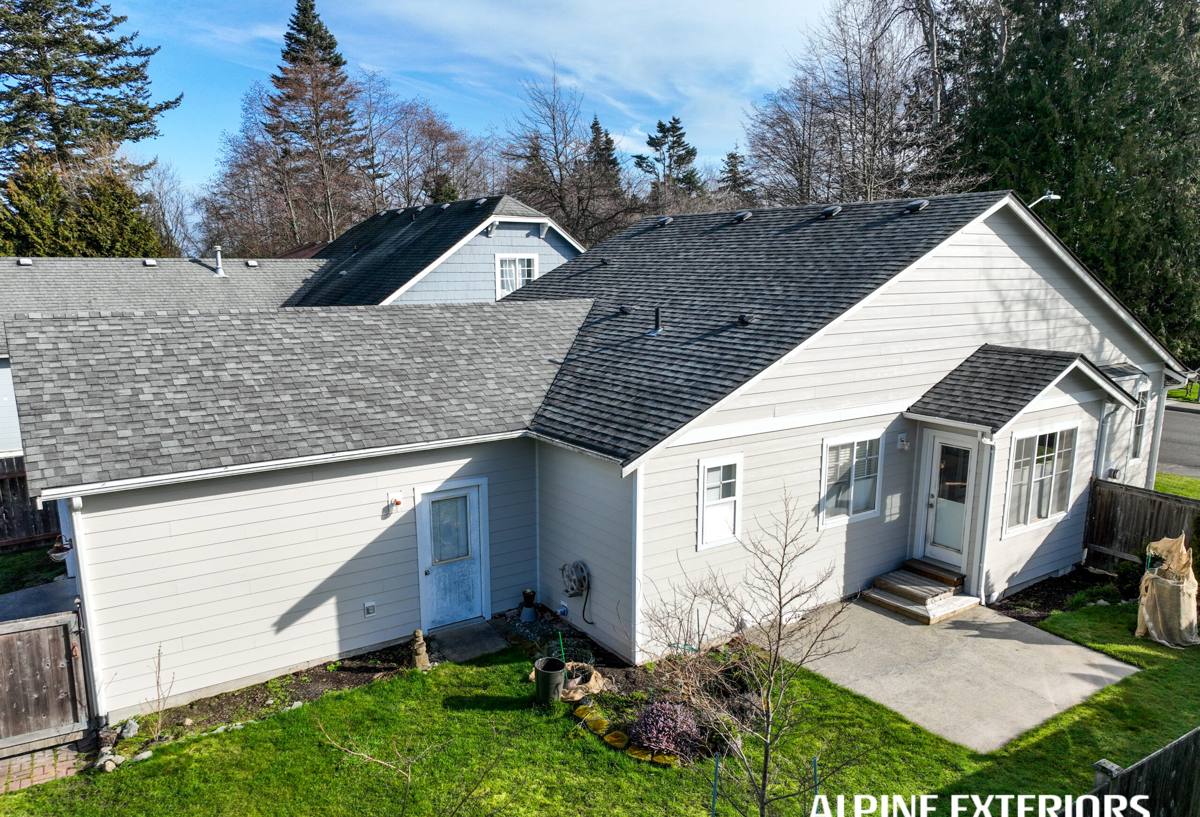
What Kendall's Climate Actually Does to an Exterior Wall
Three things do most of the damage to siding in this part of Whatcom County over time, and none of them are dramatic on their own. It is the combination, repeated over ten or twenty winters, that separates siding that ages well from siding that fails early.
Driving Rain
Rain that falls straight down is easy to shed. Rain pushed sideways by wind is not. It works its way into lap joints, behind trim, and into any seam where flashing and caulking were not done right the first time. Wind-driven rain is a much tougher test of an installation than annual rainfall totals suggest, and it is a routine part of a Kendall winter.
Persistent Moisture and Salt-Influenced Air
Whatcom County's overall climate carries a marine influence across most of the region, and even properties well inland deal with steady, moisture-heavy air for much of the year rather than short, isolated wet spells. That constant dampness is harder on fasteners, trim hardware, and factory finishes than an equivalent amount of rain concentrated into a few storms would be. It is a slow, cumulative effect, not an obvious one, which is exactly why it gets underestimated.
A Long Moss and Mildew Season
Kendall's tree cover and larger, shaded lots are good for privacy and bad for siding. Moss and mildew need shade and steady moisture to establish, and a lot of Kendall properties offer both for most of the year. Organic growth on a siding surface holds moisture against the wall behind it, and that trapped moisture is where a lot of long-term rot and finish failure actually starts, well before it is visible from the yard.
Why Fiber Cement Is the Right Call for This Kind of Property
Fiber cement is a mix of Portland cement, sand, and cellulose fiber, engineered specifically to resist the two things that wreck most siding materials over time: moisture and fire. It does not absorb water the way wood-based products do, it does not rot, and it does not provide fuel the way vinyl or engineered wood siding can. For a shaded, moisture-exposed lot like a lot of Kendall properties sit on, that resistance to sustained dampness is the single biggest reason we recommend it over anything else.
We install James Hardie specifically, not fiber cement in general. Hardie engineers its HZ5 product line for regions with real freeze-thaw cycles and sustained moisture exposure, which describes Whatcom County's winters accurately. That is not a marketing detail. A fiber cement product engineered for a hot, dry climate does not perform the same way here, and using the correct HZ line for this region is part of what a correct installation means.
What ColorPlus Finish Adds
Standard field-painted siding depends entirely on the quality and thickness of a paint job applied on site, often under time pressure and inconsistent weather. Hardie's ColorPlus finish is baked on at the factory in a controlled environment, in multiple coats, and backed by its own finish warranty separate from the product warranty. In a climate where moss, mildew, and constant moisture are working against any painted surface year-round, starting with a factory finish instead of a field-applied one is a meaningful advantage, not a cosmetic upgrade.
What a Correct Fiber Cement Installation Actually Involves
Fiber cement siding fails less often because the product itself is weak and more often because it was installed wrong. This is a heavier, more rigid material than vinyl or wood, and it does not forgive shortcuts the way those materials sometimes do. A correct install on a Kendall home covers several details that are easy to skip and expensive to fix later.
Water Management Behind the Siding
Fiber cement is not a waterproofing system by itself. It relies on a correctly installed weather-resistive barrier, properly lapped flashing at every window, door, and penetration, and a rainscreen gap where conditions call for one, to move any water that gets behind the siding back out instead of trapping it against the sheathing. Given how much moisture Kendall's climate pushes at a wall over a year, this layer matters as much as the visible siding itself.
Fastening and Clearances
Hardie specifies exact fastener types, spacing, and placement, and exact minimum clearances from the ground, roofline, and adjacent grade or hardscaping. Skipping these specs to save time is one of the most common causes of early siding failure we see on tear-offs, and it is invisible from the curb until the damage has already started.
Joint and Seam Detailing
Every horizontal joint, corner, and butt seam is a potential entry point for wind-driven rain. Correct caulking, correct overlap, and correct flashing at these points is what keeps water on the outside of the wall through a Kendall winter, not just in a mild dry season.
How Our Process Works for a Kendall Job
We treat every estimate as a site-specific evaluation, not a standard quote. Two homes in Kendall a mile apart can have very different exposure depending on tree cover, slope, and which direction the walls face relative to prevailing wind and rain.
- On-site assessment of current siding condition, moisture exposure by wall, and any existing rot or water damage behind the current cladding
- Review of the substrate and sheathing once old siding is off, with photos and a clear conversation before any surprise repair work proceeds
- Installation of a correct weather-resistive barrier and flashing system before a single piece of Hardie siding goes up
- Installation to James Hardie's published specifications for fastening, clearance, and joint detailing, not shortcuts to save labor time
- Final walkthrough covering what maintenance the finished product actually needs going forward
Comparing Siding Options for a Property Like This
We do not install every option in this table. It is here to show, honestly, how the materials most homeowners ask about actually compare on the factors that matter most in a wet, shaded, moss-prone climate like Kendall's.
| Material | Moisture Resistance | Moss/Mildew Behavior | Typical Service Life |
|---|---|---|---|
| James Hardie Fiber Cement | High; does not absorb water or rot | Resists organic growth; factory finish holds up to cleaning | Multiple decades with normal maintenance |
| Vinyl Siding | Sheds surface water but seams and gaps allow moisture behind panels | Growth can establish in panel laps and J-channels | Shorter than fiber cement; prone to warping and fading |
| Engineered Wood (LP SmartSide) | Wood-based; edge and cut-end sealing is critical and easy to miss | More vulnerable if finish is compromised or edges are exposed | Shorter than fiber cement if moisture reaches the substrate |
| Cedar / Primed Spruce | Natural wood; absorbs moisture without diligent refinishing | Most susceptible; needs regular treatment to resist growth | Shortest without an aggressive, ongoing maintenance schedule |
Cost Factors on a Kendall Property
We do not publish flat prices because every job is different, but the honest cost drivers on a property like this tend to be the same handful of things every time.
- Square footage of wall area and number of stories, which affects both material and labor time
- Condition of the sheathing underneath the existing siding, discovered once tear-off begins
- Amount of trim, corner detail, and window and door count, since these are labor-intensive regardless of wall size
- Access and site conditions, including how much of the lot is shaded, sloped, or landscaped close to the foundation
- Choice of Hardie product line and ColorPlus color, since some profiles and finishes carry different material costs
Maintaining Fiber Cement Siding in a Climate Like This
Fiber cement is low-maintenance compared to wood or vinyl, but low-maintenance is not the same as no-maintenance, especially with the moss pressure Kendall properties deal with.
- Rinse siding gently once or twice a year to clear organic buildup before it establishes, especially on shaded or north-facing walls
- Keep gutters clear and downspouts directed away from the wall so runoff is not concentrating moisture at any one section of siding
- Trim back vegetation and tree limbs that keep a wall section shaded and damp longer than the rest of the house
- Inspect caulking at trim and joints every couple of years and have any cracked or failed sections resealed before a wet season
- Address any impact damage or chips promptly, since exposed edges are where moisture intrusion typically starts
Why It Matters That We Already Work in Kendall
Correct fiber cement installation is not generic. A crew that has actually worked this specific area understands which walls in Kendall take the worst of the driving rain, which lots hold moisture longest under tree cover, and where moss pressure tends to be worst by the time a homeowner calls about it. That local pattern recognition shows up in small decisions during the job, like where extra flashing attention pays off or which corner of a house needs a closer look at the sheathing before new siding goes up. It is the difference between an installation that meets the manufacturer's minimum spec and one that is actually built for the property it is going on.
If you are planning a re-side or building new in Kendall, we would rather walk your specific property with you than quote a generic number. Reach out for a free, no-pressure estimate, and we will give you a straight assessment of what your home needs and what correct James Hardie installation looks like for your situation.