 Lynden Siding
 Roofing Built for Aldergrove's Weather, Not Just Any Weather
Aldergrove sits in that stretch of the Pacific Northwest where the weather doesn't do anything dramatic — it just doesn't stop. Long stretches of drizzle, damp air moving through the valley, and short winter days that never quite dry a roof out between storms. Add in salt-tinged air carried on the wind and a moss season that can run from fall through spring, and you've got a climate that is genuinely hard on a roof, even a good one. Asphalt shingle roofing can handle all of this, but only when it's specified and installed with this specific climate in mind — not installed the same way you'd install it in a dry inland town.
We work on homes in and around Aldergrove regularly, and the roofs that fail early almost always share the same story: underlayment that wasn't matched to the moisture load, ventilation that was never corrected, or flashing details that were rushed. None of that shows up on install day. It shows up two, five, or ten years later as a leak, a soft spot in the decking, or shingles that are granulating years before they should.
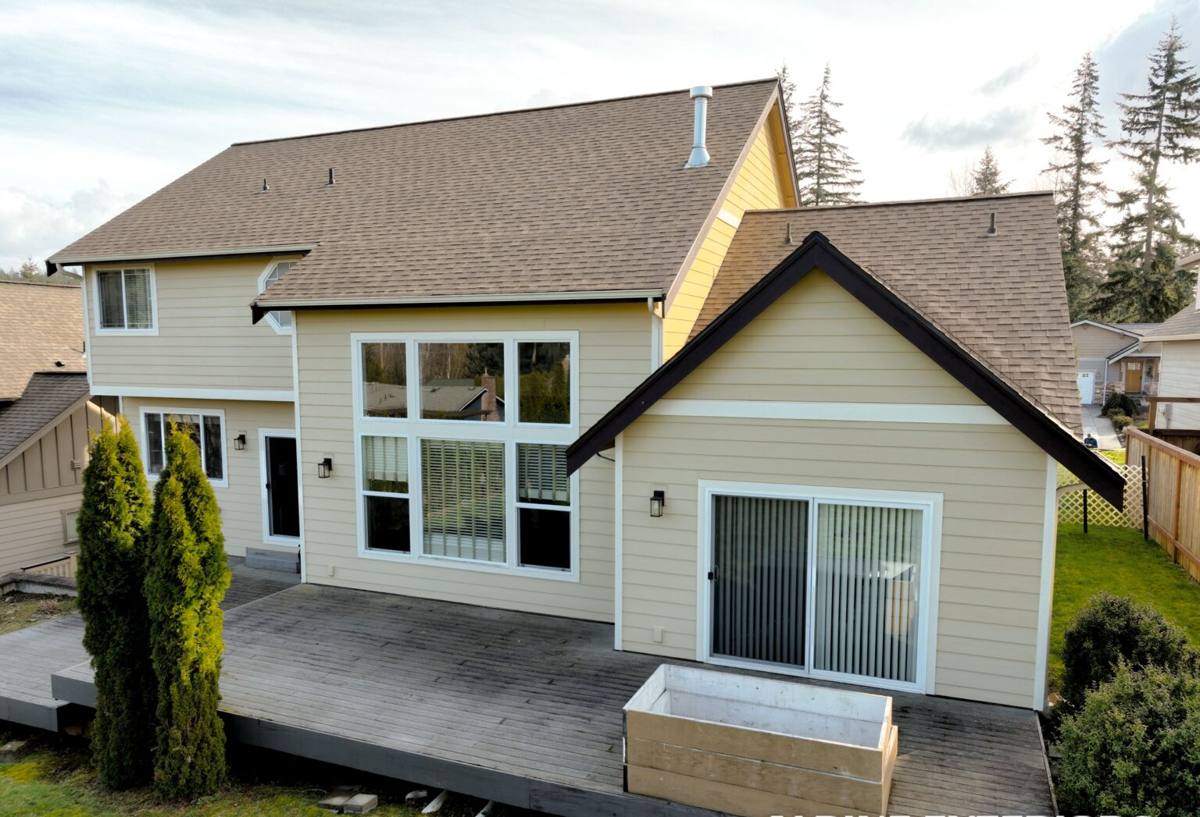
What This Climate Actually Does to a Shingle Roof
Moisture That Never Fully Leaves
Asphalt shingles are designed to shed water, not sit under it. In a climate where rain returns every few days for months at a time, any weak point in the underlayment, flashing, or ventilation gets exposed to repeated wetting instead of the occasional storm. Moisture that gets trapped under a shingle or into the decking doesn't get a long dry spell to fully evaporate before the next system rolls through.
Moss and Organic Growth
Moss doesn't just look bad — it holds moisture against the shingle surface, works its way under tab edges, and can lift shingles enough to let wind-driven rain in underneath. A roof with poor airflow or heavy shade will grow moss faster than one with good ventilation and sun exposure, which is why moss control has to be part of the roofing plan, not an afterthought tackled with a pressure washer every few years.
Salt-Influenced Air and Metal Components
Even inland from the coast, this region gets enough salt-influenced air moving through that it accelerates corrosion on unprotected metal — flashing, fasteners, drip edge, and vent components. Standard-grade metal or exposed fasteners age faster here than they would in a drier, salt-free environment, which is why material choice on the metal accessories matters as much as the shingle itself.
Wind-Driven Rain
Storms coming through the valley don't always arrive straight down — wind pushes rain sideways and up under shingle edges, especially at eaves, valleys, and any place the roof plane changes direction. A roof that only handles vertical rain well will still leak in these conditions.
What a Correct Asphalt Shingle Job Includes Here
A shingle roof is really a system of layers, and in this climate every layer matters more than it would somewhere drier. Here's what we consider non-negotiable on an Aldergrove-area roof:
- Ice-and-water shield at vulnerable zones — eaves, valleys, and roof-to-wall transitions get a self-adhering waterproof membrane, not just standard felt.
- Synthetic underlayment across the field — more resistant to prolonged moisture exposure than old-style asphalt felt, and it stays intact longer if the roof is exposed during install.
- Balanced intake and exhaust ventilation — soffit intake paired with ridge or roof-line exhaust so moist air actually moves out of the attic instead of condensing on the underside of the decking.
- Corrosion-resistant flashing and fasteners — metal components chosen to hold up against the salt-influenced air rather than standard-grade materials that pit and rust prematurely.
- Proper valley treatment — closed or open valleys built to shed heavy, sustained rain without backing up under the shingle courses above.
- Shingle rated for algae and moss resistance — most major manufacturers now offer a copper- or zinc-treated granule option specifically to slow moss and algae growth, which is worth the modest upgrade cost in this climate.
Our Process for an Aldergrove-Area Roof
1. Inspection and Honest Assessment
We start on the ground and in the attic, not just on the roof surface. We're looking at moss coverage and pattern, shingle granule loss, flashing condition at every penetration and transition, and — critically — attic ventilation and any signs of trapped moisture on the underside of the decking. If the roof genuinely has years of life left, we'll say so. Roofing is not a service where more work is automatically better for you.
2. A Straightforward, Written Scope
You get a plan that spells out the shingle product, the underlayment system, the ventilation approach, flashing materials, and anything specific to your roof's geometry — valleys, dormers, skylights, chimneys. No vague line items, no allowances that get "discovered" mid-project.
3. Tear-Off and Deck Inspection
Old roofing comes off down to the deck so we can actually see the sheathing. In this climate, hidden moisture damage under old roofing isn't rare — soft or delaminated decking gets replaced before anything new goes down, because covering a compromised deck just buys the problem a few more years to get worse.
4. Installing the System, Not Just the Shingles
Underlayment, ice-and-water membrane, flashing, and ventilation components go in per the plan, in the sequence that actually sheds water correctly — laps running the right direction, valleys built before field shingles, flashing integrated rather than caulked over gaps.
5. Final Walkthrough
We walk the completed roof with you, cover what maintenance (if any) it needs, and make sure you understand what's under warranty and for how long before we consider the job done.
Comparing Shingle Options for This Climate
| Option | Moss/Algae Resistance | Typical Lifespan Here | Best Fit |
|---|---|---|---|
| Standard 3-tab shingle | None built in | 15-20 years | Budget-driven projects, less shaded roofs |
| Standard architectural shingle | None built in | 20-25 years | Most homes; good balance of cost and durability |
| Algae/moss-resistant architectural shingle | Copper or zinc granules slow growth | 25-30 years | Shaded lots, north-facing roof planes, moss-prone areas |
| Impact-rated architectural shingle | Varies by product | 25-30 years | Homes wanting added storm durability |
Lifespan figures are general ranges and depend heavily on ventilation, installation quality, and roof exposure — not just the shingle itself. A moss-resistant shingle installed over poor ventilation will still underperform its rating.
Signs an Aldergrove-Area Roof Needs a Closer Look
- Moss visibly growing on the shingle surface, especially in shaded or north-facing sections
- Granules collecting in gutters or downspouts
- Shingles that look curled, cupped, or lifted at the edges
- Dark streaking that isn't just surface dirt
- Daylight visible through the roof deck from inside the attic
- Musty smell or visible condensation in the attic during cooler months
- Sagging in valleys or along roof edges
Any one of these on its own might not mean an urgent problem, but a few together are usually a sign the roof's moisture management has broken down somewhere.
Ventilation: The Part Homeowners Rarely Think About
We bring this up on almost every roof in this area because it's the most commonly overlooked factor in how long a shingle roof actually lasts. Attics need air moving in low (typically soffit vents) and out high (ridge vent or equivalent), in roughly balanced quantities. Without that, moisture from daily living — showers, cooking, laundry — gets trapped in the attic space, condenses on the cold underside of the roof deck during our cooler, damp months, and slowly breaks down the decking and the underside of the shingles from the inside out. This kind of damage is invisible from the ground and often invisible from a quick roof-surface inspection too, which is one more reason the attic side of the inspection matters as much as the shingle side.
Maintenance That Actually Extends Roof Life Here
Shingle roofs in this climate benefit from a short list of maintenance items, done consistently, more than any one expensive intervention:
- Keep gutters and valleys clear so water has a clean path off the roof
- Address moss growth early with appropriate treatment rather than letting it establish and spread
- Trim back overhanging branches to reduce shade, debris, and physical wear on shingles
- Check attic ventilation isn't blocked by insulation stuffed into soffit vents
- Have flashing and roof penetrations checked periodically, since these fail well before the shingle field usually does
Why a Crew That Already Works This Area Is Worth Choosing
Roofing crews that mainly work drier or milder climates sometimes default to standard-grade underlayment, skip the extra ice-and-water membrane at valleys, or treat ventilation as optional. None of that is dishonest — it's just not built around this weather. A crew already working homes in and around Aldergrove and the wider Whatcom County area has already seen what happens when those shortcuts meet this climate, and builds the extra protection in as standard practice rather than an upsell. That's less about brand loyalty to any one shingle manufacturer and more about respecting what driving rain, extended moss season, and salt-influenced air actually do to a roof over ten or twenty years.
Getting a Straight Answer on Your Roof
If you're dealing with visible moss, granule loss, an aging roof you're not sure has years left, or you're simply planning ahead, a proper inspection is the place to start — not a sales pitch, an actual look at the shingle surface, the flashing, and the attic. We're happy to walk through what we find, what it means for your timeline, and what your realistic options are, with no pressure either way. Reach out through the form below for a free, no-obligation estimate on your Aldergrove-area roof.