 Lynden Siding
 Laurel's Climate Is Harder on Siding Than Most Homeowners Realize
Laurel sits in the farmland just outside Lynden, in the Nooksack River lowlands of Whatcom County. It doesn't look like a coastal town, but it behaves like one when it comes to weather. Marine air off the Salish Sea pushes inland through the county's low, flat terrain with very little to slow it down, and that means Laurel homes deal with a version of "salt air" even without an ocean view — persistent moisture in the air, salt-laden fog on cold mornings, and humidity that lingers long after a storm has passed.
Add in the region's driving rain — storms that come in sideways off the water rather than falling straight down — and siding here takes on water in places that stay dry in calmer climates: under trim, behind butt joints, and at any seam that isn't sealed or flashed correctly. Then there's moss. Whatcom County's moss season isn't a few weeks in spring; on shaded, north-facing walls and anywhere tree cover blocks the sun, it can be a nine- or ten-month condition. Moss holds moisture directly against the siding surface, and that's a slow, steady problem most homeowners don't notice until paint is peeling or a wall feels soft.
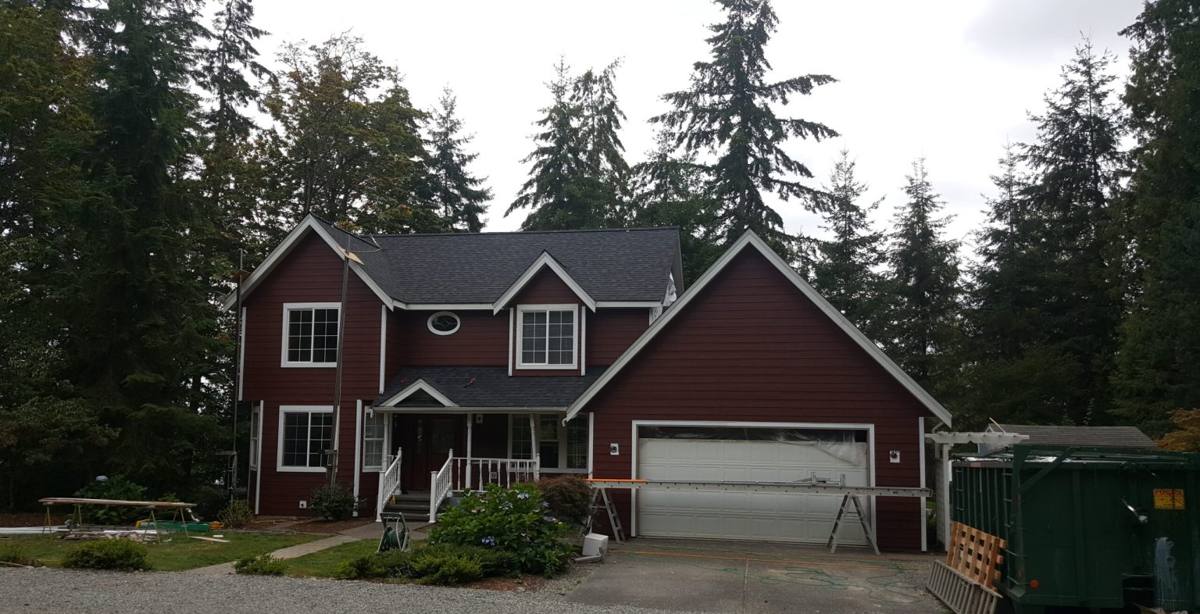
What Laurel Homes Actually Need From Their Siding
Given all of that, siding on a Laurel property needs to do three things well, not just one:
- Shed water fast — the material and the installation both have to move water away from the wall, not just resist it for a while.
- Tolerate constant dampness without breaking down — swelling, softening, and rot are the real enemies here, more than any single storm.
- Hold its finish through repeated wet-dry cycles — a coating that fails lets moisture in behind it, which is worse than having no coating at all.
Wood-based products struggle with the second point. Vinyl struggles with the first — it moves water toward the wall as often as away from it if the laps aren't tight and the wall isn't properly prepared underneath. That's part of why we standardized on one material for every home we side, in Laurel and everywhere else we work in Whatcom County.
Why We Install Only James Hardie Fiber Cement
We don't install vinyl, LP SmartSide, Cemplank, Allura, primed spruce, or cedar. That's not a marketing line — it's a standard we hold to on every job, including the ones with a tighter budget than a homeowner would like. Each of those products has legitimate strengths. Vinyl is inexpensive and low-maintenance in dry climates. Cedar looks the way a lot of people want a house to look. Wood composite panels install quickly. But none of them handle Laurel's specific combination of driving rain, marine moisture, and long moss season as well as fiber cement does over the life of the siding.
James Hardie's fiber cement is non-combustible, doesn't swell or rot from moisture the way wood-based products can, and comes from the factory with a ColorPlus finish that's baked on and warrantied — not a field-applied coat that starts breaking down the first year it's exposed to this climate. Hardie also builds specific product lines engineered for different exposure levels (their HZ5 and HZ10 zones account for exactly this kind of moisture and freeze-thaw variation), which matters more in a lowland river valley than in a drier inland climate.
| Factor | Vinyl | Cedar / Primed Wood | James Hardie Fiber Cement |
|---|---|---|---|
| Moisture/rot resistance | Doesn't rot, but traps water behind it if installed loose | Vulnerable to rot without diligent upkeep | Engineered to resist moisture damage |
| Finish durability in wet climates | Can fade and become brittle over time | Needs repainting/staining every few years | Factory ColorPlus finish, warrantied separately from the substrate |
| Moss and algae behavior | Moss sits on the surface, doesn't feed into material | Moss holds moisture against wood fibers | Surface can be treated; material underneath doesn't break down from contact |
| Fire resistance | Melts/burns readily | Combustible | Non-combustible |
We won't tell a homeowner that vinyl or cedar is a bad product in every setting. We will tell you, honestly, why we stopped putting them on homes in this climate — and it comes down to what happens in year eight, twelve, and twenty, not what a wall looks like on installation day.
Siding Styles That Fit Laurel's Rural Character
Laurel is farm country, and a lot of the homes here — old farmhouses, newer builds on acreage, outbuildings converted into living space — call for a different look than a tight in-town lot in Lynden proper. James Hardie makes that easy without giving up any of the performance this climate demands. Lap siding in various widths covers the classic farmhouse look. Shingle-style panels suit a more detailed, traditional elevation. Board-and-batten panels are a common choice for barns-turned-homes and newer construction going for a modern-farmhouse exterior. All of it comes in the same factory-finished ColorPlus system, so the aesthetic choice doesn't come at the cost of durability.
This matters more here than it sounds like it should. A dark, saturated color on a field-applied paint job is one of the first finishes to show chalking and fading in a climate this wet. Factory-baked color on fiber cement holds up dramatically better, which is part of why we don't offer primed wood siding that needs a separate paint job and a separate five-to-seven-year repaint cycle to keep looking right.
What a Correct Siding Replacement Actually Involves
Tear-Off and Wall Inspection
Replacement starts with full removal of the old siding, not siding over it. That's the only way to find out what's actually happening behind the wall — soft sheathing, old water staining, insulation that's absorbed moisture over the years. On a Laurel property that's been through a decade or more of this climate, this step regularly turns up problems the homeowner had no way to see from outside.
Moisture Barrier and Flashing
A weather-resistive barrier goes on correctly lapped, shingle-style, so water is directed down and out rather than into seams. Flashing at every window, door, and roofline intersection is where most siding failures actually start — not from the siding material itself, but from a gap where water gets behind it. This is the step that separates a job that lasts twenty-plus years from one that needs attention again in five.
Installation to Manufacturer Spec
James Hardie siding has to be installed to specific fastening patterns, gapping, and clearances to keep its warranty valid and to actually perform the way it's engineered to. That includes proper clearance from grade, roof lines, and decks — all places we see corners cut on rushed jobs, and all places where the driving rain in this region will find the mistake within a season or two.
Our Process, Start to Finish
- Walkthrough and assessment — we look at your existing siding, trim, and any visible trouble spots before quoting anything.
- Written estimate — a clear scope and price, not a vague range, so you know what you're deciding on.
- Tear-off and inspection — old material comes off, sheathing gets checked, and we flag anything unexpected before covering it back up.
- Barrier, flashing, and Hardie installation — done to manufacturer spec, not shortcuts.
- Final walkthrough — we go over the finished work with you before calling the job done.
Cost Factors for a Laurel Siding Replacement
Every home is different, but the same handful of factors drive most of the variation in price on jobs like this:
| Factor | Why It Matters Here |
|---|---|
| Extent of hidden water damage | Rot found during tear-off means sheathing repair before new siding goes on — common on older Laurel-area homes |
| Home size and wall complexity | Gables, dormers, and multiple stories add labor and material cutting |
| Trim and accessory work | Fascia, soffits, and trim boards are often replaced at the same time for a consistent, sealed result |
| Siding profile and color | Lap width, shingle-style panels, and ColorPlus finish options vary in material cost |
| Site access | Rural lots and outbuildings can affect staging and scaffolding needs |
We won't quote a firm number without seeing the house, but we'll always explain what's driving the price up or down so there are no surprises mid-project.
Signs a Laurel Home Needs Siding Replacement Now, Not Later
- Soft or spongy spots when you press on the siding, especially near the bottom courses or under windows
- Persistent moss or dark staining on north- or shade-facing walls that keeps coming back after cleaning
- Paint that's peeling, bubbling, or chalking heavily rather than just fading evenly
- Visible gaps, warping, or cupping in individual boards or panels
- A musty smell near exterior walls inside the home, which can mean moisture has already worked its way through
- Siding that's been patched repeatedly in the same spots over the years
Any one of these on its own might just need a repair. Several together, especially on a home that's had the same siding for fifteen-plus years in this climate, usually means replacement is the more honest recommendation.
Why Hiring a Crew That Already Works in Laurel Matters
Siding installation isn't just about the product — it's about knowing how a specific area's weather behaves against a wall. A crew that works Laurel and the Lynden area regularly knows which wall orientations take the worst of the driving rain, where moss builds up fastest, and how much clearance really holds up against this valley's wet-dry cycle year after year. That's knowledge you don't get from a general regional average — it comes from doing the work here, on homes like yours, season after season.
It also means straightforward scheduling and follow-up. A local crew isn't driving in from out of the area for a callback, and isn't guessing at what "normal wear" looks like on a Whatcom County home versus a drier part of the state.
If you're weighing a siding replacement on a Laurel-area home, we're glad to come take a look and give you a straightforward, no-pressure estimate — no obligation, and no pressure to sign anything on the spot. Use the form below to get started.