 Lynden Siding
 Siding Repair Isn't Just Patching a Hole
Most siding repair calls in Custer don't start with a homeowner asking for a repair. They start with someone noticing a stain, a soft spot, or a section of siding that looks a little off compared to the wall around it, and wanting to know what it is before deciding what to do about it. That's the right instinct. A repair that only addresses the visible symptom, without figuring out how water got in and where it's been sitting, tends to come back within a season or two. Real siding repair means finding the source of the problem first, then fixing both the damage and whatever let it happen.
Custer sits close enough to the water that salt-laden air reaches most properties in town, not just the ones right on the shoreline, and that exposure combines with wind-driven rain and a moss season that runs most of the year on shaded walls. None of those three conditions is unusual for this stretch of Whatcom County on its own. Together, they're what turns a small siding flaw into a real repair job if it sits unaddressed for a few years.
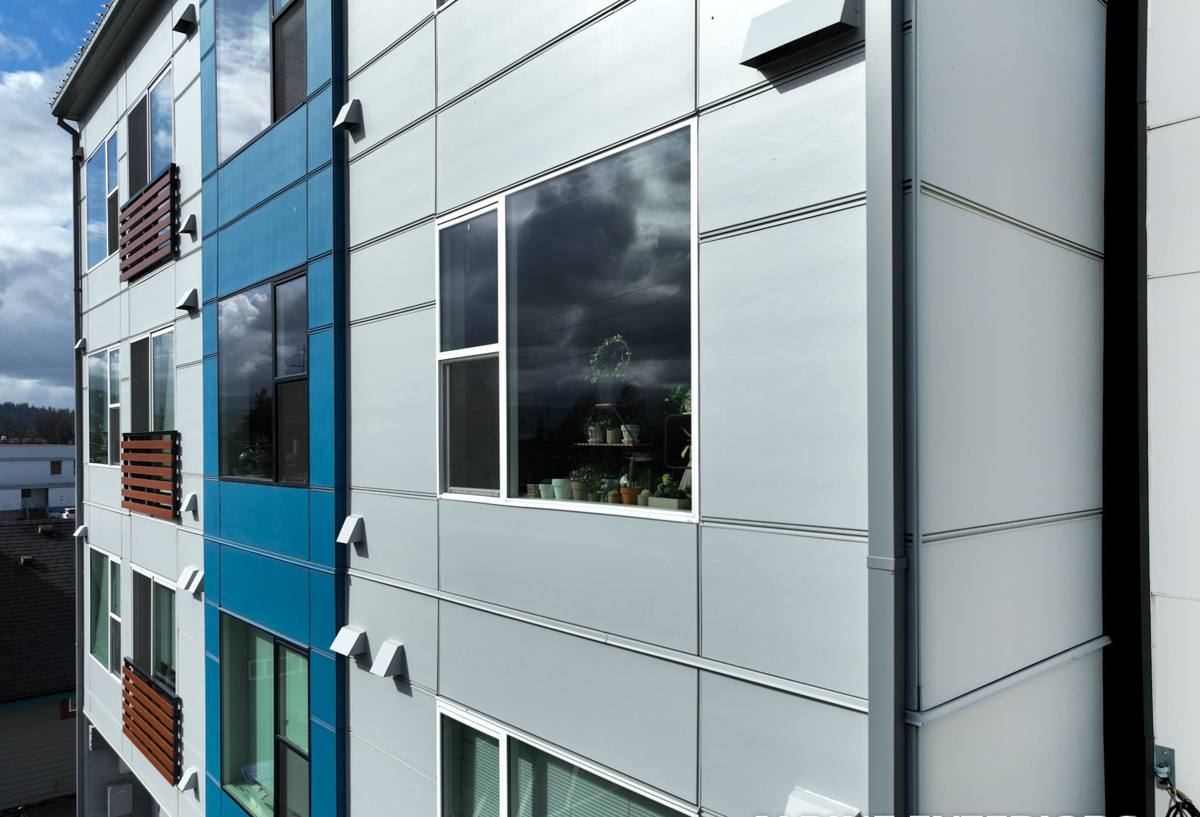
What Custer's Climate Does to Siding Between Repairs
Salt Air and Slow Corrosion
Salt-laden air off the water speeds up corrosion on fasteners, flashing, and any exposed metal trim, and it accelerates the breakdown of lower-quality coatings faster than a drier, inland climate would. On repair calls, this often shows up as rust staining bleeding down from a nail head or a piece of trim that's degraded faster than the siding field around it.
Wind-Driven Rain Finding Weak Points
Rain in this area rarely falls straight down. Wind pushes it sideways into lap joints, under trim, and into any seam where caulking has failed or flashing was never installed correctly in the first place. That's the mechanism behind most of the water intrusion we find during repair work: not a dramatic leak, but persistent sideways moisture finding the one detail that wasn't sealed right.
A Long Moss and Mildew Season
Mild temperatures and steady moisture keep moss and mildew active across most of the calendar on shaded, tree-lined lots, which describes a lot of Custer properties. Moss on a siding surface holds moisture against the wall behind it, and that trapped dampness is where a lot of soft boards and rot pockets actually originate, especially on north-facing walls that don't get much direct sun to dry out between storms.
Common Siding Repair Issues We See in Custer
- Soft or spongy boards, usually low on the wall, around window trim, or below a roofline that's been shedding water onto the same spot for years.
- Cracked or split boards from impact damage, improper fastening, or boards that were never given the manufacturer's required clearance from grade or hard surfaces.
- Failed caulking and open joints at trim, corners, and butt seams that let wind-driven rain track behind the siding.
- Rust staining and corroded fasteners, especially on older installations that used fasteners not rated for this level of salt and moisture exposure.
- Moss and mildew buildup on shaded walls that's trapping moisture against the surface rather than just sitting on top of it.
- Warped or delaminating boards on older wood-based or engineered wood siding, where the core has absorbed water repeatedly over wet seasons.
- Damaged flashing at windows, doors, and penetrations that's letting water behind the siding at a specific, findable point rather than across the whole wall.
How We Diagnose a Repair Before We Touch Anything
Before any board comes off, we walk the wall and look for the pattern, not just the spot the homeowner called about. A stain three feet below a window is often coming from that window's flashing, not from the siding itself. A soft patch near grade is often a drainage or clearance issue, not a defective board. Getting that diagnosis right is the difference between a repair that holds and one that's covering up a problem that will resurface somewhere else on the same wall within a year or two.
What We Check
- Whether the damage is isolated to a board or two, or spread across a section that points to a systemic flashing or drainage issue
- Condition of the sheathing and any water-resistive barrier behind the visible siding, once we open up the damaged area
- Whether existing flashing at windows, doors, and butt joints is intact and lapped correctly
- Grade clearance and whether splash-back from hardscaping or landscaping is hitting the bottom courses
- Fastener condition and whether the original install used corrosion-resistant hardware appropriate for this climate
Spot Repair vs. Partial Re-Side: How We Decide
Not every repair should be a repair. Sometimes the honest answer is that patching a section will look and perform fine, and sometimes the honest answer is that the damage is widespread enough that a partial or full re-side is the better long-term move. We tell you which situation you're in and why, rather than defaulting to the more expensive answer.
| Situation | Typical Approach | Why |
|---|---|---|
| Isolated damage: a few cracked or soft boards, clear cause | Spot repair with matched replacement boards | The problem is contained and the cause can be corrected at the same time |
| Damage concentrated on one wall or elevation | Partial re-side of that section | Repeated failures on one wall usually point to a shared flashing, drainage, or exposure issue worth addressing wall-wide |
| Widespread soft boards, delamination, or moisture behind multiple sections | Full re-side evaluation | Piecemeal repair on a wall with systemic moisture intrusion tends to just relocate the next failure |
| Older wood-based or engineered wood siding nearing end of service life | Repair now, plan a Hardie re-side conversation for the near term | Repeated repairs on an aging product usually cost more over a few years than converting to fiber cement once |
Why We Repair With James Hardie Fiber Cement
We install James Hardie fiber cement exclusively, and that standard carries into repair work too. When we're patching into existing Hardie siding, we match the profile, exposure, and ColorPlus finish as closely as the product line allows, so a repaired section blends into the wall instead of standing out as an obvious patch. When we're repairing a home that has a different siding product installed, we're upfront that our long-term recommendation is Hardie, but we'll still do honest, correct repair work on what's already on the wall rather than pushing a full re-side that isn't yet necessary.
Fiber cement's advantage in repair situations is that it doesn't absorb and hold water the way a wood-based core does, so a properly repaired section isn't fighting the same moisture problem that damaged the original board. It's also dimensionally stable, so a replacement board installed to spec won't swell or shift against the boards next to it as the seasons change.
What Correct Repair Work Actually Involves
A repair is only as good as the details underneath it, and that's especially true in a climate that gives water this many chances to find a weak point.
- Remove damaged boards and any trim needed to expose the area fully, rather than just cutting out the visibly bad section.
- Inspect the sheathing and water-resistive barrier underneath, and repair or replace either if moisture has compromised them.
- Correct the underlying cause: re-flash a window, restore proper grade clearance, or fix a drainage path, whatever the diagnosis pointed to.
- Install matched replacement boards with manufacturer-specified fastener type, placement, and clearances.
- Reflash and reseal all seams, corners, and penetrations in the repaired area to current standards, not just to match what was there before.
- Confirm the repaired section drains and dries the way the rest of the wall does, so it's not left as the one spot still trapping moisture.
What to Ask Before Hiring Anyone for Siding Repair
- Ask them to explain what caused the damage, not just what they plan to replace.
- Ask whether they're checking the sheathing and water barrier underneath, not just swapping visible boards.
- Ask how they'll match the existing siding's profile, exposure, and finish.
- Ask whether they carry current WA contractor licensing and liability insurance.
- Ask what happens if they find more damage once the old siding comes off, and how that changes the price.
Why a Crew That Already Works Custer Matters for Repair
Repair work rewards local pattern recognition more than new installation does. A crew that's opened up walls across Custer and the surrounding parts of Whatcom County has a working sense of which details tend to fail first in this specific exposure: which wall orientations stay damp longest, which older siding products in this area are starting to show their age, and which flashing shortcuts show up often enough to check for by default. That local experience shortens the diagnosis step and reduces the odds of missing a related problem a few feet from the one that got the call in the first place.
If you're seeing a soft spot, a stain, or damage on your Custer home's siding, we're glad to come take a look, tell you honestly whether it's a repair or something bigger, and give you a straight answer either way. Reach out using the form below to schedule a free, no-pressure estimate.