 Lynden Siding
 Why Nooksack Roofs Wear Differently Than You'd Expect
Homes around Nooksack sit in a part of Whatcom County where weather doesn't take turns — it stacks. Wet Pacific systems roll through with wind behind them, pushing rain sideways into fascia and roof edges rather than letting it fall straight down. Add the marine air that moves inland off the Salish Sea and up the Nooksack River valley, and you get a slow, steady dose of moisture and salt that most roofing products were never really tested against by the people who sell them. On top of that, this area gets a long stretch of the year — often five or six months — where shaded roof sections simply never fully dry out. That's the recipe for moss, and moss is the single biggest reason we see roofs fail here 5-10 years before their rated lifespan.
None of that means Nooksack homes need exotic materials or gimmicks. It means the installation details that get glossed over in drier climates — underlayment choice, flashing sequence, ventilation balance, edge protection — matter more here, and skipping them costs homeowners real money down the road.
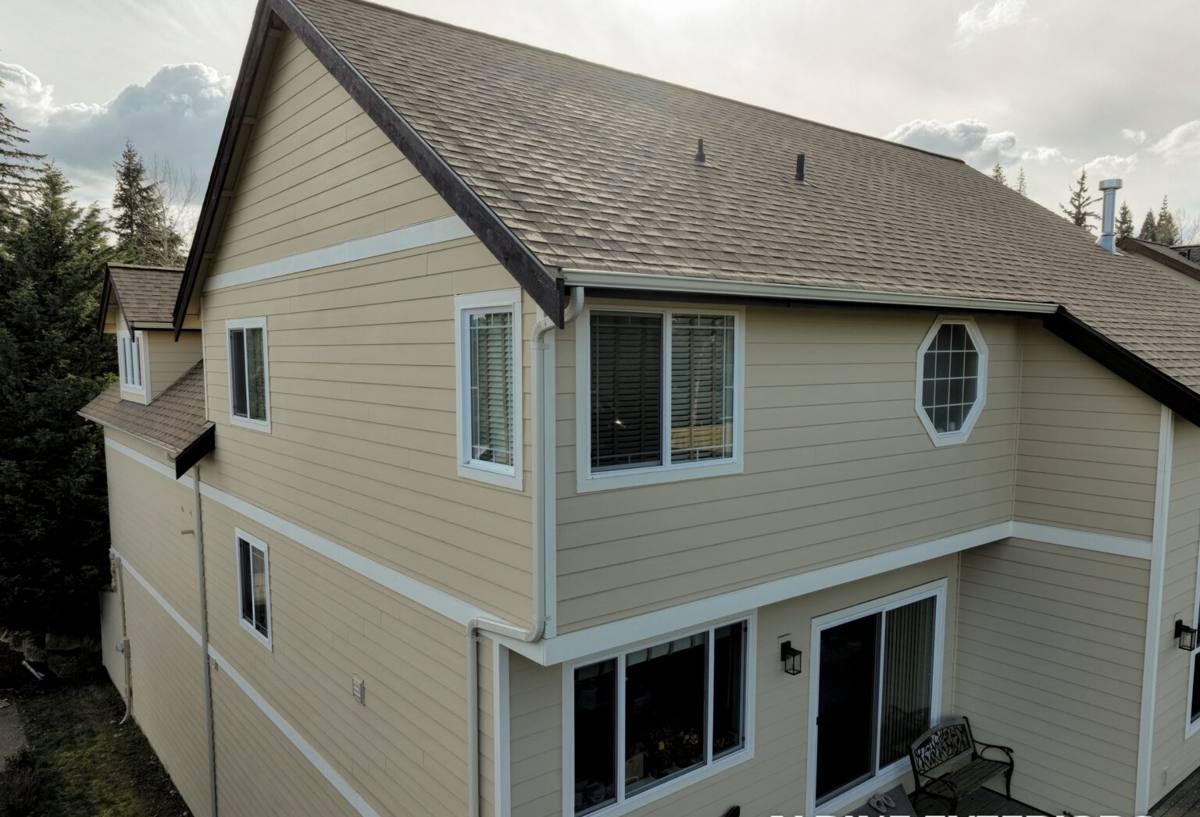
What Driving Rain, Moss, and Marine Air Actually Do to a Roof
Wind-driven rain
Standard shingle installations rely on gravity and overlap to shed water. When rain comes in at an angle instead of straight down, it can work its way under shingle tabs, around vent boots, and along valley lines that weren't sealed with enough margin for error. Over time this shows up as soft decking, stained interior ceilings, or mold in the attic — long before there's an obvious leak anyone would notice from the ground.
Moss and organic growth
Moss doesn't just look bad. Its root structure holds moisture directly against the shingle surface and, worse, lifts shingle edges as it grows — which is exactly where wind-driven rain finds its way in. Moss also holds cool, damp conditions right at the roof deck, which accelerates granule loss on asphalt shingles and speeds up rot on older wood-based decking.
Marine air and metal fatigue
Salt-tinged, humid air is harder on exposed metal than most people assume — flashing, fasteners, gutter systems, and metal roofing panels themselves. Cheaper or mismatched metal components corrode faster here than the same products would in a dry inland climate, especially where dissimilar metals touch and start a slow electrolytic reaction.
Signs a Nooksack-Area Roof Needs Replacement, Not Another Repair
Repair makes sense when the damage is isolated and the roof has years of usable life left. Replacement becomes the honest answer once the problems are systemic. Here's how we tell the difference on a walk-through:
- Granule loss heavy enough that you can see bare asphalt mat in multiple spots, not just one damaged shingle
- Moss or algae covering more than roughly a third of the roof, especially on north-facing or shaded slopes
- Soft spots underfoot during inspection, which usually means the decking underneath has already started to rot
- Daylight visible through the attic at roof boards, or consistent moisture staining on rafters
- Shingles curling, cracking, or losing their seal along multiple courses rather than one weak run
- Flashing that's rusted, loose, or was clearly installed as an afterthought around chimneys and valleys
- The roof is at or past the manufacturer's expected service life for this climate, which typically runs shorter here than the national average printed on the shingle wrapper
If only one or two of these apply, a repair or partial re-roof section may genuinely be the right call — we'll tell you that directly if that's what we find.
Material Options: What Actually Holds Up Here
There's no single "best" roofing material for every home — it depends on roof pitch, budget, how long you plan to stay in the house, and how much maintenance you're willing to do. Here's an honest comparison based on how each option actually performs under Whatcom County conditions:
| Material | Moisture & Moss Resistance | Typical Lifespan Here | Trade-offs |
|---|---|---|---|
| Architectural asphalt shingle | Good with proper ventilation; algae-resistant granules help | 20-25 years | Best value; still needs periodic moss treatment |
| Standard 3-tab asphalt | Fair | 15-18 years | Lower upfront cost, but shortest realistic lifespan in this climate |
| Standing seam metal | Excellent — sheds moss and water fastest | 40-50 years | Higher upfront cost; fastener and flashing quality matters even more near marine air |
| Composite / synthetic shake | Very good | 30-40 years | Higher cost than asphalt; installation-sensitive, so crew experience matters |
We steer most Nooksack homeowners away from anything that traps moisture against the deck or relies on frequent hand-maintenance to perform as advertised — not because a product is bad on paper, but because the upkeep burden in this climate outweighs the savings for most people. If a specific material fits your budget and roof style better, we'll say so and explain the trade-off honestly rather than upselling.
What a Correct Roof Replacement Actually Involves
Tear-off and deck inspection
We remove the old roofing down to the deck rather than layering over it. This is the only way to actually see rot, soft spots, or prior water damage — problems that get hidden, not fixed, when a new layer goes on top of an old one.
Underlayment built for wind-driven rain
Given how often rain comes in sideways here, we use a synthetic or ice-and-water-shield underlayment at eaves, valleys, and penetrations rather than the minimum felt underlayment some crews still default to. This is the layer that saves you if wind ever pushes water past the shingle surface.
Flashing done in the right order
Flashing around chimneys, skylights, and valleys has to be layered correctly with the underlayment and shingles — not caulked on afterward. Most leaks we get called out to inspect on other contractors' work trace back to flashing that was rushed or sealed with caulk instead of properly integrated.
Ventilation balance
A roof that can't breathe traps moisture at the deck from the inside, which accelerates rot regardless of how good the exterior materials are. We check intake and exhaust ventilation as part of every replacement, not as an upsell add-on.
Fasteners and metal components matched for marine air
Where we're near enough to the coast for salt air to matter, we use corrosion-resistant fasteners and flashing metals that won't set up a slow electrolytic reaction with each other.
Our Process for Nooksack Homeowners
- On-site inspection. We walk the roof (weather permitting) and the attic, and photograph problem areas so you can see exactly what we see.
- Honest scope and written estimate. You get a clear breakdown of materials, labor, and any deck repair likely to be needed — no vague allowances that turn into surprise charges.
- Material selection. We walk through the options above against your budget and how long you plan to stay in the home.
- Scheduling around the weather. Given how much rain this area gets, we plan tear-off days around forecast windows and protect the deck if weather turns mid-project.
- Tear-off, deck repair, and installation. Full removal, deck inspection and repair as needed, then underlayment, flashing, and roofing material installed in that order.
- Final walkthrough. We review the finished roof with you, including ventilation and any gutter or edge work completed alongside the roof.
Cost Factors Worth Understanding Up Front
Roof replacement pricing depends on more than square footage. The biggest swing factors we see on Nooksack-area homes are:
| Factor | Why It Moves the Price |
|---|---|
| Roof pitch and access | Steeper roofs and limited access require more time, safety equipment, and labor |
| Deck condition | Rot found during tear-off means additional plywood or board replacement |
| Number of layers being removed | Multi-layer tear-offs take longer and cost more in disposal |
| Material choice | Asphalt, composite, and metal carry different material and labor costs |
| Valleys, chimneys, and penetrations | Each one adds flashing work and detail time |
| Ventilation upgrades | Adding or correcting intake/exhaust venting adds modest cost but pays off long-term |
We'd rather walk you through these in person and give you real numbers for your roof than quote a generic per-square-foot figure that doesn't hold up once we're actually on the deck.
A Homeowner's Pre-Replacement Checklist
- Ask any contractor for proof of Washington state licensing and current insurance before they set foot on your roof
- Get the scope of work in writing, including underlayment type and flashing details — not just "new roof installed"
- Ask how deck repair, if discovered, will be priced and approved before it happens
- Confirm whether moss and debris removal is included or handled separately before installation begins
- Ask about ventilation as part of the quote, not as an afterthought
- Understand the manufacturer's warranty terms versus the contractor's workmanship warranty — they're not the same thing
- Ask how weather delays are handled given how much rain this area typically sees during roofing season
Why Local Nooksack Experience Matters
A roofing crew that regularly works Whatcom County knows which slopes in this area hold moss longest, how far wind-driven rain typically pushes under an edge during a fall storm, and which flashing details actually get tested by this climate instead of just by a spec sheet. That's not something a crew based somewhere drier picks up quickly — it comes from doing the work here, season after season, and seeing what holds up and what doesn't. We're not guessing at what Nooksack roofs need; we're applying what this specific stretch of Lynden-area weather has already taught us.
Get a Free, No-Pressure Estimate
If your roof is showing moss buildup, granule loss, or you're just not sure whether repair or replacement makes sense, we're glad to take a look. Fill out the form below and we'll schedule a straightforward, no-pressure inspection and give you an honest read on where your roof actually stands.