 Lynden Siding
 Why Custer's Climate Is Hard on Siding
Custer sits close enough to the water and open farmland north of Lynden that homes here take a different kind of weather beating than siding was originally designed for. Salt-laden air drifts in off the Strait and Puget Sound, driving rain comes in sideways during fall and winter storms, and the shaded, damp stretches of the year give moss months at a time to get established on north-facing walls, trim, and anything with a rough surface for spores to grip. None of that is dramatic on any single day. It's the accumulation, year after year, that separates siding that lasts thirty years from siding that starts failing in ten.
Wood and wood-composite sidings absorb moisture at cut ends and joints, and once moisture gets behind the paint film, rot follows even if the surface still looks fine. Vinyl doesn't rot, but it flexes with temperature swings and driving rain can force water behind panels at loose seams. Salt air corrodes exposed metal fasteners faster than manufacturers' generic warranty language usually accounts for. Moss doesn't just sit on the surface — it holds a film of moisture against the siding face for weeks, which is exactly the condition that breaks down caulk, paint, and unprotected wood fiber.
Why We Install Only James Hardie Fiber Cement in Custer
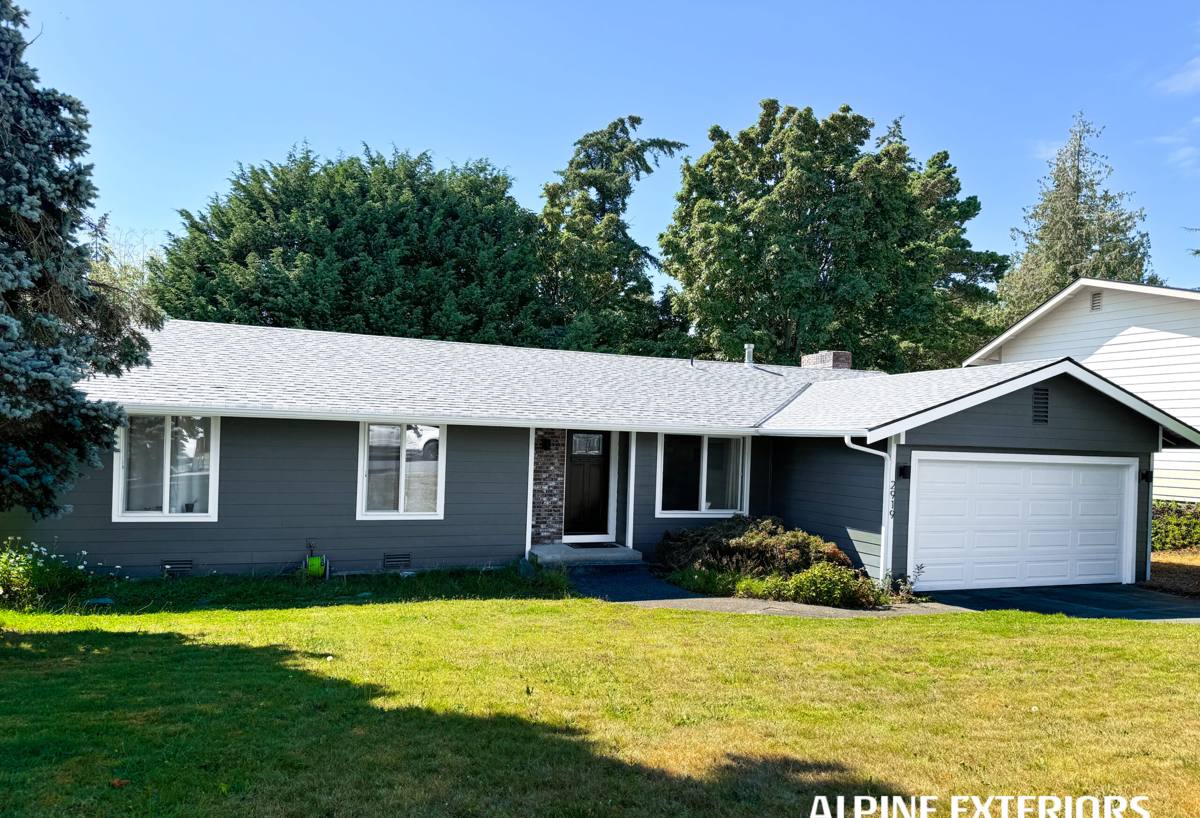
We standardized on James Hardie fiber cement siding for every job we do, including the ones out here in Custer, and we don't install vinyl, LP SmartSide, primed spruce, cedar, or other fiber cement brands. That's not a marketing position — it's a decision based on what actually holds up against this specific climate over decades, not just the first few years.
Engineered for This Climate Zone
James Hardie's HZ5 product line is engineered specifically for the wet, moderate-temperature climate of the Pacific Northwest, which includes the moisture exposure Whatcom County sees. The fiber cement itself is non-combustible and doesn't provide moss or fungus the organic material to feed on the way wood-based products can. The factory-applied ColorPlus finish is baked on under controlled conditions, which gives it a more uniform, harder-wearing surface than field-applied paint — and a more consistent surface means fewer microscopic gaps for moss spores and moisture to take hold in over time.
Hardie also backs the product with a strong, transferable limited warranty on the material itself, plus a separate finish warranty on ColorPlus color retention. That matters in a climate where UV exposure is lower than in drier regions but moisture exposure is higher — the failure modes here are different, and Hardie's product line was built with that trade-off in mind.
What Correct Installation Involves
Fiber cement siding is only as good as the installation behind it. Hardie's own installation manual is specific and detailed, and the difference between a correct install and a shortcut install usually isn't visible until five or ten years in, when the shortcut version starts showing moisture damage at the exact points where the manufacturer's spec was skipped.
Flashing and Moisture Management
Every window, door, and roof-to-wall intersection needs proper flashing and a drainable water-resistive barrier behind the siding, not just caulk at the surface. Custer's driving rain will find any gap in that system eventually, and once water gets behind the siding plane, the sheathing and framing underneath are what actually rot — not the fiber cement itself.
Fastening, Gaps, and Clearance
Hardie specifies minimum gaps at butt joints, minimum clearance from grade, deck surfaces, and roof lines, and specific fastener types and placement. Skipping the recommended gap at joints is one of the most common shortcuts we see on re-siding jobs, and it's also one of the first places moss and moisture problems show up, because tight joints trap water instead of letting it drain and dry.
- Weather-resistive barrier installed and lapped correctly before any siding goes up
- Flashing at every window, door, and horizontal trim transition
- Correct butt joint gaps and joint treatment per Hardie spec
- Minimum clearance maintained from grade, roofing, and decking
- Manufacturer-approved fasteners, driven correctly — not overdriven or underdriven
- Caulking only where Hardie's install guide calls for it, with a paintable, high-quality sealant
Fiber Cement vs. Other Siding Options in Custer's Climate
Homeowners comparing bids often see very different materials proposed side by side. Here's how they generally hold up under the specific combination of salt air, driving rain, and extended moss season that Custer deals with.
| Factor | James Hardie Fiber Cement | Vinyl | Wood / LP SmartSide |
|---|---|---|---|
| Moisture absorption | Very low; won't swell or rot | None, but seams can let water behind panels | Absorbs at cut edges and joints; primary failure point |
| Moss and organic growth | Resists organic growth; smooth finish sheds moisture | Resists growth but traps moisture behind loose seams | Organic material feeds moss and fungus once coating fails |
| Salt air / coastal exposure | Engineered for coastal-adjacent moisture, non-corrosive material | Can become brittle over years; fasteners still exposed | Salt-laden moisture accelerates rot at seams and ends |
| Fire resistance | Non-combustible | Melts and contributes fuel in fire exposure | Combustible |
| Finish longevity | Factory ColorPlus finish, long color-retention warranty | Color molded through, but fades and chalks over time | Field-applied paint or primer requires repainting cycles |
| Typical service life when installed to spec | Decades, often 30+ years | 20-30 years, seam and fastener issues sooner | Highly variable; often 10-15 years before major repair |
Choosing Colors and Textures for Salt Air and Moss
ColorPlus comes in a range of factory finishes and Hardie offers several textures, from smooth to cedar-grain lap profiles. In a moss-prone environment like Custer, texture matters as much as color. Deep cedar-grain textures give moss spores more surface area to grip on shaded, north-facing walls, while smoother lap profiles shed water and spores more readily in those same locations. That doesn't rule textured products out — plenty of homes carry them well — but it's worth weighing texture choice by wall orientation, not just curb appeal from the street.
Color choice interacts with the same conditions. Darker colors show water spotting and dust less than they show heat-related expansion stress, while very light colors make early moss staining more visible sooner, which is often a good thing — it gives homeowners an early signal to schedule a simple wash before buildup sets in. Either way, the factory-cured ColorPlus finish holds its color and resists chalking far better across wet Whatcom County winters than field-applied paint does.
Our Installation Process
We walk every Custer property before quoting anything, because wind exposure, shade patterns, and moisture history vary a lot from one lot to the next even within the same neighborhood. From there, our process is straightforward:
- On-site inspection, including a check of existing sheathing condition where old siding is coming off
- Detailed written estimate covering product line, color, texture, and scope
- Removal of old siding and inspection of the wall assembly underneath for hidden moisture damage
- Repair of any compromised sheathing or framing before new material goes up — this step gets skipped by corner-cutting crews and it's the single biggest cause of early siding failure
- Installation of weather-resistive barrier, flashing, and James Hardie siding to manufacturer specification
- Final caulking, trim, and cleanup, with a walkthrough before we call the job done
Maintaining Fiber Cement Through Moss Season
Correctly installed Hardie siding is low-maintenance, not no-maintenance. A little seasonal attention keeps it looking right and prevents small issues from becoming bigger ones during Custer's long damp stretch each year.
- Rinse shaded and north-facing walls with a garden hose once or twice a year to knock down early moss growth before it establishes
- Avoid pressure washers on siding — high pressure can force water behind joints and damage caulking
- Keep gutters clear so overflow doesn't run directly down wall sections and feed moss growth
- Trim back shrubs and trees that keep any wall section shaded and damp longer than the rest of the house
- Check caulking at trim and joints every couple of years and touch up as needed
- Have any impact damage or corner cracks repaired promptly rather than waiting — small repairs stay small when caught early
Why Hire a Crew That Already Works Custer
Siding work in Custer isn't identical to siding work twenty minutes inland. Wind exposure off open fields and proximity to the water change how a wall assembly needs to be flashed and ventilated, and a crew that hasn't dealt with those conditions before can end up learning it at your home's expense. We already work this part of Whatcom County regularly, understand the county's permitting expectations, and know which wall orientations on Custer-area homes tend to need extra attention during installation.
If you're weighing a re-side or planning ahead for one, we're happy to walk the property, look at what your current siding is telling us, and put together a straightforward, no-pressure estimate using the form below.