 Lynden Siding
 Wiser Lake's Climate and What It Means for Your Siding
Wiser Lake sits in the rural, tree-lined stretch of Whatcom County just outside Lynden, where lake humidity, dense tree cover, and the marine air that moves through this part of the county all combine into a tough environment for exterior building materials. Homes here don't just deal with rain — they deal with rain that lingers. Between the lake's moisture, shaded lots, and the salt-laden air that reaches inland across Whatcom County from the Salish Sea, siding on a Wiser Lake home is under near-constant low-grade attack for most of the year.
That combination shows up as three specific stressors: driving rain that gets pushed sideways into wall assemblies during winter storms, salt and moisture in the air that accelerates corrosion of fasteners and finishes, and a moss season that can run eight months or longer on shaded, north-facing walls. None of these individually destroys a house. Together, over a decade or two, they expose every weak point in a siding system — every gap in flashing, every under-caulked joint, every product that wasn't built for this climate in the first place.
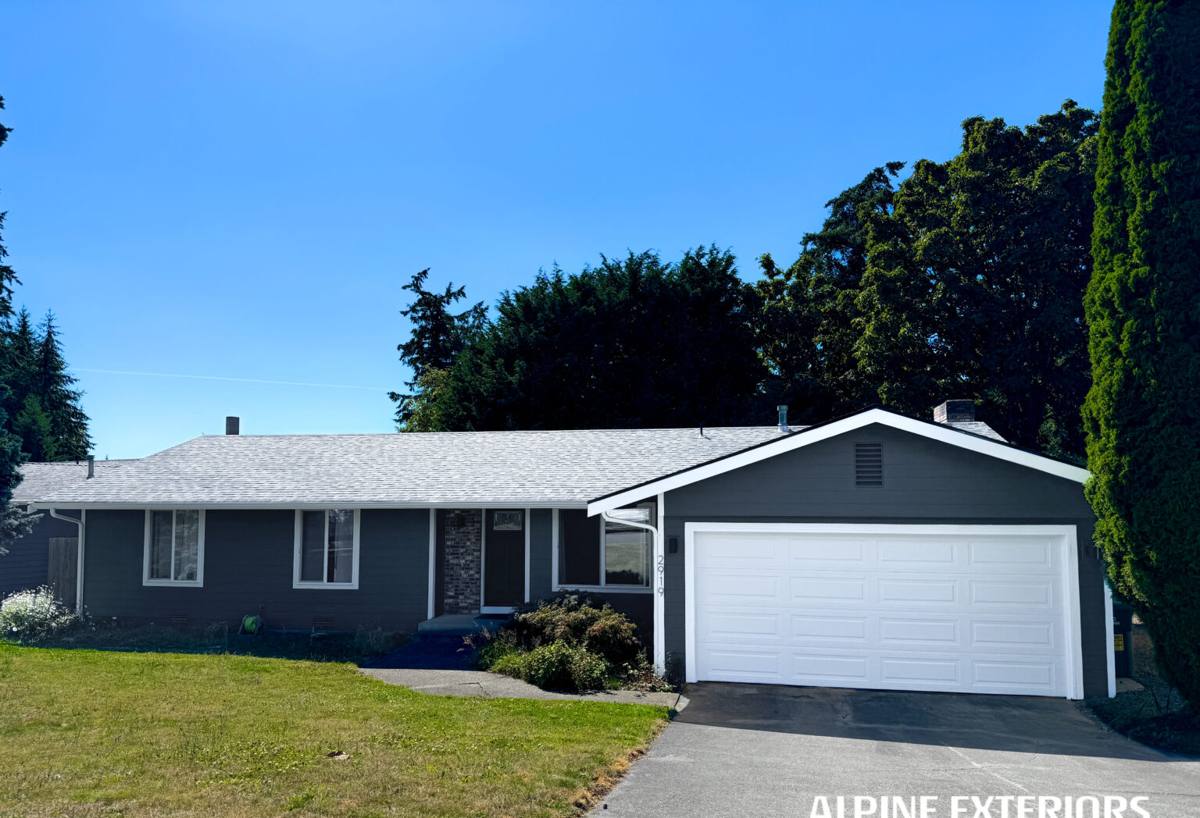
Why We Only Install James Hardie Here
We don't install vinyl, LP SmartSide, primed spruce, cedar, or other fiber cement brands like Cemplank or Allura. That's not a marketing position — it's a decision made after years of servicing homes in exactly this kind of environment. Vinyl softens, warps, and fades faster under sustained UV and moisture cycling than most homeowners expect, and it can't take an impact without cracking in cold weather. Wood siding — cedar or primed spruce — looks great on day one, but it's an organic material sitting in a climate that's ideal for rot and moss growth; it demands a maintenance schedule most homeowners underestimate. Engineered wood products like LP SmartSide perform reasonably well when installed and maintained precisely, but they're wood-based at the core, and any breach in the factory treatment or field-applied caulking becomes a moisture entry point.
James Hardie fiber cement is non-combustible, dimensionally stable, and doesn't feed moss the way wood does. It's engineered specifically for high-moisture climates, which is exactly the case for a Whatcom County lake property. That's the whole reason we standardized on one manufacturer instead of offering the full menu — we'd rather install one product correctly on every home than juggle five products and get mediocre results on all of them.
What Hardie Gets Right — and Where It Still Requires Skill
To be fair to the other side of the ledger: fiber cement is heavier and more labor-intensive to install than vinyl, it costs more upfront than most alternatives, and it still requires correct flashing, gapping, and caulking to perform as designed. Hardie board is not "install and forget." A poorly installed Hardie job — tight butt joints with no expansion gap, unsealed cut edges, fasteners driven into the wrong plane — can trap moisture just like any other siding installed wrong. The material solves the durability problem; the installation still has to solve the water-management problem.
The HZ5 Product Line and Why Climate Zone Matters
James Hardie engineers its products by climate zone (HZ5 and HZ10), because siding performance depends on regional weather patterns, not just the product itself. Western Washington, including Whatcom County, falls into the wetter, more temperate zone where moisture resistance and moss/mildew resistance matter more than extreme heat cycling. We install the HZ5 line for that reason — it's formulated and tested for exactly the wet, temperate, moss-prone conditions a Wiser Lake property deals with, rather than a general-purpose or dry-climate formulation.
| Siding Option | Moisture/Rot Resistance | Moss Resistance | Maintenance Load |
|---|---|---|---|
| James Hardie HZ5 Fiber Cement | High — non-combustible, engineered for wet climates | High — doesn't feed organic growth like wood | Low — periodic wash, repaint on ColorPlus cycle |
| Cedar / Primed Spruce | Low to moderate — organic material, rot-prone if finish fails | Low — wood is a food source for moss/algae | High — recoating, caulk checks, rot inspection |
| Vinyl Siding | Moderate — doesn't rot but traps moisture behind panels | Moderate — smooth surface but seams collect debris | Low, but limited lifespan in UV/impact terms |
| LP SmartSide / other engineered wood | Moderate — good if factory seal stays intact | Moderate — wood-based core still vulnerable | Moderate — depends heavily on install quality |
What a Correct Installation Actually Involves
The material is only half the equation. On a lake-adjacent, tree-shaded property like the ones around Wiser Lake, the installation details are what actually determine whether siding lasts 30-plus years or starts showing problems in five. That means correct starter strip and flashing at every horizontal transition, proper weather-resistant barrier underneath the siding, a true 1/8-inch minimum gap at all butt joints and trim intersections (sealed, not just butted tight), and fasteners placed and set per Hardie's published fastening schedule — not shot in wherever's convenient.
Our Wiser Lake Installation Checklist
- Inspect and repair the existing weather barrier and sheathing before any new siding goes up — covering rot or damaged sheathing with new siding just hides the problem
- Install or verify proper flashing at every window, door, and roof-to-wall intersection
- Maintain factory-specified gaps at all joints and trim for expansion and drainage, sealed with a Hardie-approved sealant
- Use corrosion-resistant fasteners rated for coastal/marine-influenced air, driven per the fastening schedule — not overdriven or underdriven
- Keep bottom clearance from grade, decks, and roof lines to the manufacturer's minimum standard so moss and standing moisture can't wick into the board
- Caulk and paint-match all cut edges on site, since factory finish doesn't extend to field cuts
Common Problem Areas on Wiser Lake Properties
Most of the siding failures we get called out to inspect on lake and rural Whatcom County properties trace back to a handful of repeat issues: north- and east-facing walls that stay shaded most of the day and grow moss fastest, siding installed too close to grade or deck surfaces where splashback keeps the bottom courses wet, and older homes where the original weather barrier was never properly lapped or sealed at penetrations. Tree cover that's great for privacy around a lake lot also means less sun exposure to dry siding out after a storm — which is exactly why gapping, flashing, and drainage matter more here than on an open, sunny lot in a drier part of the state.
We also see a lot of caulk-dependent repairs on older vinyl and wood siding — homeowners or previous contractors trying to caulk their way out of a moisture problem that a proper water-management detail would have prevented in the first place. Caulk is a maintenance item, not a substitute for correct flashing.
Color and Finish Choices for Wooded, Shaded Lots
ColorPlus factory finish matters more on a shaded lake lot than it does on a full-sun property, because the finish has to hold color and resist mildew staining without the benefit of UV exposure helping it dry out and self-clean the way a sunnier wall would. Factory-baked ColorPlus finish is more consistent and more resistant to fading and moisture staining than field-applied paint, and it carries its own finish warranty separate from the product warranty. For darker colors, which show moss and water streaking faster on north-facing walls, that factory consistency is worth the modest upcharge over standard primed board.
Our Process for Wiser Lake Jobs
Every job starts with an on-site walkaround, not a phone estimate — we want to see the tree cover, grade, drainage pattern, and existing wall condition before we quote anything. From there:
- On-site inspection and measurement, including a check of sheathing and existing moisture damage where old siding is coming off
- Written scope and estimate covering product line, color, trim details, and any sheathing or flashing repair needed
- Weather barrier and flashing work, verified before a single course of siding goes up
- Hardie HZ5 installation to manufacturer fastening and gapping specs
- Final walkthrough covering caulking, touch-up, and cleanup
Because we work this area regularly, we already know which details tend to get missed on lake-adjacent, tree-shaded lots — that's not something a crew coming from outside the county picks up on their first pass.
Cost Factors for Wiser Lake Homes
| Factor | Why It Affects Cost |
|---|---|
| Existing siding removal & sheathing condition | Rot or moisture damage found underneath old siding adds repair scope before new siding can go up |
| Home shape and trim detail | More corners, dormers, and trim transitions mean more cut edges, flashing, and labor hours |
| Access and site conditions | Tree cover, slope, and lake-lot access can affect scaffolding and material staging |
| Product line and finish | Panel vs. lap siding, trim boards, and ColorPlus color selection all shift material cost |
| Flashing and drainage upgrades | Bringing an older wall assembly up to current moisture-management standards adds value and cost |
We give straightforward, itemized estimates rather than a single lump number, so you can see exactly what's driving the price on your specific home.
Why a Crew That Already Works Wiser Lake Matters
Siding installation is detail work, and the details that matter change with the site. A crew that's already worked lake-adjacent, tree-shaded properties around Lynden knows to check bottom clearances more carefully, knows which wall orientations need extra attention to gapping and drainage, and isn't guessing at how the local moisture and moss cycle behaves over a full year. That local repetition is what turns a technically correct install into one that actually holds up on this specific kind of property.
If you're weighing a siding replacement or new build at Wiser Lake, we're happy to walk the property with you, look at what's there now, and put together a straightforward, no-pressure estimate for a James Hardie system built for this climate. Use the form below to get started.