 Lynden Siding
 Siding That Actually Holds Up in Laurel
Laurel sits in a part of Whatcom County that asks a lot of a home's exterior. Between salt-laden air moving in off the coast, long stretches of driving rain through the fall and winter, and a moss season that seems to start earlier every year, siding here doesn't get an easy ride. We install fiber cement siding on Laurel homes because it's the one product we trust to take that punishment year after year without turning into a maintenance project of its own.
This page is specifically about fiber cement siding for homes in and around Laurel — what the local climate actually does to a house, what a correct installation looks like, and how we run the job from first look to final walk-through. If you're comparing siding options for a Laurel property, this is the detail that matters more than a glossy brochure.
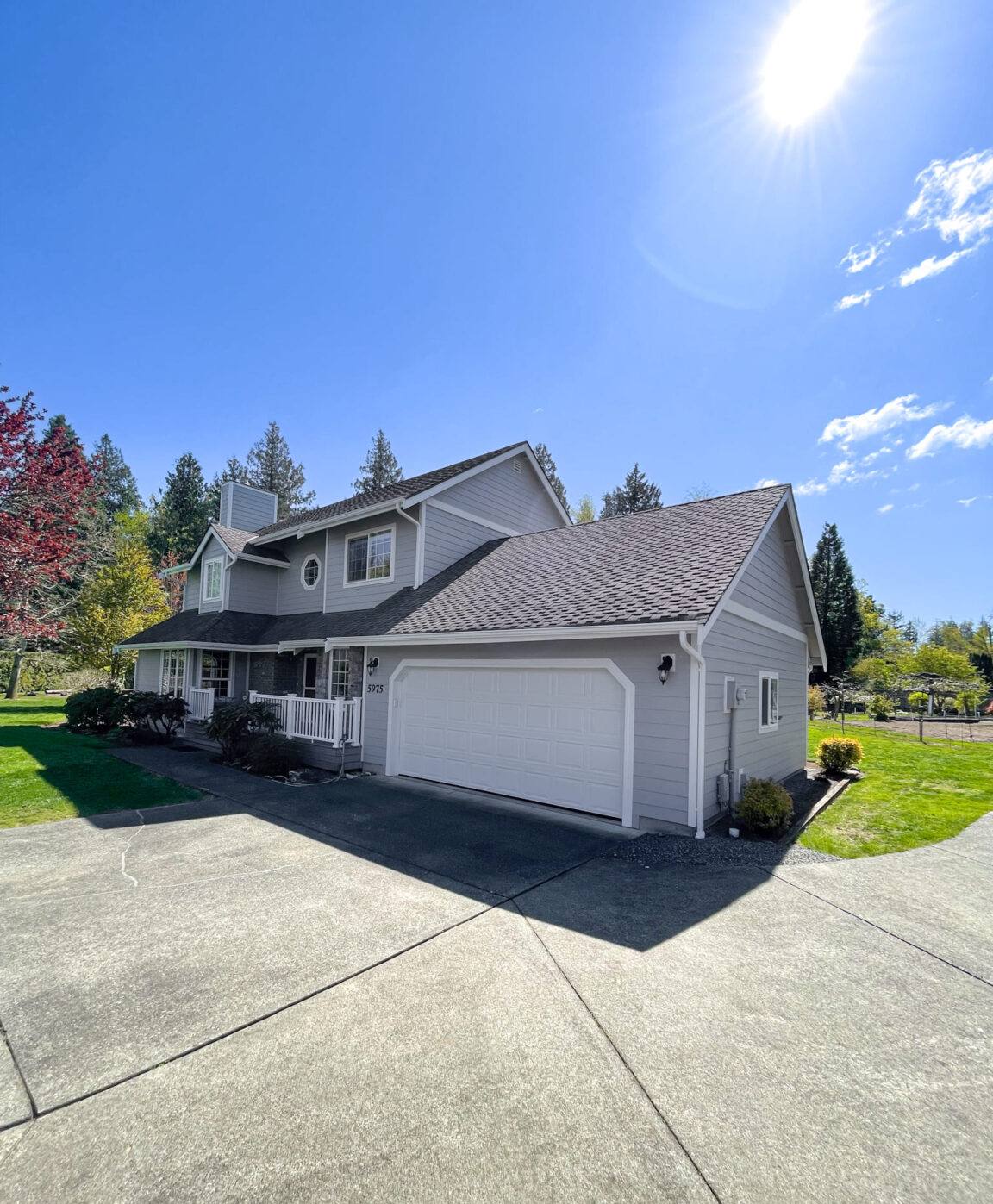
What Laurel's Climate Does to a House Over Time
Salt Air and Metal Fasteners
Homes closer to Whatcom County's coastal influence deal with airborne salt that settles on exterior surfaces and works into every seam, fastener, and joint over time. Left unaddressed, that salt exposure accelerates corrosion on lower-grade fasteners and trim hardware, and it eats away at paint films faster than homeowners expect. It's not dramatic — it's slow, and it's the kind of damage you don't notice until a repaint job reveals what's underneath.
Driving Rain and Wind-Driven Moisture
Western Washington rain doesn't always fall straight down. Wind-driven rain pushes moisture sideways into siding laps, around window and door trim, and behind poorly flashed penetrations. A siding product's water-resistance rating on paper means little if the installation doesn't manage where that water actually goes once it hits the wall.
Moss, Mildew, and Extended Damp Seasons
Whatcom County's moss season runs long — shaded north walls and areas under tree cover can stay damp for months at a stretch. Moss and mildew growth on siding isn't just cosmetic; sustained organic growth holds moisture against the substrate, which is exactly the condition that causes rot in wood-based products and coating failure in lesser siding materials.
Why Fiber Cement Is the Right Call for Laurel
Fiber cement siding is made from cement, sand, and cellulose fibers, engineered specifically to resist moisture absorption, dimensional swelling, and organic growth better than wood-based or vinyl alternatives. For a Laurel home dealing with salt air, sideways rain, and long damp stretches, that combination of properties isn't a luxury feature — it's the baseline requirement.
We install James Hardie fiber cement exclusively. We don't install LP SmartSide, vinyl, Cemplank, Allura, primed spruce, or cedar, and we're upfront about why: those products each carry real trade-offs — moisture sensitivity, maintenance burden, coating durability, or warranty structure — that we don't think hold up well against a Whatcom County exterior over the long haul. Hardie's HZ5 product line is specifically engineered for climates like ours, and its factory-applied ColorPlus finish is baked on under controlled conditions rather than field-applied, which matters enormously when the paint job has to survive years of salt air and rain before it needs attention again.
| Climate Stress in Laurel | What It Does to Weak Siding | How Hardie Fiber Cement Responds |
|---|---|---|
| Salt-laden air | Accelerated fastener corrosion, paint film breakdown | Non-organic substrate, factory finish rated for fade and film integrity |
| Wind-driven rain | Moisture intrusion at laps and trim if flashed poorly | Engineered for proper lap and flashing details; moisture resistant substrate |
| Extended moss/damp season | Organic growth holds moisture, promotes rot in wood-based products | Non-combustible, non-organic material doesn't feed moss or absorb standing moisture |
| Temperature swings | Expansion/contraction cracking on rigid or brittle products | Dimensionally stable fiber cement formulation |
What Correct Fiber Cement Installation Actually Involves
The material is only half the equation. Fiber cement siding fails prematurely almost exclusively because of installation shortcuts, not product defects. For a Laurel home, the details that matter most are the ones dealing directly with water management:
- Proper weather-resistive barrier and rainscreen gap — giving any moisture that gets behind the siding a way to drain and dry out
- Correct flashing at windows, doors, and penetrations — the single most common failure point on any home taking wind-driven rain
- Manufacturer-specified fastener spacing and clearance — Hardie's own installation guidelines call for specific nailing patterns and minimum clearances from grade, roofing, and decks
- Correct caulking and sealant at butt joints and trim — done with products rated for the exposure, not general-purpose caulk
- Proper minimum ground clearance — keeping the bottom edge of the siding out of splashback and standing moisture
- Field-cut edge sealing — any cut edge on fiber cement needs to be sealed to maintain the product's moisture resistance
Skip any one of these and you can end up with a home wearing a premium siding product that still fails in the same places a cheaper product would have. This is the gap between "fiber cement was installed" and "fiber cement was installed correctly."
Our Process for Laurel Homes
1. On-Site Assessment
We walk the property and look at what's actually happening on the walls — existing siding condition, trim and flashing details, moisture staining, moss patterns, and any areas where the home's specific exposure to wind and rain is worse than others (a north-facing wall under tree cover behaves very differently than a south wall in full sun).
2. Product and Color Selection
We walk through the relevant Hardie product lines and ColorPlus color options for the home, factoring in the HOA or neighborhood aesthetic where applicable and the home's actual exposure conditions.
3. Detailed Written Estimate
You get a clear scope of work — what's being removed, what substrate repairs (if any) are needed underneath, the flashing and water management plan, and a firm price. No vague allowances.
4. Installation to Manufacturer Spec
Every install follows Hardie's published installation guidelines — the fastening, flashing, clearance, and sealing details that keep the warranty valid and keep the wall dry underneath.
5. Final Walkthrough
We go around the home with you before calling the job done, checking trim, caulking lines, and touch-up work.
Maintenance: What Laurel Homeowners Should Actually Expect
Fiber cement with a factory ColorPlus finish is low-maintenance, not no-maintenance. In Laurel's climate, a reasonable expectation looks like:
- An annual rinse-down to clear moss spores and organic buildup, especially on shaded or north-facing walls
- A visual check of caulking at trim and butt joints every year or two, since sealants are the first line of defense against wind-driven rain
- Prompt attention to any gutter or downspout issues, since concentrated runoff onto siding defeats even a well-installed system
- No repainting on the factory-finished color for many years under normal conditions — a major reason ColorPlus exists in the first place
Why Hire a Crew That Already Works in Laurel
Siding installation isn't one-size-fits-all across Whatcom County. A crew that already works Laurel jobs knows which walls typically take the worst of the wind-driven rain, how long the moss season actually runs on shaded lots, and where salt exposure tends to be worse. That local pattern recognition shapes real decisions — where to be more aggressive with flashing details, which walls need extra attention to ventilation and drainage, and what color and finish choices actually hold up to years of local weather rather than looking good on a sample board.
It also means fewer surprises during the job itself — permitting familiarity, knowledge of typical substrate conditions in older versus newer Laurel homes, and a realistic sense of scheduling around the region's wetter months.
Cost Factors for a Laurel Fiber Cement Project
| Factor | Why It Matters |
|---|---|
| Home size and wall complexity | More corners, gables, and trim details mean more labor and cut-edge sealing |
| Existing siding removal and substrate condition | Rot or moisture damage found underneath needs repair before new siding goes on |
| Product line selected | Hardie offers multiple plank, panel, and shingle profiles at different price points |
| Color and finish | ColorPlus factory finishes vs. primed-for-paint options affect both cost and long-term maintenance |
| Flashing and water management scope | Homes with prior moisture issues may need more extensive detailing, not just new siding |
We give straight, itemized estimates rather than a single lump number, so you can see exactly what's driving the price.
Get a Free, No-Pressure Estimate
If you're weighing siding options for a home in Laurel, we're glad to come take a look, walk you through what we see, and put together a clear written estimate — no pressure, no obligation. Use the form below to get started.