 Lynden Siding
 Why Kendall's Climate Is Harder on Siding Than Most Homeowners Realize
Kendall sits in the low, green country east of Lynden, in a part of Whatcom County where marine air, seasonal rain, and shaded, damp ground conditions all combine against exterior building materials. It's not one dramatic weather event that wears down a home's exterior here — it's the steady accumulation of small exposures, year after year, that eventually finds every weak point in a siding system.
Three factors matter most for Kendall specifically:
- Salt-laden marine air drifts inland from the Strait of Georgia and Puget Sound corridor, carrying fine salt and moisture that settles on exterior surfaces and slowly attacks paint films, fasteners, and any wood-based siding product.
- Driving, wind-pushed rain is common through fall and winter, and it doesn't just wet a wall — it forces water sideways and upward under laps, trim, and joints that aren't detailed correctly.
- A long moss season, often running from early fall through late spring, means shaded elevations and north-facing walls stay damp far longer than in drier climates, giving moss, algae, and mildew a long runway to establish themselves on any surface that holds moisture.
None of this is unusual for Whatcom County. But it does mean that siding decisions made for a drier climate, or installation shortcuts that would be forgivable elsewhere, tend to show up as real problems in Kendall within a few years rather than a few decades.
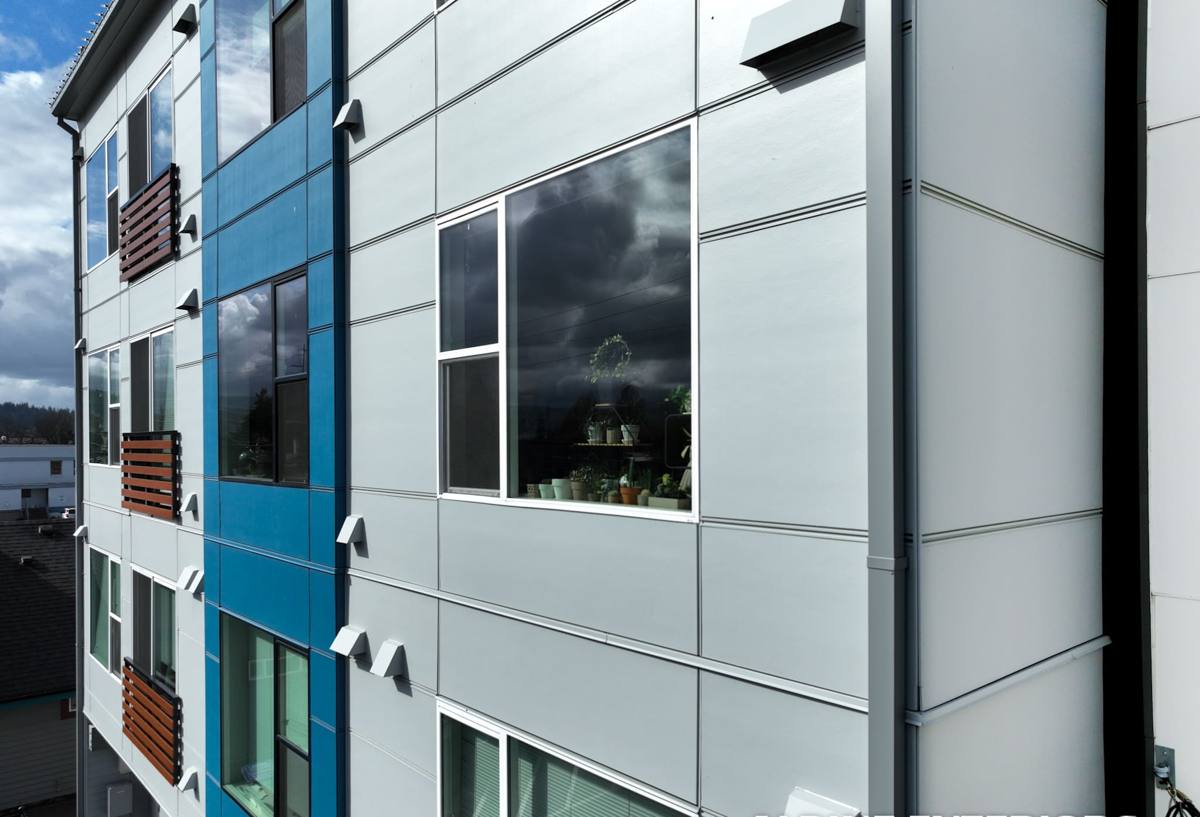
Why We Install Only James Hardie Fiber Cement
We don't install vinyl, LP SmartSide, primed spruce, cedar, or other fiber cement brands. That's a deliberate standard, not a sales pitch. Wood-based products, however well-treated, are organic material — in a climate with a long moss season and persistent damp shade, organic siding is fighting its environment from day one. Vinyl handles moisture fine but moves with temperature swings, can become brittle in cold snaps, and doesn't hold a factory finish the way a baked-on coating does.
James Hardie fiber cement is cement, sand, and cellulose fiber — non-combustible, dimensionally stable, and manufactured with an engineered moisture-management design. It doesn't feed mold or moss the way wood does, and it doesn't warp or swell the way wood-based composite panels can when a caulk joint fails and water gets behind them. For a house in Kendall that will spend a good portion of every year sitting under damp, salt-tinged air, that's the difference between a wall system that shrugs off the climate and one that's in a slow fight with it.
The HZ5 Product Line
James Hardie makes climate-engineered versions of its siding, and for this region we specify the HZ5 line, built for areas with significant moisture exposure and freeze-thaw cycling. It's formulated to resist moisture absorption better than the standard national formulation, which matters directly in a place where siding stays wet for days at a stretch during winter storm systems.
What a Correct Installation Actually Involves Here
James Hardie siding performs to its rated lifespan only when it's installed to the manufacturer's specifications — and in a high-moisture climate like Kendall's, the details that get skipped on a rushed job are exactly the ones that cause trouble later.
The details we don't skip
- Rain screen gap: a drainage cavity behind the siding lets any incidental moisture that gets past the cladding drain and dry out instead of sitting against the wall sheathing.
- Weather-resistive barrier and flashing sequencing: housewrap, window and door flashing, and kick-out flashing at roof-wall intersections have to be layered correctly — water always has to be directed out, never trapped in.
- Fastener spec: corrosion-resistant fasteners, placed and set to Hardie's exact pattern and depth — over-driven nails crack the board's factory edge and create a moisture entry point that shows up years later as a stain or a soft spot.
- Gaps and caulking at joints: Hardie specifies clearance at trim, butt joints, and penetrations, sealed with a high-quality sealant rated for the exposure — not just caulked tight everywhere, which can actually trap water.
- Bottom clearance: siding kept off decks, patios, and grade by the manufacturer's minimum clearance so splashback and ground moisture don't wick into the board's cut edge.
Every one of these is a place where a corner cut is invisible on installation day and expensive five years later. In a climate that stays wet as long as Kendall's does, there's very little margin for skipping them.
ColorPlus Factory Finish: Why It Matters for Moss and Algae
James Hardie's ColorPlus finish is baked onto the board at the factory under controlled conditions, rather than field-painted after installation. That matters here for two reasons. First, a factory finish bonds more consistently and resists fading and moisture intrusion better than a field-applied coat, which means fewer repaint cycles. Second, a sound, consistent finish gives moss and algae less to grip onto — surface texture and micro-cracking in an aging field paint job are exactly where spores take hold. It's not a guarantee against moss (nothing fully is, on a shaded wall in this climate), but it removes one of the easiest footholds.
ColorPlus also carries its own finish warranty separate from the substrate warranty, so a homeowner isn't relying on a repaint schedule to keep the product looking right.
Our Process for a Kendall Siding Job
- On-site assessment: we walk the exterior, check for existing moisture damage, moss buildup on shaded elevations, and any trouble spots around windows, decks, and roof-wall intersections.
- Tear-off and sheathing check: old siding comes off and we inspect the sheathing underneath — this is where hidden rot or past moisture intrusion surfaces, and it needs to be addressed before anything new goes on.
- Weather barrier and rain screen installation: housewrap, flashing, and furring for the drainage gap go in per spec, not by habit.
- Hardie panel or lap installation: fastened, gapped, and sealed to manufacturer tolerances, with trim and flashing detailed at every penetration.
- Final walk-through: we check joints, clearances, and finish consistency before calling the job done.
Why Local Experience in Kendall Specifically Matters
A crew that already works this part of Whatcom County knows which elevations on a typical Kendall property will fight moss the hardest, how far wind-driven rain travels under an eave in a winter storm, and what clearance and drainage details actually hold up here versus in a drier inland climate. That's not something a general contractor unfamiliar with the area gets right by following a national spec sheet alone — it comes from seeing how houses in this specific stretch of county actually age.
Local familiarity also means fewer surprises with permitting timelines and an understanding of how rural and semi-rural Kendall properties — often with more tree cover and shaded exposure than in-town Lynden lots — need slightly different attention to drainage and moss-prone elevations.
Cost Factors to Expect
| Factor | Why It Affects Price |
|---|---|
| Tear-off complexity | Removing old wood or vinyl siding and dealing with any hidden rot adds labor before new siding ever goes up. |
| Home size and elevation count | More wall area and more corners, gables, and trim details mean more material and installation time. |
| Panel vs. lap siding choice | Different Hardie profiles have different material and labor costs per square foot. |
| Moisture damage found underneath | Rotted sheathing or framing discovered during tear-off needs repair before siding can go on correctly. |
| Trim and accessory detailing | Corner boards, window trim, and soffit work add finish quality but also add cost. |
| ColorPlus color and profile selection | Some colors and textures carry different material pricing from the factory. |
We don't quote broad numbers here because every property is different — a shaded, moss-prone north wall with hidden moisture damage is a different job than a well-ventilated south elevation in good shape. An on-site look is what makes a quote accurate.
Maintenance Checklist for Kendall Homeowners
- Rinse shaded and north-facing walls once or twice a year to knock down early moss and algae growth before it establishes.
- Keep gutters clear so overflow doesn't run down the siding face and hold moisture against a section of wall.
- Trim back vegetation and tree limbs that keep an elevation in constant shade — airflow and sun exposure are the best natural defense against moss.
- Inspect caulked joints and trim annually, especially after a hard winter, and have any cracked sealant redone promptly.
- Check clearance at grade, decks, and patios periodically to make sure soil, mulch, or hardscaping hasn't crept up against the bottom edge of the siding.
If you're weighing a siding project for a Kendall property, we're glad to come take a look and talk through what your home actually needs — no pressure, no obligation. Use the form below to request a free estimate.