 Lynden Siding
 Why Ferndale Roofs Take a Different Kind of Beating
Ferndale sits close enough to Bellingham Bay and the Strait of Georgia that salt-laden air is a real factor in how roofing materials age here, not just an abstract coastal concern. Add Whatcom County's pattern of driving winter rain, sideways gusts off the water, and a moss season that can run eight months or more, and you've got a roof that's under more sustained stress than the same roof would face fifty miles inland. Storm damage on a Ferndale home rarely shows up as one dramatic event. More often it's a windstorm that lifts a few shingles, followed by weeks of rain finding that gap, followed by moss quietly working into the opening until a small problem becomes a ceiling stain.
That combination — salt air accelerating corrosion on fasteners and flashing, wind loosening material, and moisture exploiting every gap — is why storm damage repair in this area needs to be diagnosed by someone who understands the whole picture, not just patched at the visible spot.
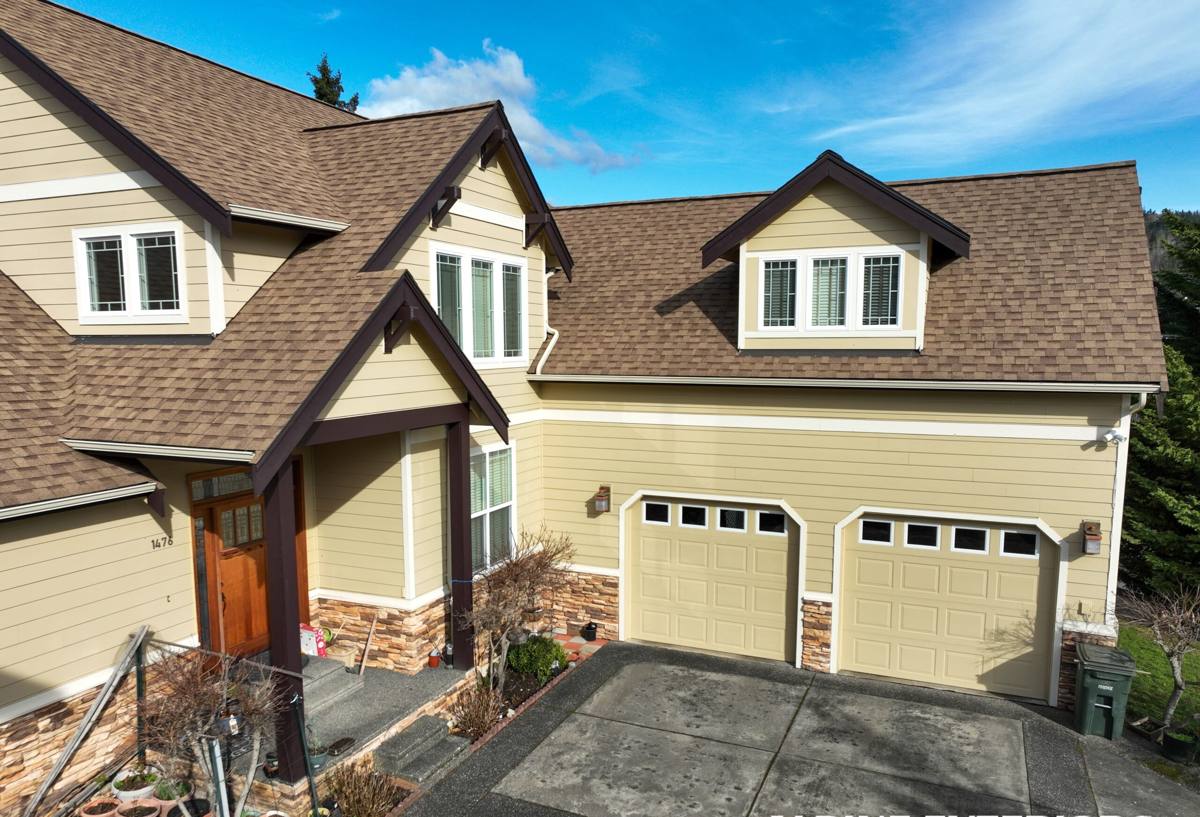
What Counts as Storm Damage on a Local Roof
Homeowners usually call us about one of two things: an obvious event (a windstorm, a fallen branch, hail) or a slow leak they can't explain. Both fall under storm damage repair, because both usually trace back to wind or water finding a weak point.
Common storm-related issues we see in Ferndale
- Shingles or panels lifted, cracked, or torn loose by wind gusts
- Flashing pulled away from chimneys, vents, or wall intersections after repeated wind-driven rain
- Granule loss and bruising from hail or wind-blown debris
- Fastener corrosion and loosening, sped up by salt air exposure
- Moss and organic buildup trapping moisture at seams and valleys, turning a minor gap into an active leak
- Gutter and downspout damage that redirects water back under roofing material instead of away from it
Some of these are immediately visible from the ground. Others — like a lifted flashing edge or a moss mat holding water against a valley — aren't obvious until someone gets up there and looks closely.
Why "Just Patch It" Isn't Always the Right Call
A quick patch can stop an active leak, and sometimes that's exactly what a homeowner needs in the moment. But storm damage repair done right means figuring out why that spot failed, not just sealing the hole. If wind lifted shingles because fasteners had already corroded from years of salt air, patching that one shingle without checking the surrounding field just means we'll be back at the next windstorm. If a leak traces to a moss mat that's been holding moisture against the decking for a season, the shingles underneath may already be compromised even though the surface looks fine.
Our approach is to treat every storm damage call as a two-part job: stop the immediate water intrusion, then assess whether the surrounding roof section needs repair now or is likely to fail again soon. We'll tell you honestly which situation you're in — most storm damage repairs are legitimately localized, but we're not going to sell you a full re-roof you don't need, and we're not going to hand back a "fix" that fails again in six months either.
Our Process for a Ferndale Storm Damage Call
1. Assessment
We inspect the damaged area and the roof sections around it — valleys, flashing points, and anywhere moss or debris has accumulated tend to be where the next problem starts. We're also checking fastener condition, since corrosion from salt air exposure often extends beyond the storm-damaged spot itself.
2. Documentation
If you're filing an insurance claim, we document the damage clearly enough to support it — photos of the affected area, a description of likely cause, and a scope of the repair needed. We work from what we can verify on your roof, not a generic damage estimate.
3. Repair scope and options
We explain what needs to happen: a targeted repair, a larger section replacement, or in rare cases a recommendation that the roof's age and condition make repair a short-term fix rather than a lasting one. You decide what to do with that information — we're not pushing you toward the bigger job.
4. The repair itself
Matching materials as closely as possible, correcting the underlying cause (not just the symptom), and making sure flashing, fasteners, and moisture barriers in the repaired area meet current standards rather than just replicating whatever was there before.
5. Follow-up check
For anything beyond a minor patch, we recommend a check after the next significant rain event to confirm the repair is holding under real conditions, not just under a garden hose test.
Repair vs. Replacement: How We Help You Decide
Not every storm-damaged roof needs the same answer. The right call depends on the roof's age, how localized the damage is, and what we find once we're actually up there.
| Factor | Leans Toward Repair | Leans Toward Replacement |
|---|---|---|
| Roof age | Under 12-15 years, material still has useful life left | Nearing or past expected service life for the material |
| Damage extent | Isolated to one section or a handful of spots | Widespread across multiple roof planes |
| Underlying decking | Solid, no rot or long-term moisture damage found | Soft spots, rot, or repeated past leaks in the same area |
| Fastener/flashing condition | Localized corrosion, rest of roof intact | Widespread corrosion consistent with age and salt air exposure |
| Moss history | Recently developed, minimal trapped moisture damage | Long-established moss with visible decking impact |
We'll walk you through where your roof falls on this table honestly. Most storm calls we get in Ferndale are genuine repairs — but a roof that's already near the end of its service life sometimes gets pushed over the edge by a storm, and it's better to know that up front than to keep patching a roof that's telling you it's done.
The Salt Air and Moss Factor: What It Means for Repair Materials
Because of Ferndale's proximity to the water, we pay close attention to fastener and flashing material during repairs, not just the visible roofing surface. Standard fasteners can corrode faster here than they would inland, and a repair that reuses compromised hardware is a repair that fails early. We use corrosion-resistant fasteners and flashing appropriate for coastal exposure whenever we're working on a home in this area, as a matter of our own standard practice.
Moss is the other constant. A storm-damaged spot that isn't cleaned of moss and organic debris during repair will trap moisture again almost immediately, undermining the fix. Part of every repair we do includes clearing the surrounding area properly — not just around the patch, but far enough out that water has a clean path off the roof.
Why Local Experience Matters for This Specific Job
A crew that mostly works dry-climate roofs will look at Ferndale storm damage differently than one that works Whatcom County every week. We know which flashing points tend to fail first in this area, which fastener choices hold up against the salt air, and which moss patterns signal a problem that's been building for a while versus one that just started. That local pattern recognition is what separates a repair that lasts through the next storm season from one that's back on the schedule by spring.
We're also familiar with how insurance adjusters in this region evaluate storm claims, which helps when documentation needs to hold up to scrutiny.
What to Do Right After a Storm
If you suspect storm damage, a few steps help protect your home and make any repair — or insurance claim — go smoother.
- Check for water stains on ceilings or upper walls, especially near chimneys, skylights, or where roof planes meet
- Look at the ground and gutters for granules, shingle pieces, or flashing debris after a windstorm
- Note any visibly lifted or missing shingles from the ground — avoid climbing up yourself after storm conditions
- Clear debris away from downspouts and gutters so water has somewhere to go while you wait for inspection
- Photograph any visible exterior damage from a safe vantage point
- Call for an inspection promptly — a small gap left through a second storm event is how minor damage becomes a bigger repair
Get a Straight Answer on Your Roof
If you've had a recent storm come through Ferndale and you're seeing signs of damage — or just want a roof that took a hard windstorm checked out before the next one hits — we're glad to come take a look. We'll give you a clear, honest assessment of what's actually going on and what it would take to fix it right. Request a free, no-pressure estimate using the form below and we'll get back to you to schedule a time.