 Lynden Siding
 Building Decks in Maple Falls: A Different Kind of Wear on a Flat, Wet Surface
Maple Falls sits in the part of Whatcom County where marine air off the Sound, long stretches of driving rain, and a moss season that can run most of the year all combine on exactly the surfaces that take the most abuse: horizontal ones. A wall sheds water. A roof sheds water. A deck holds it, at least for a while, on every board, every fastener, and every joist below. That's the core problem a custom deck in this area has to solve, and it's why a deck built the same way you'd build one in a dry inland climate tends to show soft spots, rust streaks, and slick moss patches years before it should.
We build and replace custom decks specifically for homes in the Maple Falls area, and we treat this as different work from decks we'd build somewhere drier. The framing choices, fastener grade, board spacing, and drainage details all get adjusted for salt-tinged air, sustained rain, and a shaded, wooded setting that keeps moisture around longer than an open, sunny lot would.
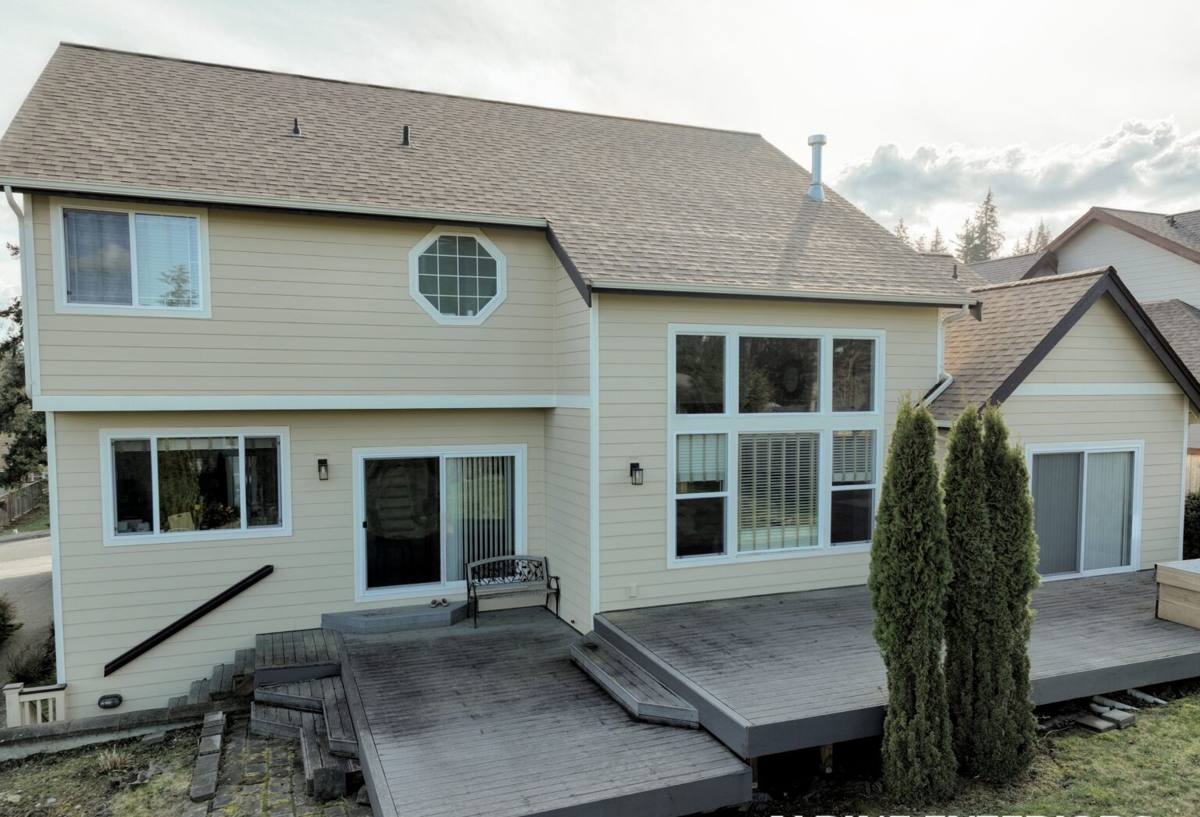
What Maple Falls' Climate Actually Does to a Deck
Salt Air and Metal Fasteners
Even away from the immediate shoreline, this part of Whatcom County carries enough salt in the air to accelerate corrosion on lower-grade screws, joist hangers, and structural connectors. A deck's strength depends on hidden hardware holding for decades, not just the visible boards looking good on day one. We spec fasteners and structural connectors rated for the corrosion exposure this climate actually delivers, not the minimum a building code inspector would accept in a drier region.
Driving Rain and Standing Moisture
Rain here rarely falls straight down. Wind pushes it sideways and it collects on flat surfaces, in ledger connections, and around post bases longer than it would on a simple vertical wall. A deck built without deliberate drainage, gapping, and flashing at the ledger board will hold that moisture against the structure, and wood, even treated wood, degrades faster the longer it stays wet.
Moss, Shade, and Tree Cover
Maple Falls' wooded, tree-covered lots mean a lot of decks sit in partial or full shade for much of the day. Shade plus consistent moisture is exactly the recipe for moss and algae growth, and once it establishes on decking boards it's not just an appearance issue — it makes the surface genuinely slick and, on porous or absorbent materials, holds moisture against the board long after the surrounding air has dried out.
What a Correctly Built Deck Looks Like in This Climate
A deck that's going to hold up through repeated wet seasons in this area needs a handful of details done right from the framing stage forward, not patched in after the fact.
- Ledger board flashing: Properly integrated flashing where the deck attaches to the house, so water is directed away from the ledger connection rather than tracking behind it into the wall framing.
- Joist tape or capping: A moisture barrier on top of each joist so the fastener penetration doesn't become the point where water enters and sits inside the joist.
- Corrosion-rated hardware: Structural screws, hangers, and post connectors rated for the salt and moisture exposure this area sees, not generic exterior-grade hardware.
- Deliberate board spacing: Gapping that lets water drain through and air circulate underneath, instead of tight joints that trap moisture between boards.
- Proper drainage slope: A slight pitch away from the house so water sheds off the deck surface rather than pooling against the foundation or ledger.
- Post footings sized for real load: Footings set below frost depth and sized for the actual span and load, not the minimum that happens to pass a quick inspection.
Choosing Decking Material for a Shaded, Wet Lot
| Material | How It Handles This Climate | Trade-Off to Know |
|---|---|---|
| Pressure-treated wood | Affordable, familiar, and repairable board by board | Needs regular sealing and cleaning to resist moss and moisture; shortest lifespan of the common options |
| Cedar | Naturally rot-resistant and a look many homeowners prefer | Still needs periodic finish maintenance and can gray or check faster in heavy shade and moisture |
| Composite decking | Resists rot and doesn't absorb moisture the way wood does | Higher upfront cost; some products still need occasional cleaning to keep moss from forming on the surface film |
| PVC/capped composite | Best moisture resistance of the common options, least prone to hidden rot | Highest upfront cost; installation sensitivity around expansion and fastening is less forgiving of shortcuts |
None of these materials is automatically the right call for every project. A shaded, moss-prone lot with a modest budget might do better with a pressure-treated deck that gets cleaned and sealed on a real schedule than with an expensive composite installed without proper drainage underneath it. We walk through the trade-offs with the actual site conditions in mind rather than defaulting to whatever carries the best margin.
Our Process for a Custom Deck Project
- On-site walkthrough: We look at the lot's grade, shade pattern, existing structure if there's a deck to replace, and how the new deck will tie into the house.
- Design and material discussion: We talk through size, layout, railing style, and decking material against your budget and how much upkeep you want to take on.
- Permitting and footings: We handle the permit process where required and set footings to proper depth and spacing for the design.
- Framing with climate-appropriate details: Ledger flashing, joist protection, and corrosion-rated hardware go in at this stage, not as an afterthought.
- Decking, railing, and finish work: Boards are spaced and fastened for drainage, and railing and stairs are completed to code.
- Final walkthrough: We go over the finished deck with you, including what maintenance it actually needs going forward.
Replacing an Existing Deck
A lot of the deck work we do in Maple Falls is replacement, not new construction — homes with an older deck that's showing soft boards, rust staining at the fasteners, or a substructure that was never built for this much sustained moisture. When we replace a deck, we inspect the ledger connection and framing underneath before assuming the new decking is the only issue. Sometimes the boards are the visible problem, but the framing underneath has been quietly absorbing moisture for years, and replacing boards on top of a compromised structure just delays the real fix.
Signs a Maple Falls Deck Needs Attention
- Boards that feel soft, spongy, or bounce noticeably underfoot
- Moss or dark green staining that returns quickly after cleaning, especially in shaded corners
- Rust streaks running down from screws or bolts
- Gaps opening up around the ledger board where it meets the house
- Railings or posts that feel loose or wobble under normal use
- Standing water that doesn't drain within an hour or two after rain stops
Cost Factors for a Maple Falls Deck Project
Every deck project is priced around the specific site and design, but a few factors consistently drive cost more than homeowners expect:
- Size and shape of the deck, including multiple levels or curved sections
- Decking material chosen, from pressure-treated wood up through capped composite
- Height above grade and whether stairs, railings, or a roof structure over the deck are part of the scope
- Site access and how much of the old structure, if any, needs to be removed first
- Footing depth and count, which depends on soil conditions and the load the design carries
We give real numbers after seeing the site, not a generic square-footage rate, because the drainage and framing details that matter most in this climate can add real cost that a flat estimate would miss entirely.
Why Hiring a Crew That Already Works in Maple Falls Matters
A crew that builds decks across this specific corner of Whatcom County, on shaded, tree-covered lots with the same salt air and sustained rain Maple Falls gets, already knows where the moisture problems tend to start on this kind of property. That's different from general deck-building experience picked up in a drier region or an open, sunny neighborhood. Local experience shows up in small decisions — how much slope to build into the drainage, which fastener grade is worth the extra cost, where joist tape earns its keep — and those decisions are exactly what separates a deck that's still solid in fifteen years from one that needs major repair in five.
If you're planning a new custom deck or need to replace one that's past its prime, we're glad to walk your property in Maple Falls and give you a straightforward, no-pressure estimate. Reach out using the form below to get started.