 Lynden Siding
 Siding Installation in Bellingham, from a Crew Already Working This Corridor
Bellingham sits close enough to the water that its siding problems look different from what a purely inland Whatcom County town deals with, and different again from a straight coastal town further out. Homes here take on salt-bearing marine air, rain that arrives sideways off Bellingham Bay more often than it falls straight down, and long stretches of shade under mature tree cover that keep walls damp well past when an open, sun-exposed lot would have dried out. We're based in Lynden, a short drive east, and this is one of the corridors our crew works regularly rather than a market we bid into occasionally. That distinction matters on a siding job more than people expect — the contractor who's actually seen how a specific wall orientation behaves through a Bellingham winter tends to make different, better decisions than one working from a spec sheet alone.
This page is specifically about siding installation for Bellingham homes — not a general overview of every service we offer. It covers what the local climate demands from a siding system, what a correctly executed installation actually involves, how our process runs from first estimate to final walkthrough, and why we've standardized on one product rather than offering a menu of options.
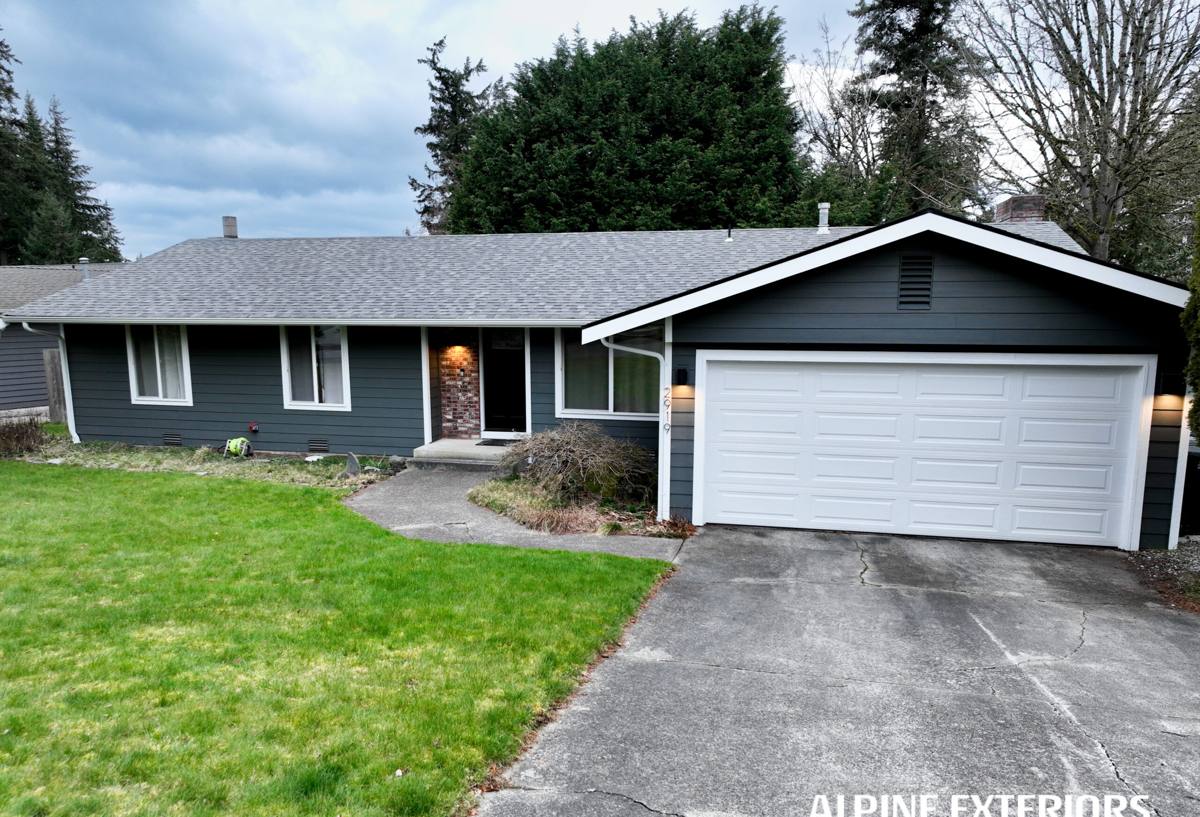
What Bellingham's Climate Actually Does to a Wall
Salt Air Off the Bay
Proximity to Bellingham Bay means salt-laden air is a constant, low-grade presence on exterior surfaces here in a way that inland Whatcom County towns don't experience to the same degree. Over years, that salt exposure accelerates corrosion on fasteners, flashing, and lower-grade trim hardware. It doesn't announce itself the way a leak does — it shows up slowly, as rust streaking below a nail head or a fastener that's lost its grip long before the siding around it looks like it's failing.
Driving Rain
Wind off the water pushes rain sideways into wall assemblies rather than letting it fall straight down and shed off a properly lapped surface. That sideways load hits window flashing, trim joints, and the transition where roofline meets wall hardest, and those are exactly the spots where a rushed or generic installation lets water in behind the cladding instead of over it. A siding material's water rating on a spec sheet doesn't mean much if the flashing details behind it were an afterthought.
A Long, Shaded Moss Season
Bellingham's mix of tree-lined residential streets and near-constant winter moisture adds up to a moss and mildew season that can run most of the year on north-facing or heavily shaded walls. Any siding material that holds moisture against the substrate, rather than shedding it and drying quickly, becomes a growth surface over time. This plays out unevenly from house to house in this area — a wall backing up to a tree line behaves nothing like an open, sun-facing wall thirty feet away on the same house.
What a Correct Siding Installation Has to Get Right Here
Given those three pressures, a siding job in Bellingham isn't just about which panel goes on the wall. The details that actually determine whether a house stays dry for the next twenty-plus years are mostly hidden once the job is done, which is exactly why they're easy for a less careful crew to shortcut.
- Weather-resistive barrier continuity: The house wrap or building paper underneath the siding needs to be continuous and properly lapped, with no gaps at seams, corners, or penetrations where wind-driven rain can find a way behind it.
- Window and door flashing: Flashing at every opening needs to shed water outward and downward, layered correctly with the weather barrier — not just caulked over as a substitute for proper flashing.
- Roof-to-wall transitions: Kick-out flashing and step flashing at these junctions are one of the most common failure points in this climate, since they concentrate water runoff exactly where two systems meet.
- Fastener spacing and corrosion resistance: Given the salt exposure this area sees, fastener material and spacing matter more than they would in a drier inland climate — this is a detail manufacturer specs address directly and one we don't treat as flexible.
- Clearances above grade and roofline: Siding installed too close to grade, a deck surface, or a roofline traps moisture against the bottom edge and accelerates damage regardless of the material's own rating.
- Field-cut sealing: Every cut edge on fiber cement siding needs to be sealed per manufacturer spec, since an unsealed cut edge is a weak point for moisture intrusion that wasn't present on the factory-finished face.
None of this is exotic knowledge — it's published in manufacturer installation guides. The gap between a siding job that holds up and one that doesn't is almost never about secret expertise; it's about whether these steps get done carefully and in the right order, every time, rather than skipped when nobody's checking.
Our Installation Process for a Bellingham Home
Inspection and Estimate
We start by actually looking at the house — current siding condition, visible signs of trapped moisture, and how sun, shade, and wind exposure differ across the different walls. A north wall under tree cover and a south wall facing open sky on the same house often need different attention, and that's what shapes the estimate rather than a flat per-square-foot number.
Tear-Off and Substrate Check
Once the existing siding comes off, we check the sheathing underneath for rot or soft spots before anything new goes up. Covering damaged sheathing with new siding just hides a problem that keeps getting worse behind the wall. We'd rather find it now, while it's exposed and fixable, than have it resurface as a bigger repair a few years later.
Weather Barrier and Flashing Installation
This is the step that determines whether a Bellingham home stays dry through the next decade of driving rain, and it's also the step that's completely invisible once the siding goes up. House wrap, window flashing, and every wall penetration get careful, methodical attention here — not because it looks good, but because it's the part nobody can inspect after the fact.
Installation to Manufacturer Specification
James Hardie's product warranty is contingent on installation following their published specifications — fastener type and spacing, clearances above grade and roofline, and correct field-cutting and sealing. We install to that standard as the baseline expectation on every job, not as an add-on.
Final Walkthrough
We walk the completed job with the homeowner, go over care and maintenance expectations specific to a Bellingham property, and confirm everything matches what was estimated before calling the project finished.
Why We Install Only James Hardie Fiber Cement
We used to install a broader range of siding products. We narrowed to one system after seeing repeatedly what actually holds up under this area's combination of salt exposure, wind-driven rain, and extended shade, versus what performs well on a spec sheet but struggles on a real wall a few wet seasons in.
- Non-combustible core: Fiber cement doesn't feed a fire the way wood-based siding products can, which matters for both safety and insurance underwriting.
- Factory-applied ColorPlus finish: The color coat is baked on under controlled factory conditions rather than field-applied, holding adhesion and color far longer under sustained moisture and UV exposure than a site-applied finish.
- Climate-engineered HZ product line: Hardie's HZ5 formulation is built for regions with sustained moisture exposure and freeze-thaw cycling, which describes Bellingham and the surrounding county closely.
- Dimensional stability: Fiber cement doesn't swell, cup, or warp the way engineered wood siding can after repeated wetting and drying cycles.
- A strong transferable warranty: Hardie backs the product with a robust warranty structure, provided installation follows their published specifications — which is exactly why we treat those specs as non-negotiable rather than as a suggestion.
We don't install LP SmartSide, vinyl siding, Cemplank, Allura, primed spruce, or cedar. Each has a place in the broader market, and plenty of homeowners are satisfied with them elsewhere. Our decision is a professional one: in a climate with this much sustained moisture and salt exposure, we'd rather stand fully behind one system we know inside and out than offer a cheaper alternative that quietly shifts long-term maintenance risk onto the homeowner.
How Common Alternatives Trade Off in This Climate
| Product | Common trade-off here |
|---|---|
| Vinyl siding | Panels can warp or crack under sustained UV and temperature swings; seams and panel gaps give wind-driven rain a path in |
| LP SmartSide / engineered wood | Wood-strand core is more moisture-sensitive at cut edges and fastener points than fiber cement, especially under sustained damp shade |
| Primed spruce or cedar | Needs ongoing paint and moisture upkeep to avoid rot; the real long-term ownership cost runs higher than the upfront price suggests |
| Other fiber cement brands | May lack a climate-specific HZ-style formulation or the same depth of factory-finish warranty coverage as James Hardie |
Signs a Bellingham Home's Siding Needs Attention
- Moss or dark staining that returns quickly after cleaning, especially on shaded or tree-adjacent walls
- Soft or spongy siding, particularly near the bottom of the wall or around window and door trim
- Peeling paint or visible warping, most common on older wood or engineered wood siding
- Cracked, buckled, or missing panels after a windstorm off the water
- Rust staining running down from fasteners or trim hardware
- Musty odors or interior wall staining that backs up to an exterior wall
- Siding older than 20-25 years with no documented replacement history
None of these automatically mean a full replacement is needed, but each is worth a professional look before another wet season adds to whatever damage has already started.
What Affects Siding Cost on a Bellingham Property
Every estimate is specific to the individual house, but a handful of factors consistently move the number in one direction or another.
| Factor | Why it matters |
|---|---|
| Total square footage and number of stories | More wall area and taller work both add material and labor time |
| Trim and detail complexity | Homes with more windows, dormers, or architectural trim take more time to flash and finish correctly |
| Sheathing condition underneath the old siding | Rot or soft spots discovered during tear-off need repair before new siding goes on, which affects both cost and schedule |
| Product line and color selection | James Hardie offers multiple product lines and a range of ColorPlus finishes, which vary in price |
| Site access and existing exterior conditions | Tight lots, mature landscaping, or extensive existing damage can add labor time beyond a straightforward tear-off and reinstall |
We walk through these factors specifically during the estimate so a homeowner understands what's driving the number, rather than receiving a flat quote with no explanation behind it.
Why a Lynden-Based Crew That Already Works Bellingham Matters
Being based in Lynden rather than Bellingham itself doesn't mean we're an outside contractor bidding into a market we don't know — this corridor is one we work in regularly, on a schedule that runs through every season of the year, not just when the weather cooperates. That repeated exposure shapes real decisions on a job: which wall orientations near the bay stay wet longest, where extra flashing attention consistently pays off, and which install-day details are worth the added time so a homeowner isn't dealing with a callback two winters later. It also means that when a warranty question or a maintenance concern comes up years down the line, it's a call to a crew still working this same area, not a company that's moved on to a different region entirely.
If your Bellingham home needs new siding, or you'd like the roof, windows, or decking looked at while we're there, we're glad to come take a look and put together a straightforward, no-pressure estimate. Reach out using the form below to get started.