 Lynden Siding
 Siding Replacement Built for Acme's Climate
Acme sits in the part of Whatcom County where marine air off the Salish Sea, frequent driving rain, and long stretches of shade combine to put real stress on a home's exterior. Siding here doesn't just have to look good — it has to shed water reliably, resist moisture intrusion at every seam and penetration, and hold up to a moss and algae season that can run from late fall through spring. When we replace siding on an Acme home, we're not installing a generic product to a generic spec. We're installing a system that's engineered for exactly these conditions, and we're installing it the way the manufacturer actually requires — not the shortcut version.
This page focuses specifically on siding replacement for Acme-area homes: what the climate demands, what a correct installation actually involves, how our process works from first look to final walkthrough, and why it matters that the crew on your roofline already knows this area.
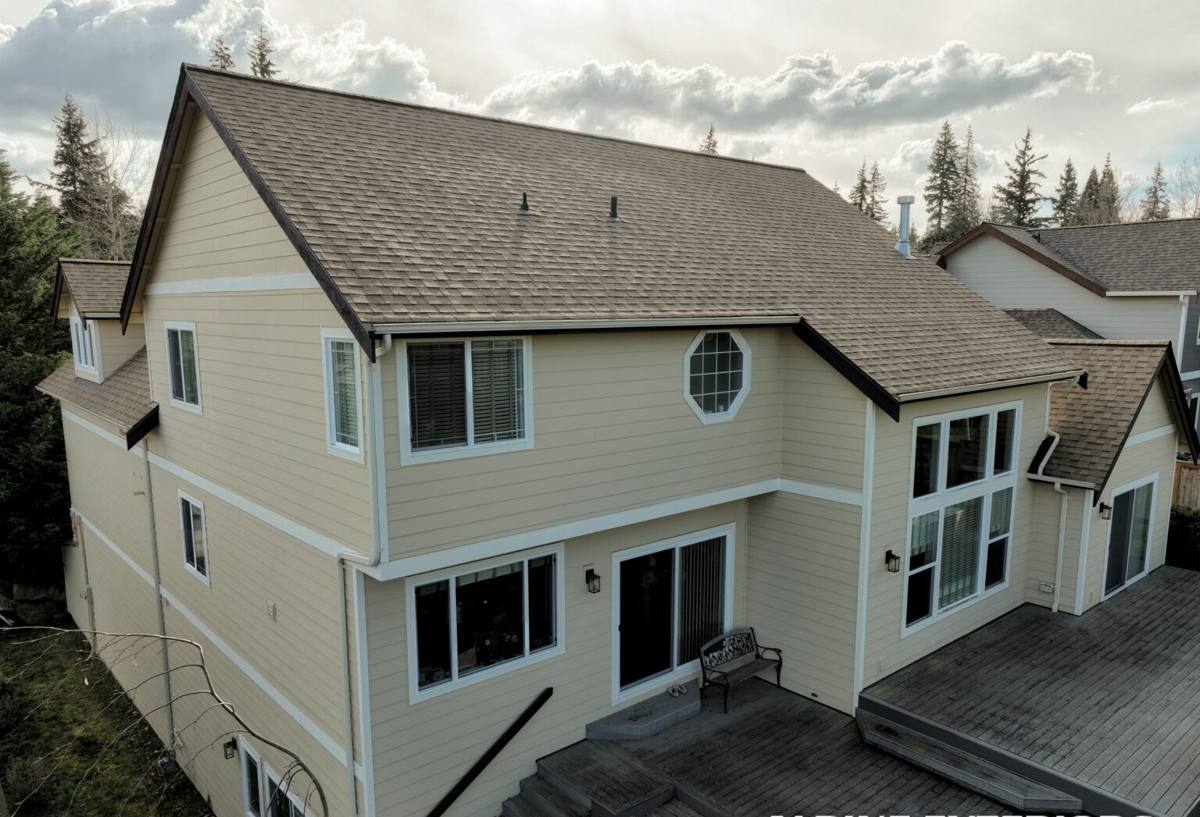
What Acme's Climate Actually Does to Siding
Salt Air and Driving Rain
Proximity to Puget Sound means airborne salt is a constant, low-level factor in how exterior materials age. Salt-laden moisture accelerates corrosion on fasteners and trim metal, and it degrades paint and coatings faster than it would further inland. Combine that with the wind-driven rain that comes through this corridor during fall and winter storms, and you get water pushed sideways into laps, seams, and butt joints — not just falling straight down where gravity and overlap alone would handle it.
Long Moss and Algae Season
Whatcom County's tree cover and persistent damp keep siding surfaces wet for extended periods, especially on north-facing walls and anywhere shaded by mature trees or neighboring structures. That moisture retention is what feeds moss and algae growth. On the wrong substrate, that growth doesn't just look bad — it holds water against the surface, which accelerates rot in wood-based products and paint failure in general.
What This Means for Material Choice
A siding product that can't handle sustained moisture contact, that swells or delaminates when repeatedly saturated, or that needs frequent refinishing to keep water out, is going to struggle in Acme. That's the core reason we standardized on James Hardie fiber cement rather than wood-based or vinyl alternatives — it's a non-combustible, engineered material that doesn't rot, doesn't feed moss the way organic substrates can, and holds its factory finish far longer under this kind of exposure.
Signs an Acme Home Needs Siding Replacement
- Soft or spongy spots when you press on siding, especially near the bottom courses or around window trim
- Persistent moss or algae staining that returns within weeks of cleaning
- Visible cupping, warping, or separation at seams and butt joints
- Paint that's peeling, bubbling, or chalking heavily rather than just fading
- Rust streaks from fasteners bleeding through the surface
- Gaps opening up around window and door trim where caulking has failed
- Interior signs — damp drywall, musty smell near exterior walls, peeling interior paint on shared walls
Any one of these on its own might be a minor repair. Several at once, especially combined with the home's age and how it was originally built, usually points to a replacement conversation rather than another round of patching.
What a Correct Siding Replacement Actually Involves
Siding replacement is not just stripping old material and nailing up new panels. Done correctly, it's a system — and the parts you don't see matter as much as the parts you do.
Tear-Off and Substrate Inspection
Once the old siding is off, the sheathing underneath gets inspected for rot, soft spots, and prior water damage. This is often the first real look anyone's had at the wall assembly in decades, and in a climate like Acme's, it's common to find damage that wasn't visible from the outside. Any compromised sheathing gets replaced before anything new goes up — installing new siding over damaged substrate just hides a problem that will resurface.
Weather-Resistive Barrier and Flashing
A correctly installed weather-resistive barrier (housewrap) goes on next, with proper overlap and taping at seams. Flashing gets installed at every horizontal transition, window and door head, and any penetration — this is the layer that actually stops wind-driven rain from getting behind the siding in the first place. In a driving-rain environment like this one, flashing details are where a lot of failures actually originate, not in the siding material itself.
James Hardie Installation to Manufacturer Spec
James Hardie fiber cement is engineered for climates like this, but it only performs to spec when installed to spec — correct fastener placement and type, proper clearances from grade and roof lines, correct gapping at butt joints, and factory-finish touch-up done the right way rather than skipped. We install to those specifications every time, because that's what preserves the product warranty and what actually keeps water out over the long run.
Trim, Caulking, and Final Detailing
Trim boards, corner details, and caulking at penetrations are finished last. This is also where a lot of corner-cutting happens on lower-quality jobs — gaps left uncaulked, trim not properly flashed — and it's exactly where Acme's driving rain finds its way in if it's not done right.
Why James Hardie for This Area
We install James Hardie fiber cement exclusively — not vinyl, not LP SmartSide, not primed wood products. That's a deliberate standard, not a default. Fiber cement is non-combustible, dimensionally stable under moisture cycling, and finished at the factory with ColorPlus technology, which holds color and resists the fading and chalking that repeated damp exposure accelerates. Hardie's HZ5 product line in particular is engineered for climates with significant moisture exposure, which describes this corridor well. It also carries a strong transferable warranty, but that warranty depends on correct installation — which is why the install process matters as much as the product choice.
| Factor | James Hardie Fiber Cement | Vinyl / Wood-Based Alternatives |
|---|---|---|
| Moisture behavior | Dimensionally stable, engineered for wet climates | Prone to swelling, warping, or rot under sustained moisture |
| Fire resistance | Non-combustible | Combustible (wood) or melts/deforms under heat (vinyl) |
| Finish longevity | Factory ColorPlus finish, long fade resistance | Field-applied or thinner factory finishes, faster fade/chalk |
| Moss/algae resistance | Non-organic substrate, doesn't feed growth | Wood substrates can retain moisture and support growth |
| Warranty structure | Strong transferable warranty when installed to spec | Varies widely; often shorter or non-transferable |
Our Process for an Acme Siding Replacement
1. On-Site Assessment
We walk the entire exterior, not just the section that looks obviously worn. Given how localized moisture damage can be in this climate — often concentrated on shaded, north-facing, or low-airflow walls — a full assessment catches problems a quick look would miss.
2. Honest Scope and Estimate
We tell you what we actually see: what needs replacing, what sheathing repair (if any) is likely, and what the realistic scope looks like. No inflated scope, no surprise change orders for things we should have caught upfront.
3. Tear-Off and Substrate Repair
Old siding comes off, sheathing gets inspected and repaired as needed, and you get told exactly what we found before we cover it back up.
4. Weather Barrier, Flashing, and Hardie Installation
Housewrap, flashing, and James Hardie siding go on to manufacturer specification — the sequence that actually keeps water out long-term in this climate.
5. Final Walkthrough
We walk the finished job with you, point out the details, and make sure you understand what was done and why.
Cost Factors for Acme Siding Replacement
Every home's scope is different, so we don't quote broad numbers without seeing the house. That said, the main factors that move cost on a real Acme job are consistent:
- Home size and number of stories (access and labor time)
- Condition of existing sheathing once old siding comes off
- Amount of trim, corner, and detail work versus plain wall runs
- Siding profile chosen (lap, shingle-style panels, board-and-batten accents)
- Accessibility — tree cover, tight side yards, and site conditions common in this area
The honest answer to "what will it cost" is always "let's look at your house" — anything else is a guess dressed up as a quote.
Why It Matters to Hire a Crew That Already Works Acme
A crew that regularly works this specific area already understands which wall orientations tend to hold moisture, how the local moss cycle behaves through the seasons, and what substrate condition is common on homes of a given age and construction style here. That's not something you get from a crew that only occasionally works in Whatcom County — it comes from repetition in this exact climate. It also means faster, more accurate assessments and fewer surprises once tear-off starts, because we've seen the patterns before.
Maintaining Your New Siding in This Climate
James Hardie siding is low-maintenance compared to wood or vinyl, but "low-maintenance" isn't "no-maintenance" in a climate like this one. A periodic rinse to keep moss and organic buildup from accumulating, an annual look at caulking around trim and penetrations, and prompt attention to any impact damage will keep the system performing the way it's designed to over the long run. None of this is heavy work — it's the kind of light upkeep that protects the investment you just made.
If your Acme home is showing signs it's time for new siding, we're happy to take a look and give you an honest assessment — no pressure, no inflated scope. Fill out the form below to schedule a free estimate.