 Lynden Siding
 Siding Built for Abbotsford's Climate, Not Just Its Curb Appeal
Abbotsford sits in a stretch of the Fraser Valley where three things conspire against exterior siding at the same time: salt-laden air moving in off the Strait, some of the heaviest driving rain in the Pacific Northwest, and a moss and algae season that can run eight or nine months out of the year. Any one of those is manageable. Together, they punish siding products that weren't built to handle sustained moisture exposure, and they shorten the lifespan of anything installed without real attention to water management. A siding job that looks fine on a dry September afternoon has to prove itself in February, when wind-driven rain is hitting the wall sideways for days at a stretch.
We install siding across the Whatcom County and lower Fraser Valley corridor, and Abbotsford homes see a version of this weather that's close enough to Lynden's that the lessons transfer directly, but with a bit more coastal moisture influence working against wood-based and moisture-sensitive products. That's the backdrop for every recommendation on this page.
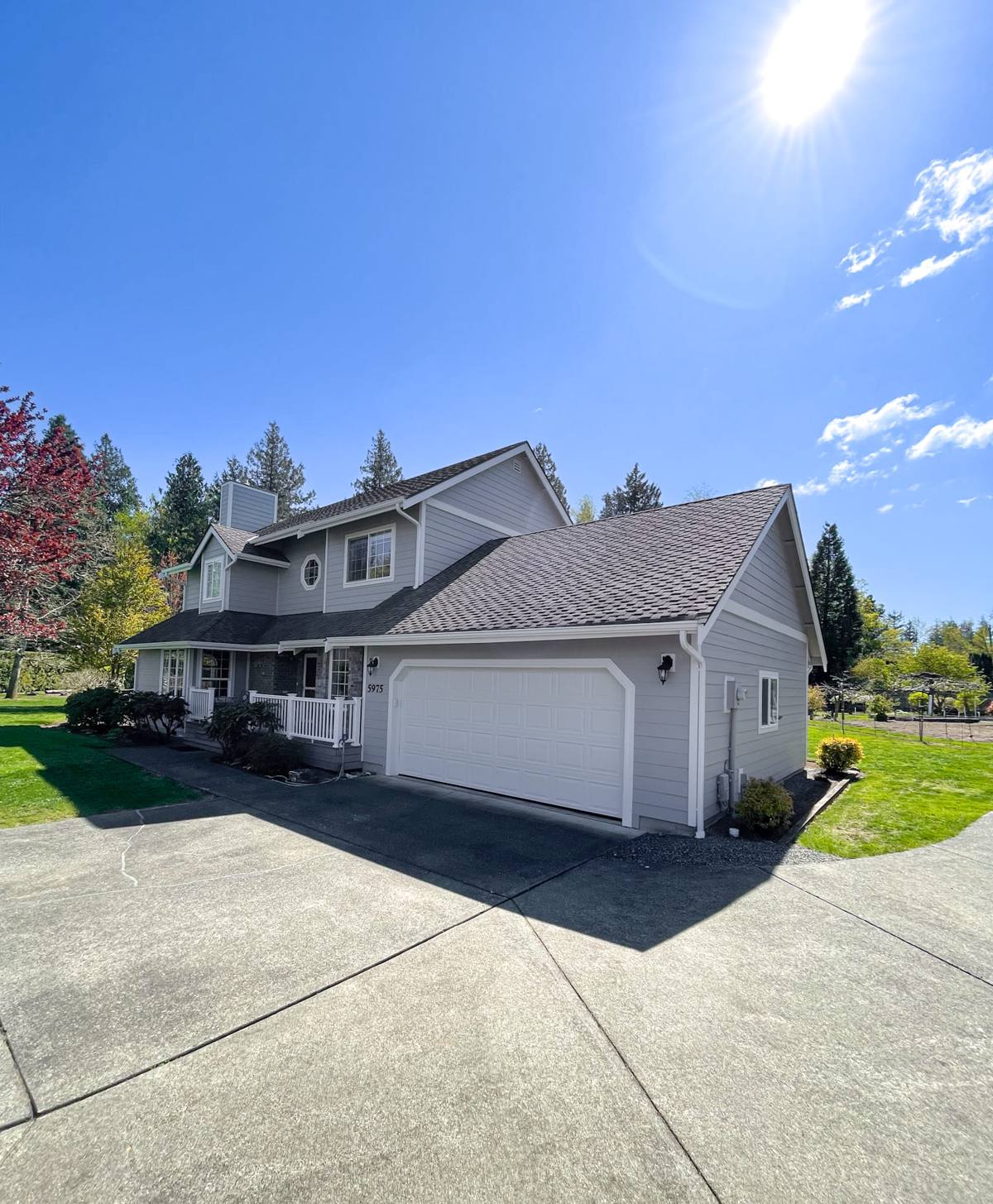
What Abbotsford Homes Actually Need From Their Siding
Moisture Management First
The single biggest factor in how long a siding job lasts in this climate isn't the material on the surface — it's what's happening behind it. Rain will find gaps, laps, and fastener penetrations no matter how good the product is. What determines whether that moisture causes rot, mold, or paint failure is whether the wall assembly behind the siding is built to let incidental water drain and dry. A weather-resistive barrier installed correctly, proper flashing at every window, door, and roofline intersection, and a drainage gap where the siding profile calls for one all matter more than the brand name on the plank.
Salt Air Tolerance
Abbotsford isn't oceanfront, but it's close enough to the Strait of Georgia and the Fraser River delta that airborne salt is a real factor, especially on west- and south-facing walls that catch prevailing weather. Salt air accelerates corrosion on fasteners and trim hardware, and it degrades some paint and coating systems faster than inland areas see. Siding and trim need finishes and fastener specs that are rated to hold up to that exposure, not just standard interior-grade hardware.
Moss and Algae Resistance
Persistent damp, shaded north walls, and long stretches of overcast weather are exactly the conditions moss and algae need to establish themselves on exterior surfaces. Some siding materials are far more hospitable to that growth than others — porous or wood-based products give organic growth something to root into, while a factory-cured fiber cement surface with a baked-on finish gives it much less to hold onto. Growth that's allowed to sit on siding traps additional moisture against the surface, which compounds the very problem it started with.
Why We Install Only James Hardie Fiber Cement Here
We don't install vinyl, LP SmartSide, primed spruce, cedar, or other fiber cement brands like Cemplank or Allura. That's not a marketing position — it's a decision we made after weighing how each of those products actually performs over a decade-plus in coastal Pacific Northwest weather, and specifically in a climate profile like Abbotsford's where moisture exposure is constant and prolonged.
- Vinyl expands and contracts with temperature swings, can crack in cold snaps, and offers essentially no resistance to wind-driven rain intrusion at seams and laps — it's a cladding, not a water management system.
- LP SmartSide and primed spruce are engineered or solid wood products. Wood-based sidings depend entirely on an intact paint film to keep moisture out; once that film is compromised at a cut edge, fastener hole, or impact point, the substrate itself can begin to swell or deteriorate, and that process is faster in a wet climate than a dry one.
- Cedar is a beautiful, legitimately good material, but it's a maintenance commitment — regular refinishing, vigilance about moss and mildew, and vulnerability to the same rot risk as any wood product if maintenance lapses.
- Other fiber cement brands (Cemplank, Allura) are chemically similar to James Hardie in raw composition, but we've standardized on Hardie specifically for its ColorPlus factory-applied finish, its regionally engineered HZ5 product line, and the depth and structure of its transferable warranty — consistency we can stand behind on every job rather than mixing product lines.
James Hardie fiber cement is non-combustible, dimensionally stable across the temperature and humidity swings this region sees, and its HZ5 formulation is specifically engineered for the moisture and freeze-thaw patterns of the Pacific Northwest and similar climates. The ColorPlus finish is baked on at the factory rather than field-applied, which means better fade resistance, better adhesion, and a finish that's harder for moss and algae to gain a foothold on than a site-painted surface.
What a Correct James Hardie Installation Involves
The product only performs as well as the installation. A rushed or shortcut Hardie job will still fail in a climate like this — the material isn't magic, it's an engineered system that depends on correct execution at every step.
Before the Siding Goes On
- Inspect and repair any existing sheathing damage, rot, or compromised framing before covering it up
- Install a code-compliant weather-resistive barrier, lapped correctly from the bottom up
- Set up a drainage plane where required so incidental moisture behind the siding has somewhere to go
- Flash every window, door, and penetration so water sheds outward, not into the wall cavity
During Installation
- Follow James Hardie's fastening pattern and fastener spec — corrosion-resistant fasteners matter especially in a salt-air environment
- Maintain correct plank overlap and gapping at butt joints per manufacturer instructions
- Caulk and seal only where Hardie's install guide specifies — oversealing can trap moisture instead of releasing it
- Cut and seal exposed edges properly so raw fiber cement isn't left absorbing water
Trim and Finish Details
Corner boards, window trim, and transitions are where most siding failures start, regardless of the cladding material. We treat those details with the same care as the field of the wall — proper flashing, correct fastener placement, and finish materials that match the performance level of the siding itself.
Our Process for Abbotsford Projects
- On-site assessment. We look at your current siding condition, wall assembly, sun and wind exposure on each elevation, and any existing moisture or moss issues.
- Scope and product plan. We walk you through the right Hardie profile and finish for your home, and flag any sheathing or moisture-barrier repairs needed before installation.
- Written estimate. Clear scope, materials, and timeline — no vague allowances.
- Installation. Full water-management detailing, correct fastening, and finish work done to manufacturer spec.
- Final walkthrough. We review the completed job with you and confirm everything meets both our standard and Hardie's warranty requirements.
Cost Factors for Abbotsford Siding Projects
| Factor | Why It Matters Here |
|---|---|
| Home size and elevation count | More wall area and more corners/trim transitions means more labor and material |
| Existing wall condition | Rot or sheathing damage from prior moisture intrusion adds repair scope before siding starts |
| Siding profile and finish selection | Lap width, texture, and ColorPlus finish tier affect material cost |
| Trim and detail complexity | Multiple gables, dormers, or architectural detail increase installation time |
| Access and site conditions | Multi-story sections or tight lot access can affect equipment and labor needs |
We don't quote a number until we've actually looked at the house — anyone who does otherwise is guessing.
Why a Crew That Already Works This Area Matters
Siding installation isn't a one-size-fits-all trade. A crew that regularly works the Whatcom County and Fraser Valley corridor already understands how local weather patterns hit different elevations of a house, which detailing choices actually hold up here versus in a drier climate, and where moss and moisture problems tend to originate on homes in this region. That's knowledge you don't get from a general contractor pulled in from outside the area, and it shows up in the small decisions — flashing details, fastener specs, drainage planning — that determine whether a siding job lasts fifteen years or fifty.
Signs Your Current Siding May Be Struggling
- Visible moss or algae buildup that returns shortly after cleaning
- Paint that's peeling, bubbling, or chalking, especially on south- or west-facing walls
- Soft spots, warping, or visible gaps at seams and corner boards
- Rising utility bills that may point to compromised insulation behind failing siding
- Visible cracking or buckling, particularly after temperature swings
If you're seeing any of these on an Abbotsford-area home, it's worth having the wall assembly looked at, not just the surface — by the time siding shows visible damage, moisture may already be affecting what's behind it.
If you'd like an honest look at your home's siding and what it would take to move to a James Hardie system built for this climate, we offer free, no-pressure estimates — just fill out the form below.